
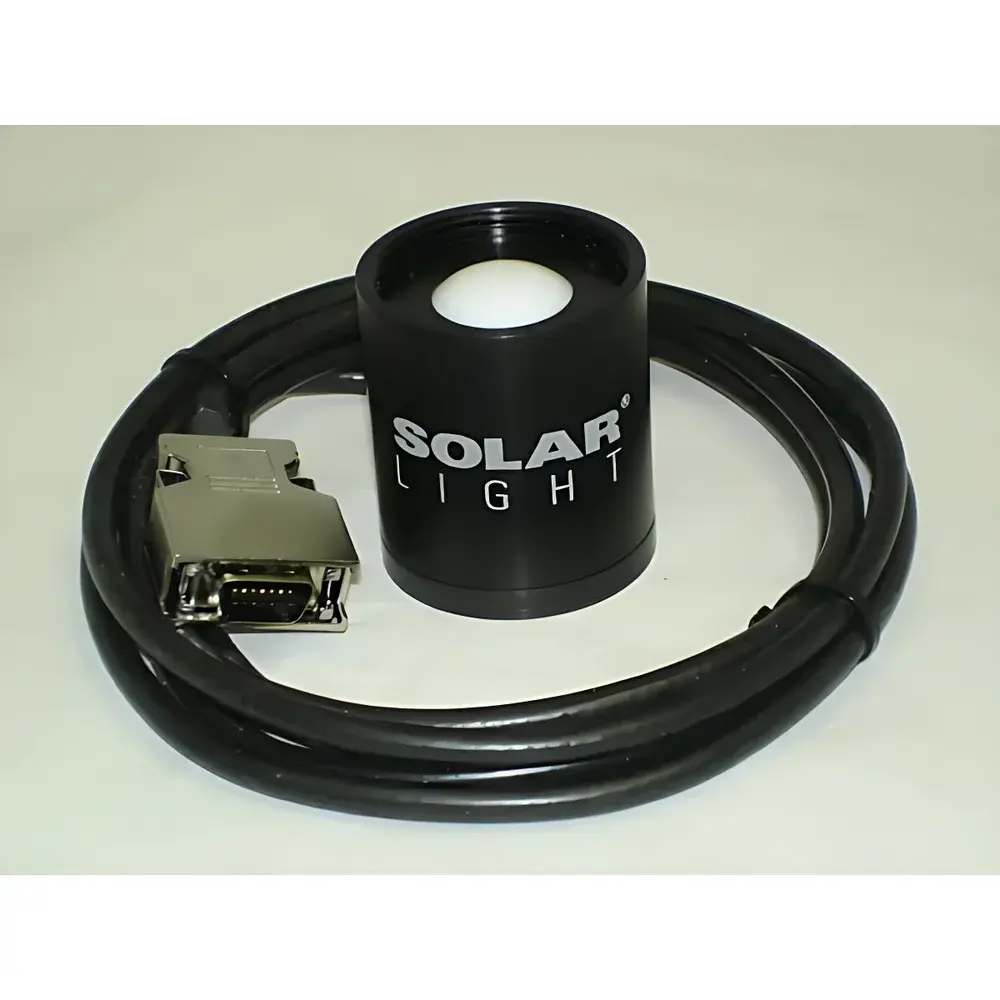
Solar Light PMA2123 Bilirubin Phototherapy Radiometer
| Brand | Solar Light |
|---|---|
| Origin | USA |
| Model | PMA2123 |
| Spectral Range | 425–475 nm |
| Calibration | NIST-traceable |
| Output Unit | μW/cm²/nm |
| Cosine Correction | Yes |
| Stability | Long-term drift < ±0.5% per year |
| Dynamic Range | 10⁴:1 (typical) |
| Detector Type | Silicon photodiode with bandpass interference filter |
Overview
The Solar Light PMA2123 Bilirubin Phototherapy Radiometer is a precision optical measurement instrument engineered for quantitative spectral irradiance assessment in clinical phototherapy applications. It operates on the principle of narrowband radiometric detection, utilizing a thermally stabilized silicon photodiode coupled with a hard-coated interference bandpass filter to isolate the biologically active 425–475 nm blue-light spectrum—precisely aligned with the absorption peak of unconjugated bilirubin (λmax ≈ 450 nm). This spectral selectivity ensures direct correlation between measured irradiance and photochemical efficacy in neonatal hyperbilirubinemia treatment. Unlike broadband illuminance meters, the PMA2123 delivers spectrally weighted irradiance values expressed in μW/cm²/nm, enabling clinicians and biomedical engineers to validate therapeutic dose delivery per ASTM E2981-22 and IEC 62471 compliance frameworks. Its design adheres to ISO/IEC 17025-accredited calibration practices, with full NIST-traceable documentation supplied with each unit.
Key Features
- Narrowband spectral response (FWHM ≤ 25 nm) centered at 450 nm, optimized for bilirubin photoisomerization kinetics
- Integrated cosine-corrected diffuser ensuring angular response deviation < ±3% up to 75° incidence—critical for uniformity mapping across phototherapy panels
- Long-term radiometric stability: < ±0.5% annual drift under continuous operation, verified per ISO 17025 calibration intervals
- High dynamic range (10⁴:1) supports accurate measurement from low-output LED arrays to high-intensity quartz-halogen systems
- Real-time analog output (0–5 V) and digital RS-232 interface for integration into hospital QA/QC data logging platforms
- Field-replaceable detector head with serialized calibration certificate including spectral responsivity curve and uncertainty budget
Sample Compatibility & Compliance
The PMA2123 is validated for use with all clinically approved phototherapy light sources, including blue fluorescent tubes (e.g., Philips TL520W/BL), daylight fluorescent lamps, quartz-halogen emitters, and modern high-power LED arrays. Its spectral bandpass excludes non-therapeutic UV (475 nm) that contribute to retinal risk or thermal load without enhancing bilirubin degradation. The instrument conforms to FDA guidance documents for phototherapy device verification (K170290), meets essential requirements of IEC 60601-2-50 for medical electrical equipment, and supports audit readiness for Joint Commission and CAP-accredited neonatal intensive care units (NICUs). Calibration certificates include traceability statements compliant with ILAC-MRA and ANSI/NCSL Z540-1.
Software & Data Management
When paired with Solar Light’s optional PMA2100 Control Software (Windows-based), the PMA2123 enables automated exposure time calculation, dose accumulation tracking (J/cm²), and real-time spectral irradiance trending. All measurements are timestamped and stored with metadata (operator ID, lamp serial number, distance, ambient temperature), satisfying ALCOA+ principles for data integrity. Export formats include CSV and XML, compatible with LIMS integration and 21 CFR Part 11-compliant electronic signatures when deployed with validated system configurations. Audit trails record every calibration event, user login, and configuration change—fully supporting GLP and GCP study protocols.
Applications
- Pre-installation validation and routine performance verification of phototherapy units in NICUs and pediatric wards
- Commissioning and periodic requalification of phototherapy devices per hospital biomedical engineering SOPs
- Clinical research studies evaluating novel light sources, dosing regimens, or skin-surface vs. intra-dermal irradiance modeling
- Manufacturing QA testing for phototherapy lamp manufacturers seeking CE marking or FDA 510(k) clearance
- Inter-laboratory comparison studies under ISO/IEC 17043 proficiency testing schemes
FAQ
What is the recommended recalibration interval for the PMA2123?
Annual recalibration is advised per ISO/IEC 17025 and manufacturer specifications; however, facilities operating under strict GLP or CAP accreditation may require semi-annual verification.
Can the PMA2123 measure irradiance from LED-based phototherapy devices?
Yes—the detector’s spectral bandpass and fast rise time (<10 µs) ensure accurate integration of pulsed and modulated LED outputs, including those with narrow spectral peaks near 450 nm.
Does the unit comply with FDA 21 CFR Part 11 for electronic records?
The hardware itself is Part 11–capable when used with validated software configurations; full compliance requires site-specific risk assessment and procedural controls as defined in Annex 11.
Is cosine correction verified per CIE S 023/E-2013?
Yes—each unit undergoes angular responsivity testing per CIE S 023/E-2013 Annex B, with test reports included in the calibration dossier.
How does the PMA2123 differ from general-purpose lux meters?
Lux meters weight irradiance by the human photopic luminosity function (V(λ)), rendering them unsuitable for phototherapy dosimetry; the PMA2123 applies a biologically relevant action spectrum, delivering therapeutically meaningful μW/cm²/nm values.




