
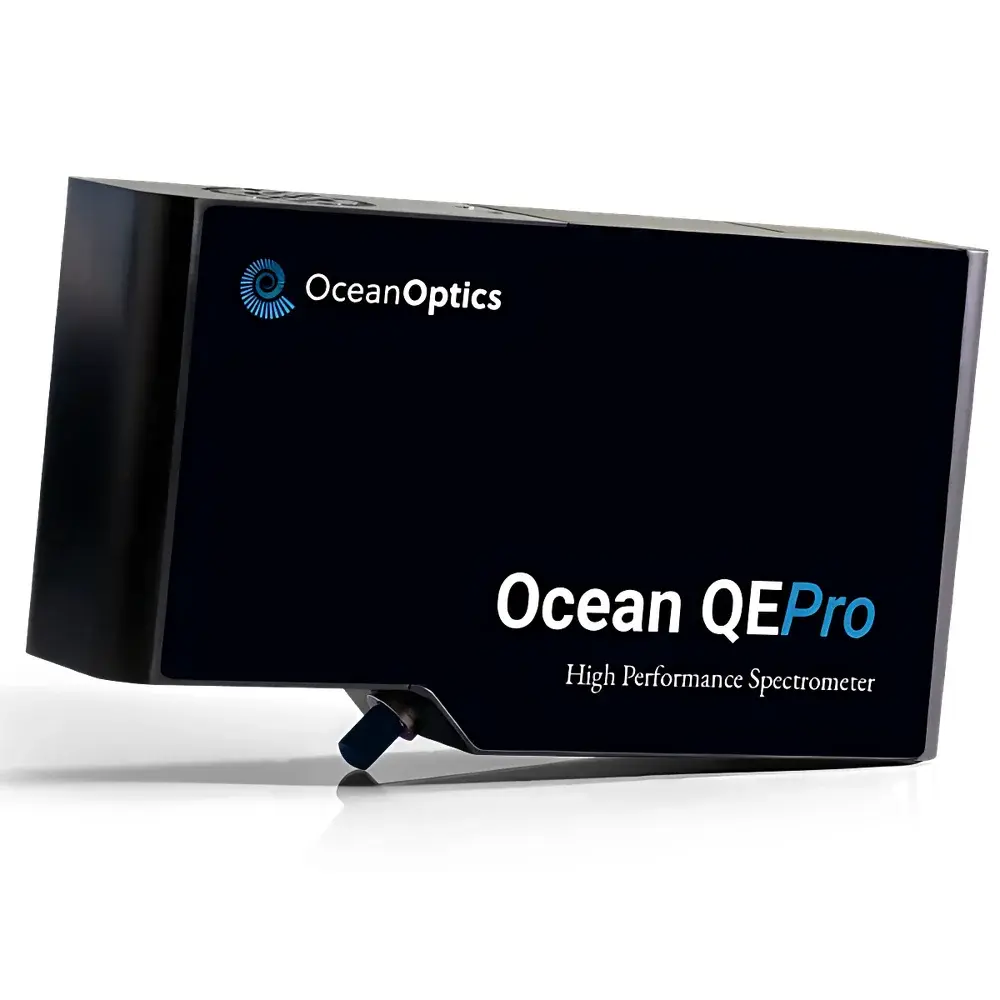
Ocean Optics QE Pro High-Performance Fiber Optic Spectrometer
| Brand | Ocean Optics |
|---|---|
| Model | QE Pro |
| Detector Type | Back-Illuminated CCD |
| Spectral Range | Configurable from 185–1100 nm |
| Resolution | 18-bit digitization |
| Peak Quantum Efficiency | 90% |
| Signal-to-Noise Ratio | 1000:1 (full well) |
| Dynamic Range | 85,000 (typical, single acquisition) |
| Stray Light | <0.08% at 600 nm |
| Onboard Memory Buffer | Yes |
| Optional Integrated Mechanical Shutter | Yes |
| Interchangeable Slit Options | Yes |
Overview
The Ocean Optics QE Pro is a high-performance, back-illuminated CCD-based fiber optic spectrometer engineered for demanding low-light spectroscopic applications including fluorescence, Raman scattering, and UV-Vis-NIR absorbance measurements. Its optical architecture employs optimized Czerny-Turner design with thermoelectric cooling (−15 °C typical stabilization), minimizing dark current and enabling extended integration times without thermal noise degradation. The spectrometer operates on the principle of wavelength-dispersive detection: incoming light—delivered via standard SMA 905 optical fiber—is collimated, diffracted by a ruled or holographic grating, and focused onto a 1024 × 58 pixel deep-depletion back-illuminated CCD sensor. This detector architecture delivers exceptional quantum efficiency (>90% peak), broad spectral response (185–1100 nm), and high linearity across its dynamic range—making the QE Pro particularly suited for quantitative applications requiring reproducibility under variable illumination conditions.
Key Features
- Back-illuminated CCD detector with peak quantum efficiency of 90%, optimized for UV through NIR sensitivity
- Thermoelectric (TE) cooling to −15 °C, reducing dark current by up to two orders of magnitude versus uncooled sensors
- 18-bit analog-to-digital conversion providing >260,000 intensity levels per spectrum for high-fidelity signal resolution
- Onboard 15 MB memory buffer enables continuous high-speed spectral acquisition without host PC bottlenecking
- Integrated mechanical shutter option for precise dark reference acquisition and dark current characterization
- Interchangeable slit assemblies (10–200 µm widths) allow optimization of resolution vs. throughput trade-offs per application
- Rugged aluminum housing with internal EMI shielding ensures stable operation in laboratory and industrial environments
Sample Compatibility & Compliance
The QE Pro interfaces seamlessly with standard optical fiber probes (e.g., reflection, transmission, immersion, or cuvette-based), integrating into modular spectroscopy systems for liquid, solid, and gas-phase analysis. It supports compliance-critical workflows through hardware-level synchronization (TTL trigger I/O), stable thermal management, and repeatable optical alignment—enabling adherence to ISO/IEC 17025 calibration traceability protocols. While the instrument itself is not FDA-cleared, its data integrity features—including timestamped spectra, non-volatile configuration storage, and deterministic acquisition timing—support GLP/GMP-aligned documentation practices. When paired with Ocean Insight’s OceanView software, audit trails, user access controls, and electronic signatures can be implemented to meet 21 CFR Part 11 requirements for regulated laboratories.
Software & Data Management
Ocean Insight provides comprehensive software support including OceanView (Windows/macOS), Ocean HDX (cross-platform GUI), and a fully documented SDK (C/C++, Python, MATLAB, LabVIEW). All drivers expose low-level control of integration time, boxcar averaging, dark subtraction, and real-time baseline correction. Spectral data are exported in standardized formats (CSV, ASCII, JCAMP-DX) and support metadata embedding per ASTM E1421 and ISO 14253-1 conventions. The onboard memory buffer allows burst-mode acquisition at up to 100 spectra/sec (depending on integration time and ROI settings), with lossless transfer via USB 3.0. Firmware updates are digitally signed and version-controlled, ensuring long-term maintainability and interoperability across instrument generations.
Applications
- Fluorescence lifetime and quantum yield measurements in material science and biochemistry
- Low-frequency Raman spectroscopy using 785 nm or 1064 nm excitation sources
- UV-Vis quantification of trace analytes in environmental water testing (e.g., nitrate, humic substances)
- In-line process monitoring of pharmaceutical tablet coating uniformity via reflectance spectroscopy
- Plasma emission diagnostics in semiconductor fabrication and fusion research
- LED and laser diode spectral characterization including FWHM, centroid wavelength, and side-mode suppression ratio
FAQ
What spectral ranges are available for the QE Pro, and how are they configured?
The QE Pro is factory-configured with fixed gratings and slit options to cover discrete spectral bands within 185–1100 nm. Common configurations include UV-VIS (200–850 nm), VIS-NIR (350–1000 nm), and deep-UV (185–400 nm); custom grating/slit/filter combinations are available upon request.
Does the QE Pro support external triggering and synchronization with other instruments?
Yes—it features TTL-compatible input and output trigger ports for hardware-synchronized acquisition with lasers, shutters, or motion stages, enabling time-resolved and pump-probe experiments.
How is calibration maintained over time and temperature changes?
Each unit ships with NIST-traceable wavelength and radiometric calibration files. TE cooling stabilizes detector response, while onboard non-uniformity correction (NUC) compensates for pixel-to-pixel sensitivity variations across operating temperatures.
Can the QE Pro operate in continuous scanning mode for kinetic studies?
Yes—the 15 MB internal buffer supports uninterrupted acquisition of thousands of spectra at rates up to 100 Hz, with streaming to host memory or disk via USB 3.0.
Is the QE Pro compatible with third-party fiber-optic accessories such as integrating spheres or bifurcated cables?
Yes—it accepts standard SMA 905 connectors and is optically matched to common Ocean Insight and industry-standard fiber components, including cosine correctors, flow cells, and remote sensing probes.




