
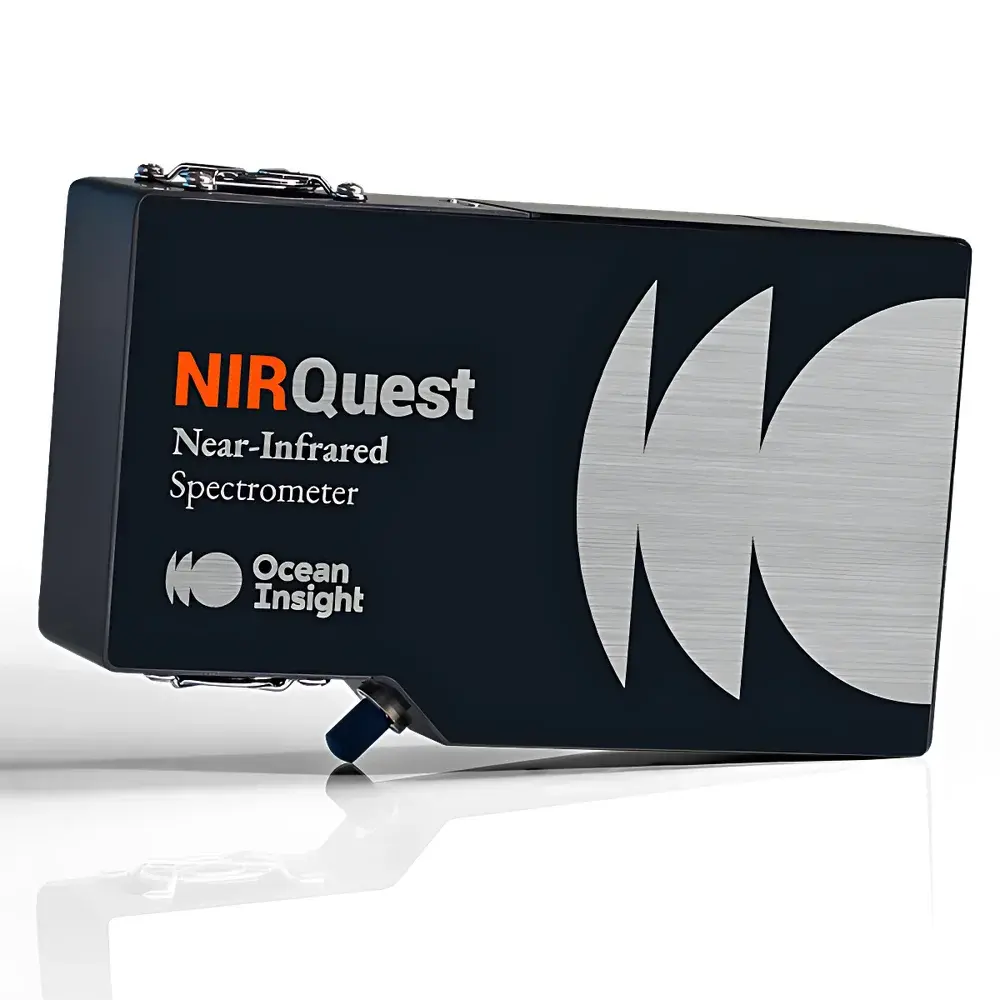
Ocean Optics NIRQuest+ High-Sensitivity Near-Infrared Fiber Optic Spectrometer
| Brand | Ocean Optics |
|---|---|
| Origin | Shanghai, China |
| Manufacturer Type | Authorized Distributor |
| Model | NIRQuest+ (NIRQuest+1.7 / NIRQuest+2.2 / NIRQuest+2.5) |
| Spectral Range | 900 nm – 2500 nm |
| Detector | InGaAs linear array |
| Optical Resolution (FWHM) | 3.13 nm (typ.), 5.47 nm (typ.), 6.25 nm (typ.) |
| Integration Time | 1 ms – 12 s |
| Dark Noise | 6–24 RMS counts (dependent on integration time) |
| Signal-to-Noise Ratio | >15,000:1 @ 100 ms |
| >13,000 | 1 @ 1000 ms |
| ≥10,000 | 1 @ 100 ms (multiple configurations) |
| Dynamic Range | 7.5 × 10⁶ (system) |
| 10,000 | 1 (single acquisition) |
| Slit | 25 µm |
| Grating Options | GRATING_#NIR1 / #NIR2 / #NIR3 |
| Order-Sorting Filter | OF1-RG830 long-pass NIR filter (optional) |
| Dimensions | 182 × 110 × 47 mm |
| Weight | 1.18 kg (without power supply) |
| Cooling | Thermoelectrically cooled to –20 °C |
| Fiber Connector | SMA 905 |
Overview
The Ocean Optics NIRQuest+ is a high-sensitivity, thermoelectrically cooled near-infrared (NIR) fiber optic spectrometer engineered for quantitative and qualitative spectral analysis across the 900–2500 nm range. Based on InGaAs linear array detector technology and optimized optical bench architecture, the NIRQuest+ employs advanced light collection efficiency enhancements—including improved aperture design, low-stray-light optical path geometry, and precision-aligned diffraction gratings—to deliver up to 2.5× higher sensitivity than previous-generation NIRQuest instruments. Its core measurement principle relies on dispersive spectroscopy: incident light, delivered via SMA 905 fiber, is collimated, diffracted by a selectable grating, and focused onto the InGaAs detector array, where photon intensity vs. wavelength is digitized with high linearity and temporal stability. The instrument’s –20 °C thermoelectric cooling minimizes dark current drift, enabling reproducible low-light measurements critical for process monitoring, laboratory QC, and field-deployable applications requiring high signal fidelity over extended integration periods.
Key Features
- Three preconfigured spectral coverage options: NIRQuest+1.7 (900–1700 nm), NIRQuest+2.2 (900–2200 nm), and NIRQuest+2.5 (900–2500 nm)
- Thermoelectric cooling to –20 °C, reducing dark current by >90% compared to uncooled operation and stabilizing baseline response across ambient temperature fluctuations
- Optimized optical throughput via 25 µm entrance slit and proprietary optical bench design—enhancing radiometric sensitivity without compromising resolution
- Multiple grating options (GRATING_#NIR1, #NIR2, #NIR3) enabling user-selectable resolution/spectral range trade-offs
- Optional OF1-RG830 order-sorting long-pass filter to suppress second-order diffraction effects in extended-range configurations
- Compact, ruggedized aluminum housing (182 × 110 × 47 mm; 1.18 kg) suitable for integration into OEM systems, portable analyzers, and production-line instrumentation
- Full USB 2.0 interface with no external power supply required—enabling plug-and-play operation with Windows, Linux, and macOS hosts
Sample Compatibility & Compliance
The NIRQuest+ interfaces seamlessly with standardized fiber-optic sampling accessories—including reflection probes, transmission cells, integrating spheres, and flow-through cuvettes—supporting solid, liquid, and semi-solid sample geometries. Its spectral coverage aligns with key molecular overtone and combination bands (e.g., C–H, O–H, N–H stretches), making it suitable for regulatory-compliant analysis per ASTM E1655 (standard practices for NIR quantitative analysis), ISO 12099 (animal feeding stuffs), USP (near-infrared spectroscopy), and ICH Q5E (comparability of biotechnological/biological products). Data acquisition and processing workflows can be configured to meet FDA 21 CFR Part 11 requirements when used with compliant software platforms (e.g., OceanView with audit trail and electronic signature modules), supporting GLP and GMP environments in pharmaceutical, food, and agricultural QA/QC laboratories.
Software & Data Management
OceanView spectroscopy software provides real-time spectral acquisition, calibration management (wavelength and radiometric), multivariate modeling (PLS, PCA), and batch data export in CSV, TXT, and HDF5 formats. The NIRQuest+ supports direct integration with third-party platforms including LabVIEW, MATLAB, Python (via OceanOptics’ PyMeasure and seabreeze libraries), and EPICS for synchrotron or industrial control system deployment. All firmware and driver packages are digitally signed and version-controlled, with full backward compatibility across Ocean Optics’ NIR product family. Raw spectral data includes embedded metadata (integration time, detector temperature, grating ID, calibration coefficients), ensuring traceability and reproducibility in regulated workflows.
Applications
- Pharmaceutical & Chemical QC: Raw material identification (RMI), blend uniformity assessment, moisture content quantification in lyophilized powders, and API concentration monitoring in suspension formulations
- Food & Agriculture: Non-destructive determination of moisture, protein, starch, and oil content in grains, seeds, and dairy powders; ethanol/methanol ratio verification in distillates
- Biomedical Research: Tissue oximetry, dermal melanin/water/fat mapping, and label-free biomarker screening in ex vivo biopsy specimens
- Recycling & Polymer Analysis: Rapid sorting of PET, HDPE, PP, and ABS plastics using spectral fingerprinting algorithms trained on reference libraries
- Environmental & Remote Sensing: Solar irradiance characterization, vegetation indices (NDVI, PRI), and soil organic carbon estimation using field-portable probe configurations
FAQ
What cooling method does the NIRQuest+ use, and why is it critical for NIR performance?
The NIRQuest+ incorporates a single-stage thermoelectric cooler (TEC) that stabilizes the InGaAs detector at –20 °C. This reduces thermal dark current by orders of magnitude, directly improving signal-to-noise ratio—especially at longer integration times (>100 ms) and in low-photon-flux conditions typical of diffuse reflectance or fiber-coupled remote measurements.
Can the NIRQuest+ be calibrated for absolute radiometric accuracy?
Yes. When paired with NIST-traceable tungsten-halogen or deuterium calibration sources and appropriate integrating sphere accessories, the NIRQuest+ supports both relative reflectance/transmittance and absolute irradiance calibration per ASTM E275 and ISO/IEC 17025 guidelines.
Is the NIRQuest+ compatible with existing Ocean Optics light sources and sampling optics?
Fully compatible. It integrates natively with HL-2000, DH-mini, and QE-Pro series light sources, as well as R-series reflection probes, QP-series bifurcated fibers, and ISP-REF integrating spheres—ensuring consistent optical coupling and validated path-length calibration.
How does resolution vary across the three NIRQuest+ models?
Resolution depends on grating selection and pixel binning. Typical FWHM values range from 3.13 nm (high-resolution NIRQuest+1.7 with GRATING_#NIR1) to 6.25 nm (broad-range NIRQuest+2.5 with GRATING_#NIR3); all values are measured at specified wavelengths and reported as typical—not guaranteed minimum—per ISO 14644-1 alignment tolerances.
What is the maximum recommended integration time for stable thermal performance?
The TEC maintains detector temperature within ±0.1 °C for continuous operation up to 12 seconds integration time. For ultra-long acquisitions (>30 s), active airflow or external heat sinking is recommended to sustain optimal dark current suppression.




