
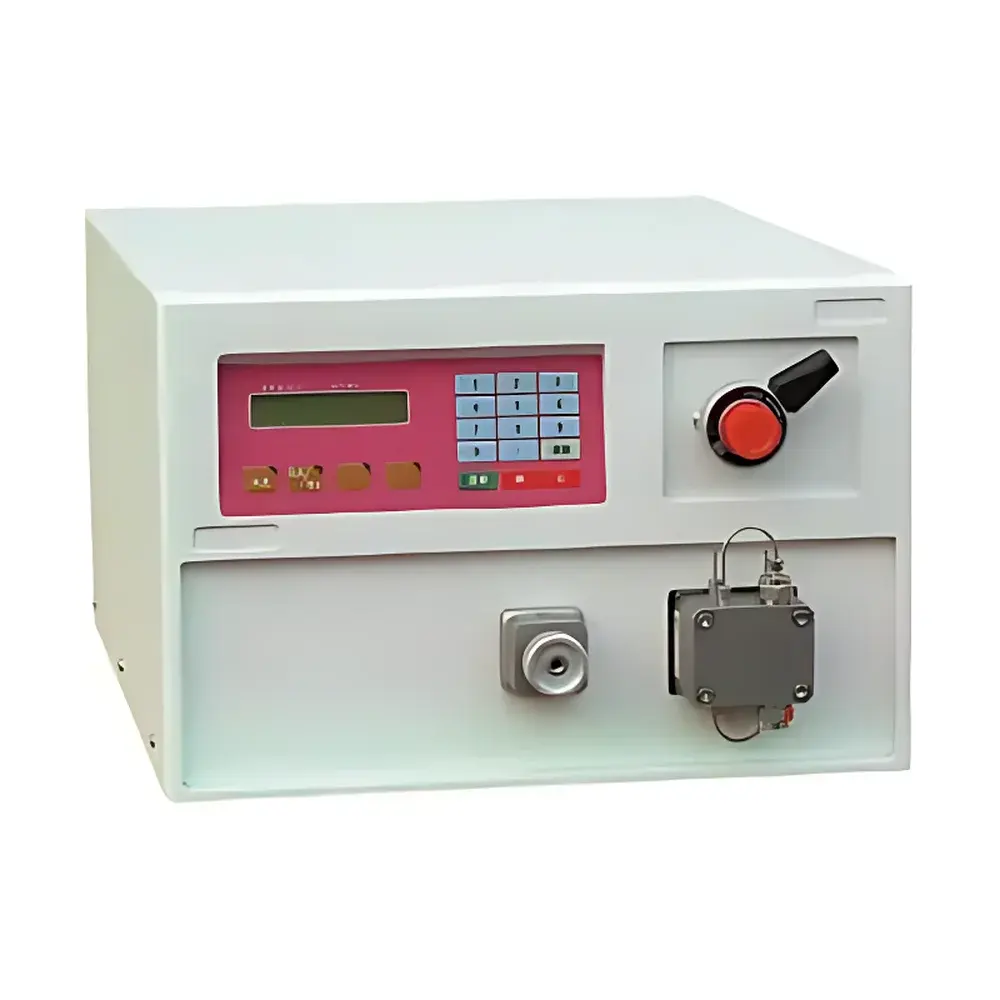
Ulunion UC-3283 High-Performance HPLC High-Pressure Solvent Delivery Pump
| Brand | Ulunion |
|---|---|
| Model | UC-3283 |
| Origin | Beijing, China |
| Pump Type | Dual-Piston Serial Reciprocating Pump |
| Flow Rate Range | 0.001–9.999 mL/min (10 mL pump head) / 0.01–49.99 mL/min (50 mL pump head) |
| Flow Accuracy | <0.5% RSD |
| Flow Precision | ≤0.1% RSD |
| Pressure Pulsation | <0.1 MPa (deionized water, 1 mL/min @ 10 MPa |
| Maximum Pressure | 0–40 MPa (standard), 0–25 MPa (low-pressure configuration) |
| Control Interface | RS-232 for PC-based remote control and bidirectional communication |
| System Protection | User-configurable pressure limit cutoff |
| Display | 2×16-character LCD with English interface |
| GLP Functionality | Cumulative solvent consumption logging |
| Dimensions (L×H×D) | 306 × 210 × 420 mm |
| Weight | 10 kg |
Overview
The Ulunion UC-3283 is a high-precision, high-pressure solvent delivery pump engineered for integration into analytical and semi-preparative liquid chromatography systems. It operates on the principle of dual-piston serial reciprocating displacement, delivering stable, pulse-minimized flow under elevated backpressures up to 40 MPa. Unlike conventional parallel-piston designs, its serial architecture eliminates one pair of check valves—reducing potential failure points by approximately 50% and inherently minimizing flow discontinuity during piston reversal. The pump employs electronic pressure pulsation suppression (EPPS), a real-time active compensation method that dynamically adjusts motor torque and valve timing in response to column backpressure, fluid compressibility, and check valve dynamics—replacing passive mechanical dampers and reducing system dead volume to sub-100 µL levels. This architecture ensures consistent volumetric delivery across variable column resistance, making it suitable for UHPLC-compatible applications when paired with appropriate tubing and fittings.
Key Features
- Dual-piston serial reciprocating design with integrated EPPS algorithm for <0.1 MPa pressure pulsation under defined operating conditions
- High-resolution DC servo motor coupled with optical encoder feedback, enabling sub-microliter per minute flow resolution and near-silent operation
- Modular pump head interchangeability: supports both 10 mL and 50 mL displacement heads, allowing seamless transition from analytical-scale (0.001–9.999 mL/min) to semi-preparative workflows (0.01–49.99 mL/min)
- User-configurable pressure limit protection with automatic shutdown to prevent column or system damage
- Real-time solvent consumption tracking with GLP-compliant cumulative logging—supports audit-ready recordkeeping for regulated laboratories
- RS-232 interface compliant with standard chromatography data system (CDS) protocols for bidirectional command execution and status reporting
- Onboard 2×16-character English LCD display with intuitive menu navigation for local parameter adjustment and diagnostic readout
Sample Compatibility & Compliance
The UC-3283 is compatible with all common HPLC mobile phases—including aqueous buffers, organic solvents (acetonitrile, methanol), and corrosive additives (e.g., TFA, HFBA)—provided wetted materials (pump seals, check valves, pistons) are selected per chemical compatibility guidelines. Standard configurations use sapphire-coated ceramic pistons, ruby/sapphire check valves, and PEEK or stainless-steel fluidic paths. The pump meets IEC 61010-1 safety requirements for laboratory equipment and supports operational alignment with ISO/IEC 17025 quality management systems. While not pre-certified for FDA 21 CFR Part 11, its RS-232 interface and GLP logging functionality enable integration into validated CDS environments where electronic records, audit trails, and user access controls are implemented at the workstation level.
Software & Data Management
The UC-3283 communicates via ASCII-based RS-232 protocol using industry-standard command sets (e.g., “FLOW=”, “PRESSURE?”, “STOP”). It is fully compatible with third-party chromatography software platforms including Chromeleon, Empower, OpenLAB CDS, and open-source alternatives such as OpenChrom. All operational parameters—including setpoints, actual flow rate, instantaneous pressure, total solvent volume dispensed, and error codes—are accessible in real time. The pump’s internal non-volatile memory retains GLP logs across power cycles, supporting traceable solvent usage history for method validation, cost allocation, and environmental compliance reporting. Firmware updates are delivered via serial upload and include version-stamped change logs for regulatory documentation.
Applications
- Analytical reversed-phase, HILIC, and ion-exchange HPLC requiring high flow stability at pressures up to 40 MPa
- Semi-preparative purification workflows where scalable flow rates (up to 49.99 mL/min) and low pulsation are critical for fraction homogeneity
- Method development labs requiring flexible gradient capability—serves as the high-pressure unit in binary or quaternary gradient configurations when paired with proportioning valves
- QC/QA environments subject to ISO 17025 or pharmaceutical GMP standards, where reproducible flow accuracy (<0.5% RSD) and documented solvent consumption support method robustness assessments
- Academic and contract research laboratories performing polymer characterization, small-molecule pharmacokinetics, or natural product isolation where system reliability directly impacts data integrity
FAQ
What pump head options are supported, and how does head replacement affect calibration?
The UC-3283 accepts interchangeable 10 mL and 50 mL pump heads. Each head type requires corresponding firmware parameter loading; factory calibration coefficients are stored per head ID to maintain flow accuracy without manual recalibration.
Is the pump compatible with modern Ethernet-based CDS platforms?
Native Ethernet is not integrated; however, RS-232-to-Ethernet converters compliant with RFC 2217 are widely deployed in production labs and fully supported.
Can pressure pulsation performance be verified independently?
Yes—pulsation metrics are verifiable using a calibrated pressure transducer (e.g., PCB Piezotronics 113B24) and oscilloscope or dynamic data acquisition system per ASTM D7217 practice for HPLC pump evaluation.
Does the pump support gradient delay volume minimization?
Its minimal internal volume (<85 µL from inlet to outlet) and absence of mechanical dampers contribute directly to reduced dwell volume—critical for fast gradient methods and low-flow microbore applications.
How is GLP-compliant solvent logging implemented?
Total dispensed volume is calculated from motor step count, corrected for fluid compressibility and piston seal leakage models, and stored with timestamped entries in non-volatile memory—exportable via RS-232 for inclusion in electronic lab notebooks or LIMS.
Related Products




