
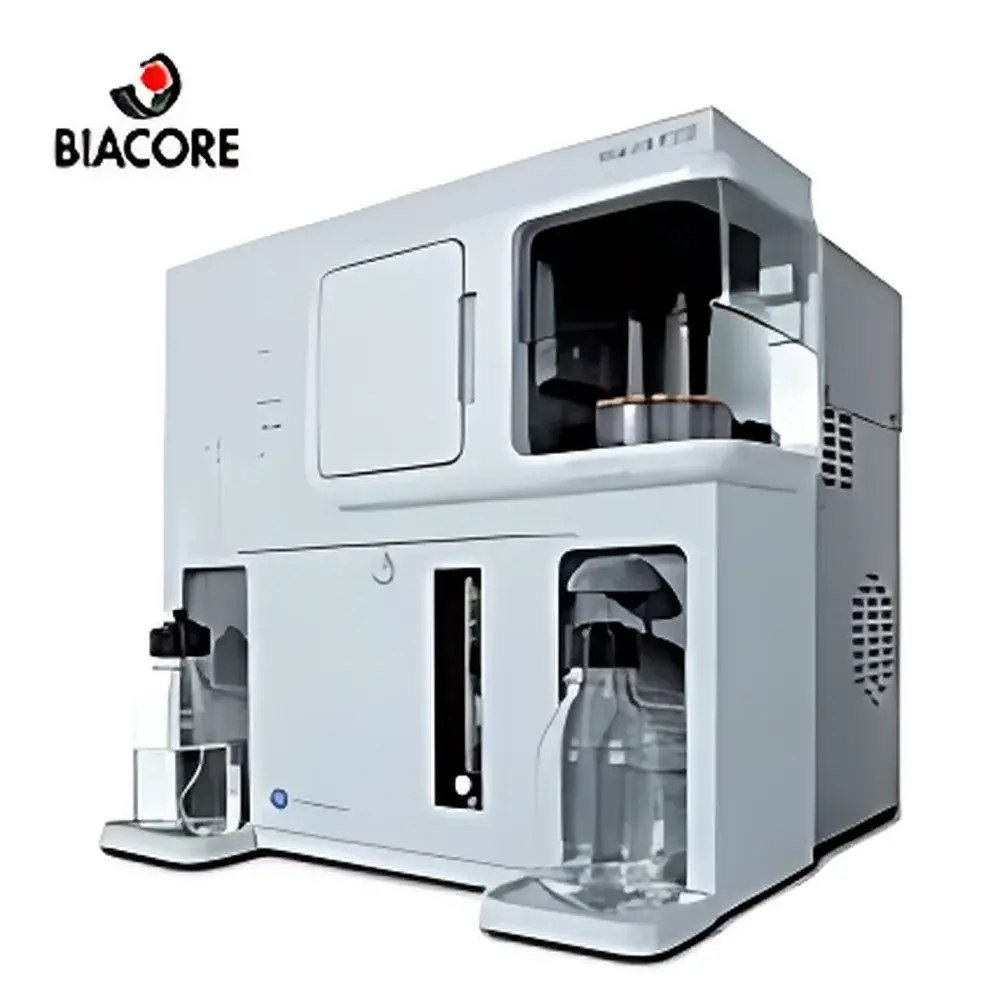
Cytiva Biacore X100 Biomolecular Interaction Analyzer
| Brand | Cytiva |
|---|---|
| Origin | USA |
| Manufacturer Type | Authorized Distributor |
| Origin Category | Imported |
| Model | Biacore X100 |
| Price Range | USD 135,000–270,000 (estimated FOB) |
| Detection Range | ≥100 Da |
| Sample Capacity | Up to 15 samples per run |
| Injection Volume | 5–90 µL |
| Analysis Time | 2–15 minutes per cycle |
| Temperature Control Range | 4°C to 40°C |
Overview
The Cytiva Biacore X100 Biomolecular Interaction Analyzer is a surface plasmon resonance (SPR)-based real-time label-free biosensor system engineered for quantitative analysis of biomolecular interactions. It operates on the principle of detecting changes in refractive index at a gold sensor surface upon binding-induced mass accumulation—enabling direct, kinetic measurement of association (kon) and dissociation (koff) rates, equilibrium dissociation constants (KD), and stoichiometry without fluorescent or radioactive labeling. Designed for mid-throughput academic and industrial laboratories, the X100 delivers high reproducibility in characterizing interactions across diverse analyte sizes—from small molecules (≥100 Da) to proteins, nucleic acids, glycans, liposomes, and even intact viral particles. Its compact footprint, integrated fluidics, and thermally stabilized flow cell support rigorous experimental control under physiologically relevant conditions (4–40°C), making it suitable for both discovery-phase screening and mechanistic validation studies.
Key Features
- Real-time, label-free detection with sub-picomolar sensitivity and low sample consumption (as little as 5 µL injection volume)
- Automated sample handling for up to 15 independent samples per assay sequence, minimizing manual intervention
- Precise temperature regulation (±0.1°C stability) across 4–40°C range to maintain conformational integrity during kinetic runs
- Optimized flow cell design enabling rapid regeneration and consistent surface chemistry performance over hundreds of cycles
- Integrated reference channel subtraction and bulk refractive index compensation for robust signal-to-noise ratio
- Pre-calibrated sensor chips (CM5, SA, NTA, C1, etc.) with validated immobilization chemistries for amine coupling, streptavidin-biotin, His-tag capture, and covalent attachment
Sample Compatibility & Compliance
The Biacore X100 accommodates a broad spectrum of molecular classes—including peptides, monoclonal antibodies, recombinant receptors, oligonucleotides, carbohydrates, and membrane-associated complexes—without requiring derivatization. Its assay format supports both ligand-capture and analyte-capture configurations, facilitating flexible experimental design for affinity ranking, epitope binning, and concentration determination. The system complies with GLP/GMP-aligned workflows: audit trails, electronic signatures, and user-access controls are fully supported within Biacore Evaluation Software v4.x. Data files adhere to vendor-agnostic .txt and .csv export formats compatible with third-party statistical platforms (e.g., GraphPad Prism, R). While not pre-certified for FDA 21 CFR Part 11 out-of-the-box, the software architecture enables configuration for regulated environments when deployed with appropriate IT infrastructure and SOP documentation.
Software & Data Management
Biacore Evaluation Software provides a workflow-driven interface with guided method setup, real-time sensorgram visualization, and automated global fitting algorithms (1:1 Langmuir, bivalent analyte, heterogeneous ligand models). Built-in quality metrics—including RU baseline drift, mass transport limitation assessment, and chi-square residuals—support objective data acceptance criteria. All raw sensorgrams, fitted parameters, and report templates are stored in a hierarchical project structure with versioned backups. Export options include publication-ready figures (TIFF, PNG, SVG), tabular kinetics summaries, and metadata-rich XML exports for LIMS integration. Remote monitoring via secure HTTPS connection allows off-site instrument status checks and queue management. Comprehensive e-learning modules, application notes, and peer-reviewed protocol libraries are accessible through Cytiva’s Biacore Knowledge Base—updated quarterly with new use cases and troubleshooting guides.
Applications
- Antibody-antigen affinity maturation and epitope mapping in biologics development
- Target engagement profiling for small-molecule inhibitors in early-stage drug discovery
- Characterization of protein-protein interaction networks in signal transduction pathways
- Validation of CRISPR guide RNA binding kinetics to Cas proteins
- Quality control of biosimilar binding profiles against originator therapeutics
- Structural-functional correlation studies using mutant protein panels
- Method development for orthogonal validation of SPR data with ITC or MST
FAQ
What types of sensor chips are compatible with the Biacore X100?
The system supports CM5, SA, NTA, C1, HPA, and L1 chips—each optimized for distinct immobilization strategies and target classes.
Can the Biacore X100 measure very fast on-rates or slow off-rates accurately?
Yes—the system’s high data acquisition rate (up to 10 Hz) and extended dissociation monitoring capability (up to 2 hours) enable reliable characterization of both transient and ultra-stable interactions.
Is method transfer possible between Biacore X100 and higher-end platforms like Biacore 8K?
Sensorgram data and evaluation methods are fully interoperable; chip surfaces and buffer conditions translate directly, ensuring scalability across Cytiva’s SPR platform family.
How does the system handle matrix effects from crude lysates or serum samples?
Reference surface subtraction, dual-channel referencing, and optional sample pre-clearing protocols mitigate nonspecific binding artifacts commonly observed in complex biological matrices.
Does the Biacore X100 support regulatory submissions?
When operated under documented SOPs with full audit trail activation and qualified hardware/software, data generated meets ICH M10 and FDA guidance expectations for binding kinetics in nonclinical studies.





