
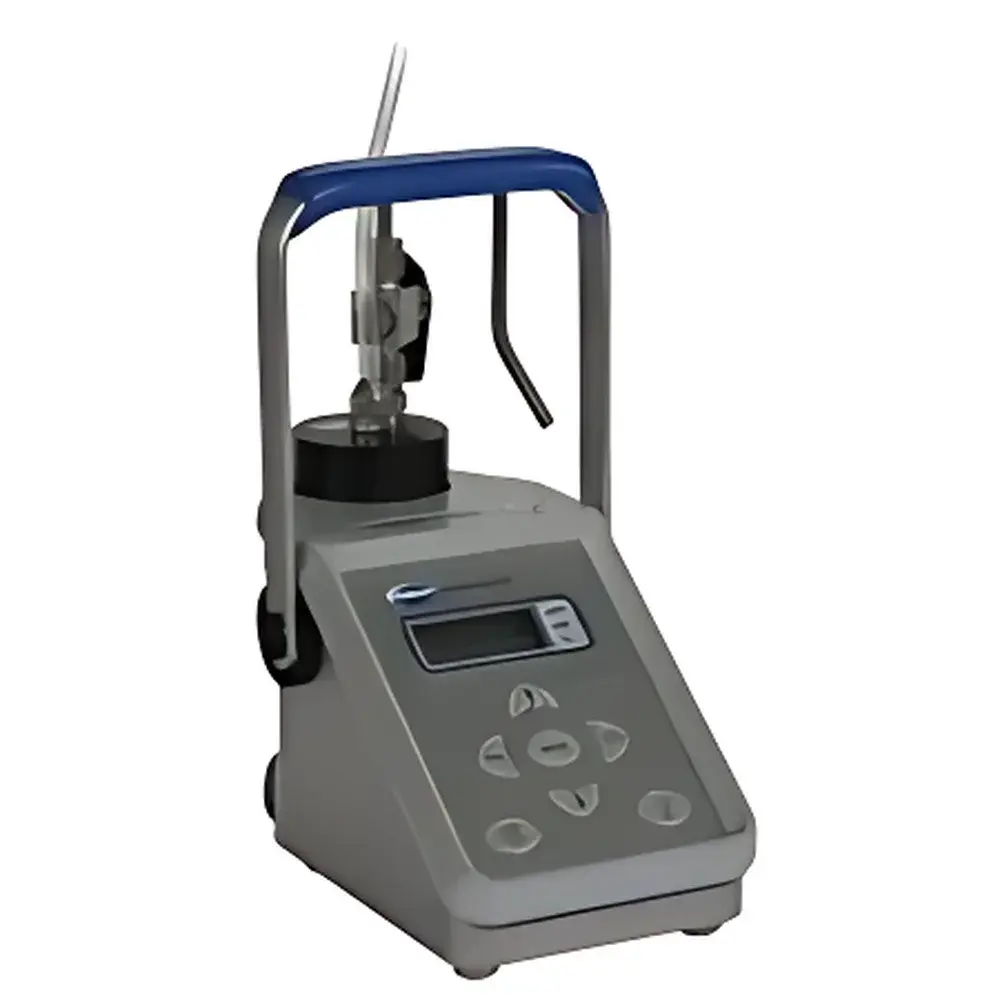
HACH Orbisphere 3650EX Oil & Lubricant Dissolved Oxygen Analysis System
| Brand | HACH |
|---|---|
| Origin | Imported |
| Manufacturer Status | Original Equipment Manufacturer (OEM) |
| Model | 3650EX |
| Power Supply | 2 × AA NiCd or alkaline batteries (2.4–3 V DC) |
| Battery Life | Up to 40 hours continuous operation |
| Measurement Principle | Electrochemical amperometric sensing with proprietary membrane-based sensor |
| Enclosure Rating | IP67 / NEMA 4X |
| Certification | ATEX II 1G Ex ia IIC T4 Ga |
| Temperature Range | –5 °C to +100 °C |
| Output Interface | RS-232 serial digital interface |
| Zero Drift | < 0.5 % FS per 24 h |
| Housing Material | Fully stainless steel (316L) |
| Data Logging | Internal non-volatile memory with PC download capability |
Overview
The HACH Orbisphere 3650EX Oil & Lubricant Dissolved Oxygen Analysis System is a purpose-engineered, intrinsically safe electrochemical analyzer designed for reliable, real-time quantification of dissolved oxygen (DO) in hydrocarbon-based fluids—including turbine oils, hydraulic fluids, transformer oils, and synthetic lubricants—within hazardous environments. Unlike aqueous DO measurement systems, the 3650EX employs a patented amperometric sensor architecture optimized for low-conductivity, non-aqueous matrices. Its operation relies on selective oxygen diffusion through a gas-permeable membrane into an electrolyte-filled electrochemical cell, where oxygen is reduced at a cathode, generating a current linearly proportional to partial pressure (and thus concentration) of dissolved O₂. This principle ensures high specificity, minimal cross-sensitivity to CO₂ or hydrocarbons, and stable baseline performance without warm-up delay—a critical advantage for field deployment and process safety monitoring in refineries, power generation facilities, and marine propulsion systems.
Key Features
- Intrinsically safe design certified to ATEX II 1G Ex ia IIC T4 Ga for Zone 0/20 use—enabling direct installation in explosive atmospheres containing gases, vapors, or combustible dusts.
- Zero warm-up requirement: Delivers metrologically valid measurements immediately upon power-on, eliminating downtime during shift changes or emergency response.
- Ruggedized stainless steel (316L) enclosure rated IP67/NEMA 4X—resistant to immersion, high-pressure washdown, corrosion, and mechanical impact in industrial settings.
- Proprietary electrochemical sensor with replaceable membrane cartridges—designed specifically for oil-phase oxygen solubility measurement, offering extended service life and field-replaceability without recalibration.
- Integrated temperature measurement (–5 °C to +100 °C) with automatic temperature compensation (ATC) applied to DO readings per ASTM D808–22 and ISO 5814:2012 methodologies.
- Onboard non-volatile data logger stores timestamped DO and temperature records; data export via RS-232 interface supports traceable reporting compliant with ISO/IEC 17025 and internal QA/QC protocols.
Sample Compatibility & Compliance
The 3650EX is validated for use with mineral oils, polyalphaolefins (PAOs), phosphate esters, diesters, and silicone-based lubricants. It does not require sample dilution, filtration, or conditioning—enabling direct insertion into reservoirs, sumps, or inline flow cells. Sensor response remains stable across viscosity ranges from 2 cSt to >300 cSt (at 40 °C). The system conforms to international hazardous area standards including EN 60079-0, EN 60079-11, and IEC 60079-26. Its design supports alignment with asset integrity management frameworks such as API RP 581 and ISO 55001, particularly for condition-based monitoring of turbine and generator bearing systems where oxygen-induced oxidation is a primary degradation mechanism.
Software & Data Management
Data retrieval is performed using standard terminal emulation software (e.g., PuTTY, Tera Term) or custom HACH-compatible utilities. Logged datasets include DO concentration (ppb or ppm), temperature (°C), measurement timestamp (YYYY-MM-DD HH:MM:SS), and sensor status flags. All communications are ASCII-based with configurable baud rates (default 9600 bps). While the 3650EX itself does not incorporate FDA 21 CFR Part 11-compliant electronic signatures, its raw output format enables integration into validated LIMS or SCADA platforms that enforce audit trails, user access controls, and electronic record retention per GLP/GMP requirements.
Applications
- Monitoring oxidative stability of turbine oils in thermal power plants and combined-cycle gas turbines.
- Early detection of air ingress in sealed hydraulic systems used in offshore drilling rigs and wind turbine pitch/yaw actuators.
- Verification of nitrogen blanketing efficacy in transformer oil storage tanks and distribution systems.
- Supporting predictive maintenance programs by correlating dissolved O₂ trends with acid number (AN), particle count, and FTIR oxidation indices.
- Field verification of deaeration efficiency in lube oil reclamation units and vacuum dehydration systems.
FAQ
Is the 3650EX suitable for measuring dissolved oxygen in water or aqueous solutions?
No—the 3650EX is calibrated and validated exclusively for non-aqueous, low-polarity media. For aqueous DO analysis, HACH recommends the HQ40d or SL1000 platform with appropriate luminescent or polarographic probes.
Can the sensor be cleaned in situ without removal from the oil stream?
Yes—mechanical wiping with lint-free cloth and isopropyl alcohol is permitted; ultrasonic cleaning is not recommended due to potential membrane delamination.
Does the instrument require periodic calibration with certified gas standards?
Calibration is performed in zero-oxygen oil (nitrogen-sparged reference fluid) and span-checked against air-saturated oil at controlled temperature; no external gas cylinders or permeation tubes are needed.
What is the typical service interval for the electrochemical sensor cartridge?
Under continuous operation in clean turbine oil at <60 °C, expected functional lifetime exceeds 12 months; replacement frequency increases under high-temperature or particulate-laden conditions.
Is firmware upgrade capability available via the RS-232 interface?
Firmware updates are performed only by authorized HACH service centers using proprietary diagnostic tools; end users cannot modify embedded software.







