
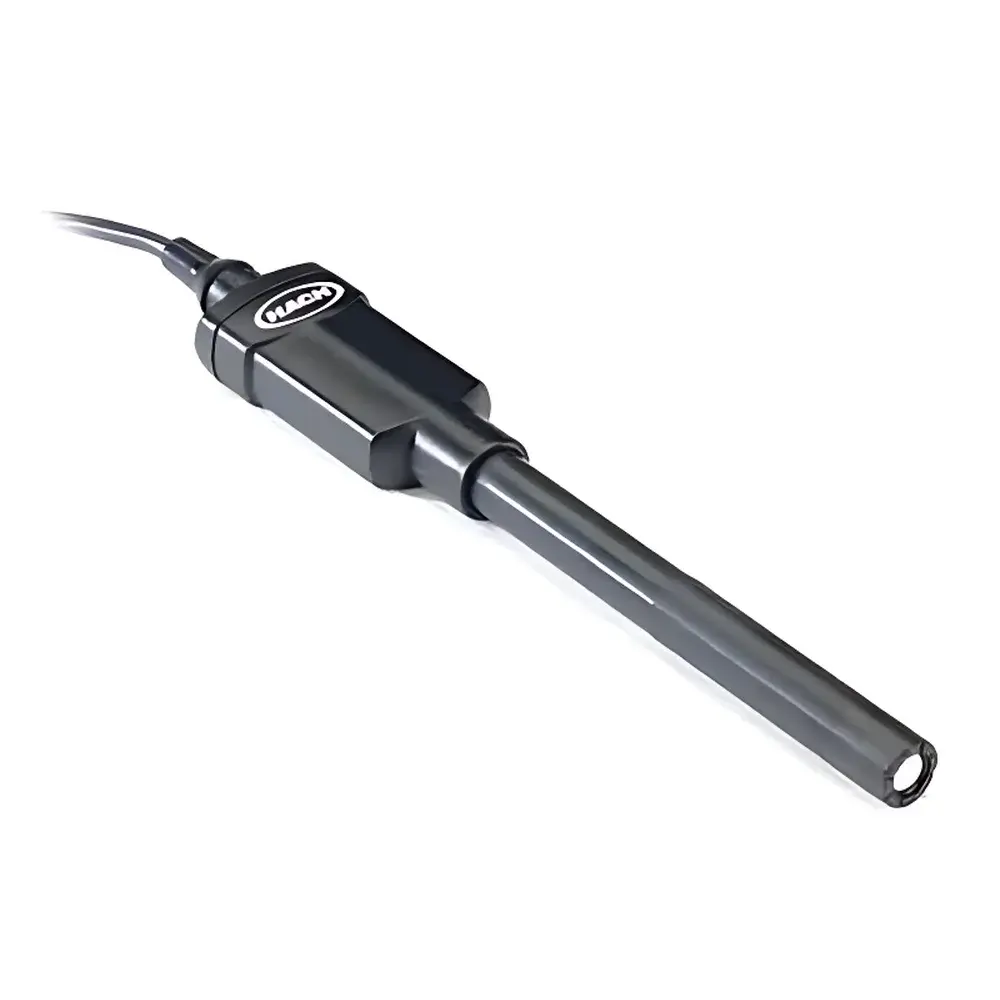
HACH IntelliCAL ISENH381 Ammonia Ion-Selective Electrode (ISE) with Integrated Temperature Sensor
| Brand | HACH |
|---|---|
| Origin | Imported |
| Manufacturer Type | Original Equipment Manufacturer (OEM) |
| Instrument Type | Portable ISE Probe |
| Measurement Principle | Potentiometric Ammonia-Specific Membrane Sensing |
| Measurement Range | 5 × 10⁻⁷ to 1 M NH₃ |
| Equivalent Concentration Range | 0.009–17,000 mg/L as NH₃ |
| Integrated Temperature Sensor | Yes |
| Cable Length | 1 m |
| Reference Junction | Large Annular Ceramic Junction |
| Compliance | ASTM D1426, ISO 7150-1, USP <791>, EPA Method 350.1 |
Overview
The HACH IntelliCAL ISENH381 is a high-performance, potentiometric ammonia ion-selective electrode engineered for precise, field-deployable measurement of free ammonia (NH₃) in aqueous samples. Unlike conventional ammonium-selective electrodes that respond primarily to NH₄⁺, the ISENH381 employs a gas-permeable hydrophobic membrane and selective ionophore chemistry optimized for undissociated NH₃ — enabling direct quantification of the biologically active, volatile fraction critical in wastewater treatment, aquaculture, environmental monitoring, and process control applications. Its integrated platinum resistance temperature detector (PT1000) ensures real-time, on-probe temperature compensation without external hardware, eliminating thermal lag and interconnection errors common with separate temperature probes. The electrode operates on the Nernstian principle, generating a millivolt signal proportional to the logarithm of free NH₃ activity, which is converted to concentration via calibration against standard solutions traceable to NIST-certified reference materials.
Key Features
- Integrated PT1000 temperature sensor — eliminates need for auxiliary temperature probe and reduces system complexity and calibration drift
- Large annular ceramic reference junction — increases electrolyte/sample interfacial area, enhancing response time (<60 s to 95% stability) and long-term stability in turbid or low-ionic-strength matrices
- Optimized polymeric membrane formulation — provides selectivity coefficient log KNH₃,Na < −4.5 and log KNH₃,K < −3.8 per ISO 15197:2015 guidelines, minimizing interference from alkali metal ions and common anions
- Rugged, IP67-rated polypropylene body with 1-m shielded coaxial cable — suitable for handheld meters (e.g., HACH HQ40d, HQ440d) and continuous online interfaces
- Factory-calibrated slope verification data provided — supports GLP-compliant documentation and audit readiness
Sample Compatibility & Compliance
The ISENH381 is validated for use across diverse sample matrices including municipal and industrial wastewater effluents, surface water, groundwater, aquaculture recirculation systems, and fermentation broths. It maintains accuracy within ±5% of true value over pH 7.5–11.5 when used with appropriate ionic strength adjustment (e.g., 10 mM NaOH or pH 10 buffer addition per ASTM D1426). The electrode complies with method requirements of EPA Method 350.1 (ammonia by ISE), ISO 7150-1 (water quality — determination of ammonia nitrogen), and USP (pH and ion-selective electrodes). Its design meets essential criteria for GMP-relevant environmental monitoring under FDA 21 CFR Part 11 when paired with compliant data loggers supporting electronic signatures and audit trails.
Software & Data Management
When connected to HACH’s IntelliCAL-enabled platforms (e.g., HQ Series meters or SC1000 controllers), the ISENH381 supports automated calibration verification, slope tracking, and date/time-stamped measurement logging. All calibration events — including standard concentrations, temperature, and electrode potential — are stored with metadata in non-volatile memory. Exported CSV files include ISO 8601 timestamps, instrument ID, operator code, and uncertainty flags, facilitating integration into LIMS environments. Firmware updates and configuration parameters are managed via HACH’s LogR software, which enforces role-based access control and maintains full revision history per ALCOA+ principles.
Applications
- Real-time monitoring of free ammonia breakthrough in nitrification-denitrification bioreactors
- Regulatory compliance testing for discharge permits (e.g., NPDES) requiring NH₃-speciation
- Early warning detection of ammonia toxicity thresholds in fish hatcheries and aquarium systems
- Process optimization in anaerobic digestion and sidestream deammonification (e.g., ANAMMOX)
- Method validation and reference measurements in certified environmental laboratories accredited to ISO/IEC 17025
FAQ
What sample pH range is required for accurate free ammonia measurement?
Free ammonia measurement requires pH ≥ 7.5 to ensure sufficient NH₃ fraction; optimal performance occurs between pH 9.0–11.0. Samples below pH 7.5 must be buffered prior to analysis.
Can the ISENH381 measure total ammonia nitrogen (TAN)?
No — it measures only the unprotonated NH₃ species. Total ammonia (NH₃ + NH₄⁺) requires complementary analysis (e.g., colorimetric Nesslerization or ion chromatography) or calculation using simultaneous pH and temperature measurements.
How often should the electrode be recalibrated?
Daily calibration is recommended for routine QC; multi-point calibration (2–3 standards spanning the expected range) is required after membrane replacement or exposure to high-solids or sulfide-rich samples.
Is the electrode compatible with non-HACH meters?
Yes — it outputs standard mV signals (±1500 mV) and is compatible with any pH/mV meter supporting ISE mode and manual temperature entry, though full IntelliCAL features (auto-recognition, diagnostics) require HACH HQ-series instruments.
What maintenance procedures extend service life?
Rinse thoroughly with deionized water after each use; store upright in 1 M NH₄Cl solution; avoid drying the membrane or exposing to chlorinated disinfectants, heavy metals, or organic solvents.




