
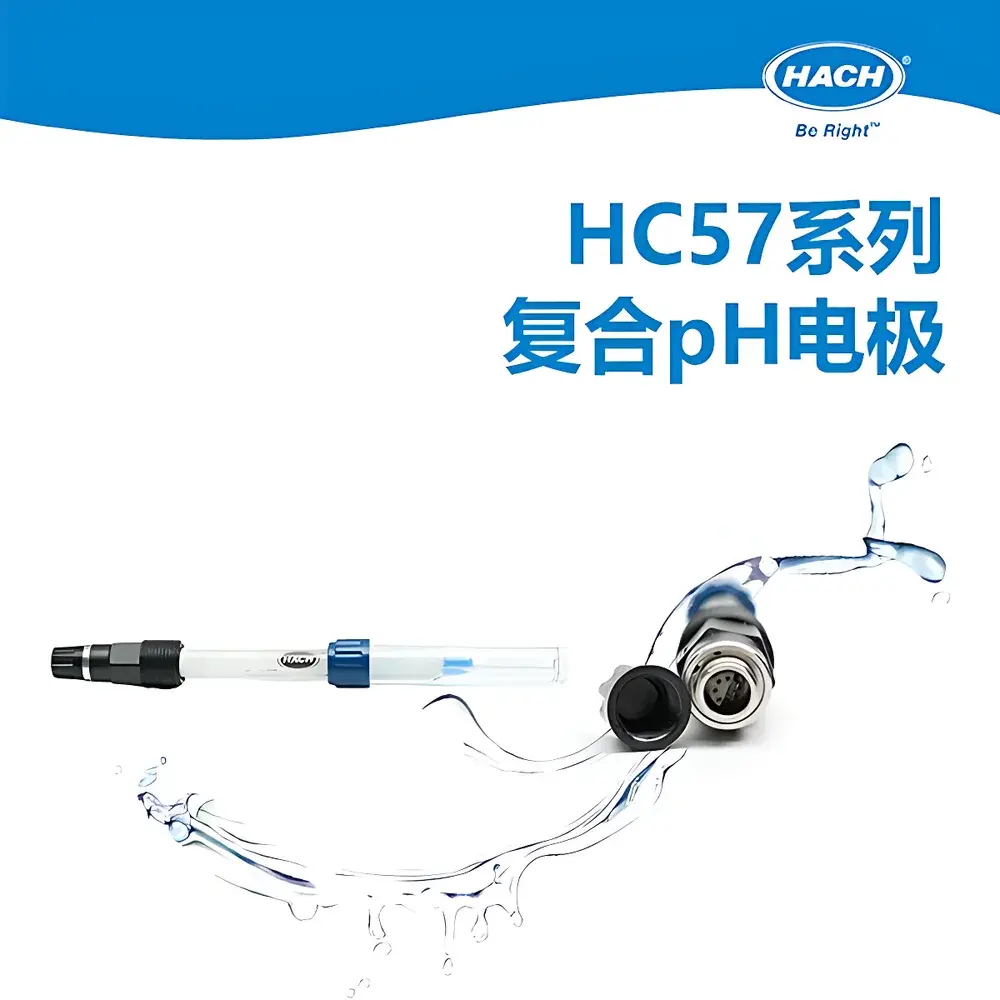
HACH HC57 Series Composite pH Electrodes
| Brand | HACH |
|---|---|
| Model | HC57 |
| Type | Laboratory & Process-Grade ORP/pH Electrode |
| Origin | Imported |
| Manufacturer | HACH (USA) |
| Electrolyte | Solid Polymer / Gel |
| Membrane Options | High-Alkali (HA) or HF-Resistant Glass |
| Junction Types | Open, Ceramic, PTFE, or Dual PTFE-Open |
| Max Pressure | 10–13 bar |
| Temp Range | 0–130 °C (model-dependent) |
| pH Range | 0–14 (except HC5703: 0–11) |
| Temperature Sensor | Integrated Pt1000 |
| Body Diameter | 12 mm |
| Length | 120 mm |
| Connector | 8-pin |
Overview
The HACH HC57 Series composite pH electrodes are engineered for high-reliability potentiometric measurement of pH and oxidation-reduction potential (ORP) in demanding industrial and laboratory environments. Based on the Nernst equation principle, these electrodes integrate a glass pH-sensing membrane and a stable reference system within a single robust probe body. Unlike conventional electrodes, the HC57 series employs a long-diffusion-path reference design to minimize ion migration interference and resist poisoning from sulfides, heavy metals, proteins, or reducing agents commonly found in wastewater, fermentation broths, chemical process streams, and food-grade emulsions. The electrodes are designed for both inline process installation and benchtop calibration—supporting continuous monitoring under elevated temperature (up to 130 °C) and pressure (up to 13 bar), with full compliance to IEC 61298-2 for industrial measuring equipment.
Key Features
- High-alkali-resistant (HA) and hydrofluoric acid-resistant (HF) glass membranes—enabling accurate measurement in caustic lye, chlorine dioxide, peroxide, and fluoride-containing solutions.
- Multiple junction configurations: open junction for low-clogging applications; ceramic junction for general-purpose use; PTFE junction for oil-laden, viscous, or suspended-solid media; dual PTFE-open junction for enhanced stability and pressure tolerance.
- Integrated Pt1000 platinum resistance thermometer—providing fast thermal response (<15 s in stirred water) and enabling automatic, high-fidelity temperature compensation per DIN 19266 and ISO 7888.
- Modular, two-part construction: electrode body and shielded 8-pin cable—reducing total cost of ownership by allowing independent replacement of either component without recalibration.
- Pressure-rated housing (10–13 bar, model-specific) certified for direct insertion into pressurized reactors, pipelines, and sterilizable bioreactors.
- Reference electrolyte options include solid polymer (low-maintenance, zero-leakage) and gel-filled (higher ionic mobility for rapid stabilization in low-conductivity samples).
Sample Compatibility & Compliance
The HC57 series demonstrates exceptional compatibility across complex matrices: turbid suspensions, protein-rich dairy effluents, chlorinated cooling water, H₂O₂ bleaching baths, nitrate/sulfate-heavy mining leachates, and high-pH caustic scrubber solutions. Its resistance to fouling and chemical attack meets ASTM D1293 (pH of water), USP (pH measurement in pharmaceuticals), and EN ISO 10523 (water quality—pH determination). All models comply with CE marking requirements for electromagnetic compatibility (EMC Directive 2014/30/EU) and low-voltage safety (LVD Directive 2014/35/EU). For regulated environments—including FDA-regulated pharmaceutical manufacturing and GLP-compliant environmental testing—the integrated Pt1000 sensor supports audit-ready temperature traceability, while the solid-polymer reference system eliminates electrolyte refill logs required under 21 CFR Part 11 data integrity guidelines.
Software & Data Management
HC57 electrodes interface seamlessly with HACH’s SC1000, HQ40d, and PI Controller platforms, as well as third-party PLCs and SCADA systems via standard analog (4–20 mA) or digital (RS-485 Modbus RTU) outputs. When paired with HACH’s LabStation software or compatible LIMS, the Pt1000 temperature data is logged synchronously with pH/ORP readings, enabling time-stamped, metadata-enriched datasets compliant with ISO/IEC 17025 clause 7.7 (result reporting). Firmware updates and calibration history are stored onboard the transmitter—not the electrode—ensuring consistent metrological traceability even after electrode replacement.
Applications
- Continuous pH/ORP monitoring in municipal and industrial wastewater treatment—especially in denitrification basins, anaerobic digesters, and chlorine contact tanks.
- In-line control of caustic cleaning-in-place (CIP) cycles in food & beverage and biopharma facilities.
- Real-time redox monitoring during electrochemical synthesis, metal plating bath management, and peroxide-based disinfection processes.
- Stability testing of alkaline battery electrolytes and fuel cell membranes under elevated T/P conditions.
- Quality assurance of high-purity water systems (UPW, PW) where silica or fluoride contamination risks demand HF-resistant sensing.
FAQ
Can the HC57 be used in hydrofluoric acid (HF) solutions?
Yes—only the HC5703 model features an HF-resistant glass membrane and is rated for pH 0–11 in HF-containing media up to 80 °C. Other models use high-alkali glass and must not be exposed to HF.
What is the recommended calibration frequency for process applications?
For critical control loops, daily verification against two-point buffer standards (e.g., pH 4.01 and 7.00 at process temperature) is advised; weekly full calibration is typical for non-GMP installations.
Is the electrode suitable for steam-in-place (SIP) sterilization?
HC57 models with solid-polymer reference and HA glass (e.g., HC5710, HC5720) withstand repeated SIP cycles at 121 °C/2 bar when installed with appropriate sanitary fittings—but prolonged exposure above 130 °C degrades the glass membrane.
How does the dual PTFE-open junction improve performance over single-junction designs?
The dual junction physically separates the inner reference electrolyte from the sample via two sequential barriers—reducing clogging risk, extending service life in oily or particulate-laden streams, and improving long-term drift stability by minimizing junction potential variability.
Does the Pt1000 sensor meet IEC 60751 Class A tolerance?
Yes—the integrated Pt1000 complies with IEC 60751 Class A (±(0.15 + 0.002 × |t|) °C), validated across the full 0–130 °C operating range.




