
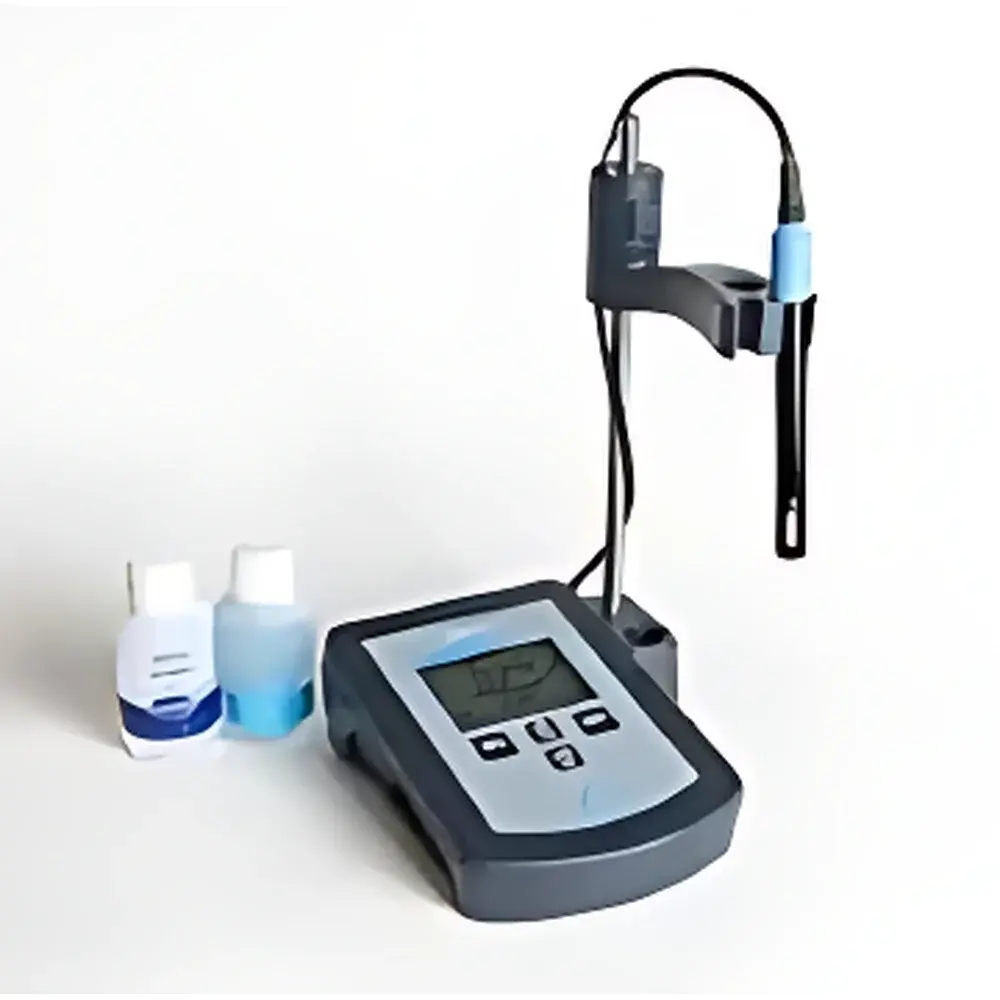
Hach LA-EC20 Benchtop Conductivity Meter
| Brand | Hach |
|---|---|
| Origin | Imported |
| Manufacturer Type | Manufacturer |
| Model | LA-EC20 |
| Measurement Parameter | Single-parameter (Conductivity) |
| Form Factor | Benchtop |
| Conductivity Range | 0.00 μS/cm – 199.9 mS/cm |
| TDS Range | 0.0 mg/L – 199.9 g/L |
| Resistivity Range | Not Specified |
| Salinity Range | Not Specified |
| Temperature Range | 0°C – 100°C |
| Accuracy | ±0.5 % of Full Scale |
| Minimum Resolution | 0.01 μS/cm |
Overview
The Hach LA-EC20 Benchtop Conductivity Meter is a precision-engineered, single-parameter electrochemical instrument designed for routine conductivity, TDS, and temperature measurements in laboratory, municipal water, wastewater treatment, and educational environments. Built upon Hach’s legacy of robust water quality instrumentation, the LA-EC20 employs four-electrode graphite conductivity cell technology to ensure stable, low-drift measurements across a wide dynamic range—from ultra-pure water (0.00 μS/cm) to highly conductive industrial brines (up to 199.9 mS/cm). Its measurement principle follows standardized AC conductivity detection per ASTM D1125 and ISO 7888, minimizing polarization effects and enabling high reproducibility in both low- and high-conductivity matrices. The instrument operates with automatic temperature compensation (ATC) using a built-in Pt1000 sensor, supporting linear or non-linear (NaCl-based) compensation algorithms compliant with USP and EPA Method 120.1 requirements.
Key Features
- Four-electrode graphite conductivity sensor: Eliminates electrode polarization errors and extends calibration stability—ideal for high-salinity or fouling-prone samples.
- Assistive Bar visual feedback system: Real-time progress bar indicates signal stabilization; auto-hold triggers with audible confirmation when reading meets defined stability criteria (±0.02 μS/cm over 3 sec).
- Assistive Pad pull-out reference guide: Integrated quick-reference panel provides step-by-step instructions for calibration, measurement, and troubleshooting—reducing operator-dependent variability.
- Intuitive four-button interface with full Chinese-language display: Enables rapid navigation without menu diving; all functions—including calibration, unit switching, and ATC selection—are accessible within two button presses.
- Adjustable universal electrode stand: Height- and angle-adjustable mount accommodates varying vessel geometries and ensures consistent immersion depth for repeatable cell constant application.
- High-resolution 128 × 64 pixel LCD: Large, backlit display supports simultaneous viewing of conductivity, TDS, temperature, and units—optimized for ambient lab lighting conditions.
- Multi-standard calibration support: Compatible with two pre-configured calibration sets (totaling seven certified conductivity standards: 1413 μS/cm, 5.00 mS/cm, 12.88 mS/cm, 80.0 mS/cm, etc.), enabling traceable calibration across regulatory and process control applications.
Sample Compatibility & Compliance
The LA-EC20 is validated for use with aqueous samples ranging from deionized water (≥18.2 MΩ·cm resistivity equivalent) to concentrated saline solutions and municipal effluents. It complies with key international performance standards including ISO/IEC 17025:2017 (for laboratory competence), ASTM D1125-22 (Standard Test Methods for Electrical Conductivity of Water), and EN 27888 (Water Quality — Determination of Electrical Conductivity). While not FDA 21 CFR Part 11–enabled out-of-the-box, its audit-ready calibration logs (date/time-stamped, operator-ID capable via optional software integration) support GLP/GMP-aligned documentation workflows. The instrument meets IEC 61010-1 safety requirements for laboratory electrical equipment and carries CE marking for EMC and low-voltage directive compliance.
Software & Data Management
Data output is supported via RS232 serial interface (standard) for direct connection to LIMS or Excel-based logging systems. Optional Hach LabStation™ PC software enables automated data capture, calibration history archiving, and report generation compliant with ISO/IEC 17025 record retention guidelines. All calibration events—including standard used, measured value, deviation, and pass/fail status—are stored internally with timestamp and can be exported as CSV files. No cloud connectivity or proprietary firmware updates are required; device configuration remains fully user-controllable without vendor lock-in.
Applications
- Drinking water quality verification in municipal labs per WHO and EPA drinking water standards.
- Wastewater influent/effluent monitoring for conductivity-based salinity screening and membrane integrity assessment.
- Boiler feedwater and cooling tower chemistry control in industrial facilities.
- Calibration and verification of online conductivity sensors in continuous monitoring systems.
- Undergraduate and graduate teaching labs for fundamental electrochemistry and water analysis coursework.
- Pharmaceutical purified water (PW) and water for injection (WFI) pre-screening per USP .
FAQ
Does the LA-EC20 support automatic cell constant recognition?
No—cell constants must be manually entered during setup. The included 4-electrode graphite probe has a fixed cell constant of 1.0 cm⁻¹, optimized for broad-range measurements.
Can the instrument store calibration records internally?
Yes—up to 20 calibration events with date, time, standard used, and measured deviation are retained in non-volatile memory.
Is temperature compensation configurable?
Yes—users may select between linear (0.02%/°C default), NaCl-based non-linear, or manual offset modes to match sample matrix behavior.
What is the recommended recalibration frequency?
Per ISO/IEC 17025, recalibration is advised before each analytical batch or at least once per 8-hour shift when used continuously in regulated environments.
Does the LA-EC20 meet requirements for ISO 17025-accredited laboratories?
Yes—when used with traceable standards, documented procedures, and maintained calibration records, it satisfies metrological requirements for conductivity measurement under Clause 6.4 and Annex A.3.




