
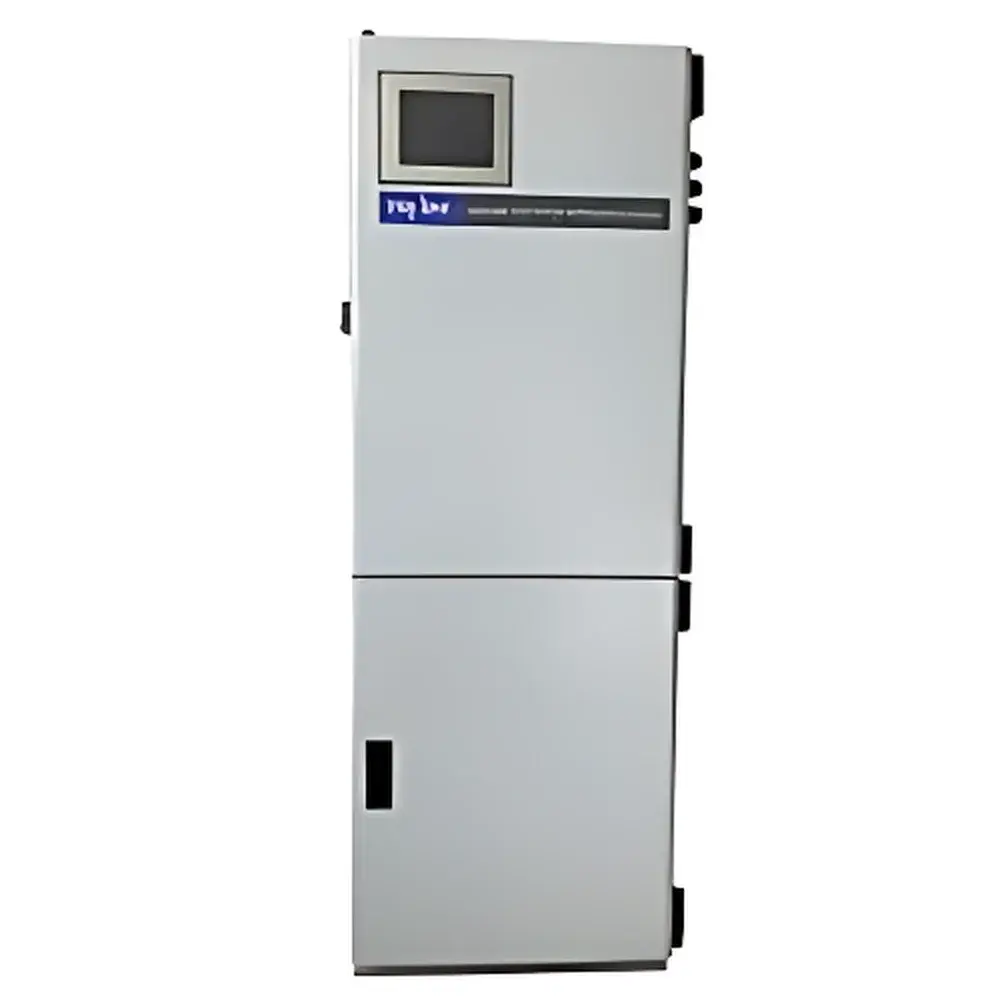
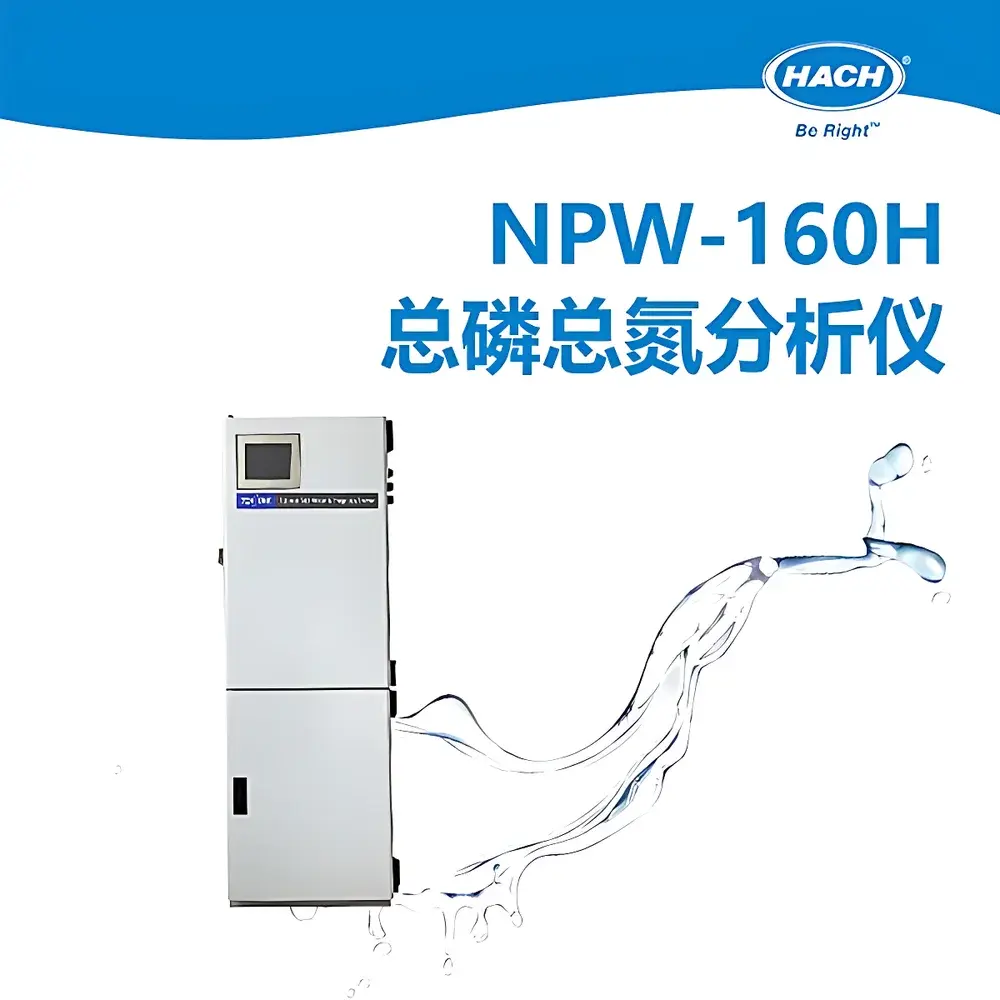
Hach NPW160H Total Phosphorus and Total Nitrogen Online Analyzer
| Brand | Hach |
|---|---|
| Origin | Imported |
| Manufacturer Type | Manufacturer |
| Model | NPW160H Total Phosphorus and Total Nitrogen Analyzer |
| Measurement Parameters | Total Nitrogen (TN), Total Phosphorus (TP) |
| Instrument Type | Online Analyzer |
| Measurement Principle | High-Temperature Alkaline Persulfate Digestion Followed by Spectrophotometric Detection (UV at 220 nm for TN |
| Measurement Range | TP: 0–0.5 mg/L to 0–20 mg/L |
| TN | 0–2 mg/L to 0–100 mg/L |
| Accuracy | ≤3% of reading |
| Detection Limit | ≤3% of full scale |
| Resolution | As per configured range |
| Repeatability | ≤3% |
| Cycle Time | Configurable from 1 hour to 24 hours per measurement |
| Sample Flow Rate | 1–3 L/min (sample volume ~35 mL per analysis) |
| Sample Inlet Temperature | 2–40 °C |
| Operating Ambient Temperature | 5–40 °C |
| Relative Humidity | ≤85% RH, non-condensing |
| Data Storage | Internal memory retains 1 year of data and logs |
| Dimensions (H×W×D) | 450 × 380 × 1280 mm (excluding drip tray) |
| Weight | ~76 kg (excluding reagents) |
| Communication Interface | RS-485 (Modbus RTU protocol) |
| Digestion Conditions | 120 °C, 30 min alkaline persulfate oxidation |
| Compliance | ASTM D5176 (TP), ASTM D4519 (TN), ISO 15681-1, HJ 636–2012 (China), GB 11893–1989 (China) |
Overview
The Hach NPW160H Total Phosphorus and Total Nitrogen Online Analyzer is an engineered solution for continuous, unattended monitoring of TN and TP in surface water, municipal wastewater effluents, and industrial discharge streams. It implements standardized high-temperature alkaline persulfate digestion—aligned with HJ 636–2012 (for TN) and GB 11893–1989 (for TP)—to quantitatively convert organic and inorganic nitrogenous and phosphorous compounds into nitrate and orthophosphate, respectively. Post-digestion, spectrophotometric detection is performed: UV absorbance at 220 nm for nitrate (with correction at 275 nm to minimize organic interference), and molybdenum blue complex formation followed by visible absorbance measurement at 700 nm for orthophosphate. This dual-wavelength, digestion-coupled methodology ensures metrological traceability to reference laboratory methods and delivers high reproducibility across variable matrix conditions.
Key Features
- Optimized reagent consumption: 40% reduction versus the NPW-160 platform, extending reagent replacement intervals and lowering operational waste volume.
- Dedicated dual-channel digestion module: Independently controlled heating zones prevent cross-interference between TN and TP reaction pathways during simultaneous or sequential analysis.
- Modular, space-efficient cabinet design: Integrated fluidic routing and compact footprint (450 × 380 × 1280 mm) simplify installation in constrained analytical shelters or on-site kiosks.
- Full-touch HMI interface: Intuitive graphical user interface remains fully functional with cabinet door closed—enabling safe, ergonomic operation without exposure to reagents or moving parts.
- Configurable measurement scheduling: Programmable cycle times from 1 to 24 hours allow alignment with regulatory reporting requirements or process control triggers.
- Robust environmental tolerance: Rated for ambient operation between 5–40 °C and ≤85% RH (non-condensing), supporting deployment in outdoor enclosures with minimal climate control.
Sample Compatibility & Compliance
The NPW160H accommodates raw, filtered, or clarified aqueous samples within a temperature range of 2–40 °C and flow rate of 1–3 L/min. Its digestion-based chemistry provides reliable performance in matrices with moderate turbidity, suspended solids (<50 mg/L), and background organic load—common in municipal influent/effluent and industrial outfalls. The analyzer conforms to internationally recognized method standards including ASTM D4519 (TN), ASTM D5176 (TP), ISO 15681-1 (phosphorus), and Chinese national standards HJ 636–2012 and GB 11893–1989. While not inherently 21 CFR Part 11 compliant, its audit-trail-capable data logging architecture—including timestamped event logs, calibration records, and error flags—supports GLP/GMP-aligned validation protocols when deployed with external secure data management systems.
Software & Data Management
Onboard firmware enables local configuration, real-time status monitoring, diagnostic alerts, and method parameter adjustment via the integrated touchscreen. All measurement results, system events, and maintenance logs are stored internally with time-stamped entries for ≥12 months. External data export is supported via USB 2.0 interface—compatible with standard FAT32-formatted drives—for long-term archival (up to 5 years of data). Communication with SCADA or centralized EMS platforms is achieved through RS-485 Modbus RTU protocol, delivering register-mapped TN/TP concentrations, instrument health indicators (e.g., digestion temperature stability, photometer zero drift, reagent level status), and fault codes. Optional Hach DataSuite™ integration enables remote diagnostics, predictive maintenance alerts, and automated report generation aligned with EPA NPDES or EU WFD reporting templates.
Applications
- Regulatory compliance monitoring at municipal wastewater treatment plant (WWTP) discharge points, including consent order-driven TN/TP tracking.
- Surface water quality surveillance networks—particularly in eutrophication-sensitive watersheds requiring early-warning detection of nutrient loading trends.
- Industrial pretreatment verification for facilities discharging to public sewers under local POTW ordinances.
- Process optimization in advanced tertiary treatment systems employing denitrification and phosphorus removal technologies.
- Long-term trend analysis in lake and reservoir management programs where seasonal nutrient dynamics inform mitigation strategies.
FAQ
What digestion temperature and duration does the NPW160H use?
The analyzer performs alkaline persulfate digestion at precisely controlled 120 °C for 30 minutes—matching the thermal profile mandated by HJ 636–2012 and GB 11893–1989.
Can TN and TP be measured independently or only simultaneously?
Both modes are supported: users may configure the instrument to measure TN only, TP only, or both parameters in alternating or concurrent cycles based on application requirements.
How is spectral interference corrected during TN measurement?
The UV photometer applies dual-wavelength correction (220 nm primary, 275 nm reference) to compensate for residual organic absorbance and ensure specificity for nitrate quantification.
What is the minimum sample volume required per analysis?
Each measurement consumes approximately 35 mL of sample, drawn at a regulated flow rate of 1–3 L/min.
Is the NPW160H suitable for high-salinity or seawater-influenced estuarine samples?
While not designed for undiluted seawater, it has demonstrated stable performance in brackish matrices up to 5,000 µS/cm conductivity when paired with optional filtration and pH buffering modules.
Related Products







