
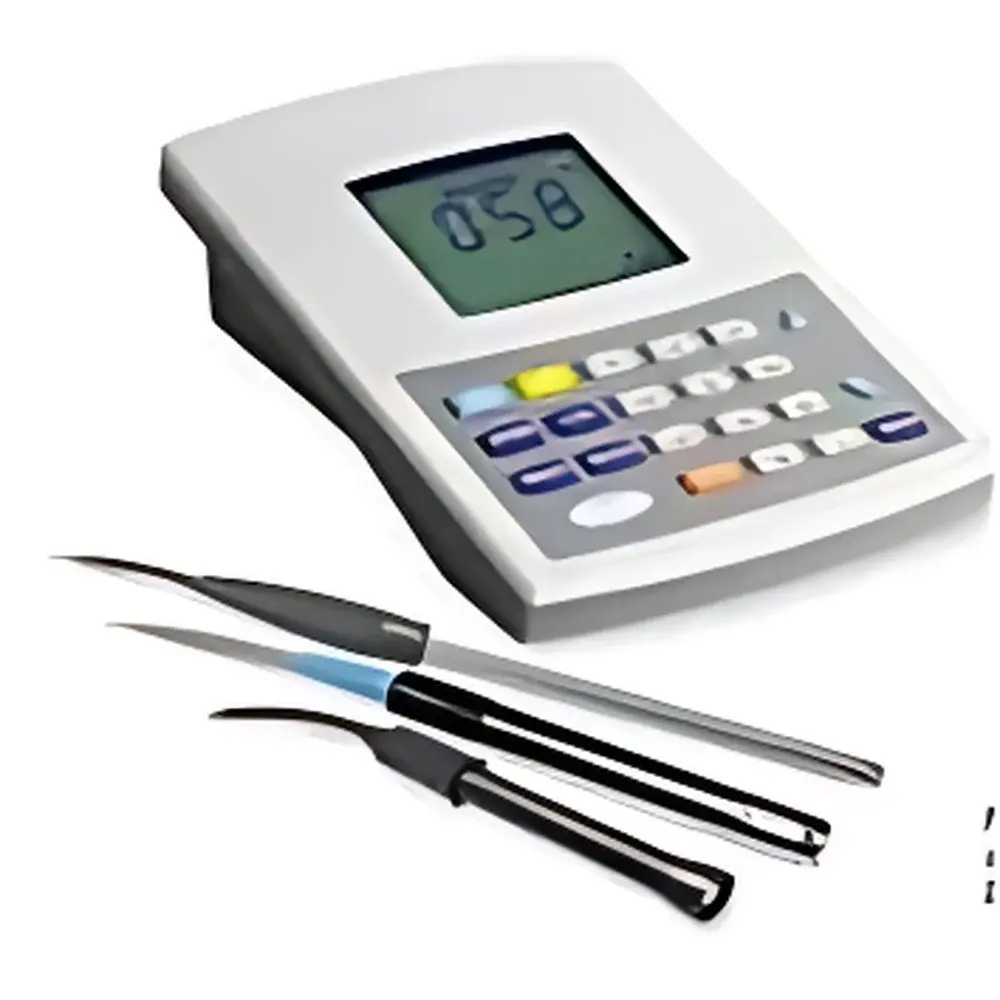
Hach H Series Portable Multi-Parameter Analyzers with Non-Glass ISFET pH Probes
| Brand | Hach |
|---|---|
| Model | H Series |
| Instrument Type | Portable |
| Parameter Types | pH, mV, Temperature, Conductivity, TDS, Salinity, ORP, Dissolved Oxygen (with optional probes) |
| Power Supply | 4 × AA batteries (up to 20 hours continuous operation, low-battery warning at 10 hours) |
| Display | Backlit LCD showing pH and temperature simultaneously |
| Ingress Protection | IP67 (portable models) / IP42 (benchtop models) |
| Data Storage | 999 readings (H160G/H170G only) |
| GLP Compliance | Yes (H160G/H170G: timestamped calibration logs, audit trail, password-protected settings) |
| Calibration | Up to 5-point for pH, conductivity, and ISE |
| Buffer Recognition | User-selectable (1.68, 4.01, 6.86, 7.00, 9.18, 10.01, 12.45) |
| Temperature Compensation | Automatic, manual, or off (parameter-dependent) |
| ISE Range | 0.0 ppm – 1999 ppt (auto-ranging) |
| ISE Resolution | 0.1 ppm / 0.1 ppt |
| Dimensions | 9 × 20 × 5 cm |
| Weight | 450 g (instrument only) |
| Warranty | 3 years |
| Connectivity | Bluetooth® (G-series models) |
| Probe Interface | Waterproof 8-pin ISFET connector (portable) / RJ-45 (benchtop) |
| Probe Compatibility | Interchangeable across platform (ISFET, glass, conductivity, DO, ORP, ISE) |
Overview
The Hach H Series Portable Multi-Parameter Analyzers represent a robust, field-deployable solution for electrochemical measurement in demanding industrial, environmental, academic, and food safety applications. Engineered around dual-sensor architecture—supporting both traditional glass pH electrodes and solid-state ISFET (Ion-Sensitive Field-Effect Transistor) technology—the H Series eliminates the fragility inherent in conventional glass electrodes without compromising metrological integrity. ISFET sensing relies on hydrogen-ion–selective surface layers deposited on silicon substrates; proton adsorption induces measurable gate voltage shifts linearly correlated to pH, enabling stable, drift-resistant response across wide temperature and mechanical stress gradients. Unlike glass electrodes requiring hydration and frequent recalibration, ISFET probes operate reliably after dry storage and tolerate repeated physical contact—including insertion into semi-solid matrices such as meat, cheese, and dough—making them ideal for QA/QC workflows where probe longevity and operational continuity are critical.
Key Features
- Dual-sensor compatibility: Seamless switching between ISFET and glass pH electrodes via standardized probe interfaces.
- True non-glass durability: Stainless-steel ISFET probes withstand impact, abrasion, and thermal shock—validated for multi-year service life in food processing, agriculture, and wastewater monitoring.
- IP67-rated ruggedness: Fully sealed housing enables submersion up to 1 m for 30 minutes; certified for use in wet, dusty, or corrosive environments (e.g., slaughterhouses, fermentation tanks, field sampling).
- GLP-compliant data governance: H160G and H170G models log calibration history (up to 10 sessions), enforce timestamped readings, support password-protected configuration, and retain full audit trails per FDA 21 CFR Part 11 requirements.
- Configurable logging: Interval-based data capture from 1–1999 seconds; auto-storage mode activates during active measurement sessions; stored records are recallable, exportable, and deletable via onboard interface.
- Bluetooth-enabled telemetry (G-series): Wireless transmission of real-time and historical data to SmartLogger II software or third-party LIMS platforms; supports remote firmware updates and instrument parameter synchronization.
Sample Compatibility & Compliance
The H Series accommodates diverse sample matrices through application-optimized probe variants. Standard ISFET probes serve general laboratory and environmental testing; micro-probes (TRIS-compatible) enable precise pH measurement in microvolumes (<5 mL), including cell culture media and microtiter wells. Penetration-type probes feature recessed sensor tips and reinforced stainless-steel shafts for direct insertion into muscle tissue (e.g., beef loin, poultry breast) and soft dairy products (e.g., mozzarella curd, cottage cheese). MNR tube probes extend to 150 mm for NMR-compatible vessels. Conductivity probes include four-electrode configurations with temperature compensation: standard epoxy-housed units for municipal water, low-ionic-strength (LIS) glass-bodied probes for ultrapure water validation, and high-salinity variants for estuarine or aquaculture applications. Dissolved oxygen sensors employ galvanic cell technology with user-replaceable membranes and electrolyte refills—calibrated per ASTM D888 and ISO 5814. All instruments comply with IEC 61000-4 electromagnetic immunity standards and meet CE, RoHS, and FCC regulatory mandates.
Software & Data Management
SmartLogger II software provides full lifecycle management for H Series instruments. It retrieves calibration metadata—including buffer IDs, slope/offset values, and date/time stamps—and generates GLP-compliant reports with electronic signatures. Data exports support CSV, PDF, and XML formats compatible with ELN systems and enterprise analytics platforms. Bluetooth-enabled G-series units permit over-the-air synchronization of instrument settings across lab-wide deployments. Audit trail functionality records all configuration changes, user logins, and data modifications—enabling traceability required under ISO/IEC 17025, USP , and EU Annex 11. Firmware updates preserve calibration coefficients and user-defined parameters, ensuring zero revalidation downtime.
Applications
- Food & Beverage QA: Rapid pH profiling of raw meat, fermented dairy, beverages, and bakery products using penetration and micro-probes—validated against AOAC 973.41 and USDA FSIS guidelines.
- Environmental Monitoring: In-situ pH, conductivity, and ORP measurements in rivers, effluents, and leachate—aligned with EPA Method 150.1 and ISO 10523.
- Academic Research: Teaching labs leverage ISFET durability for student handling; micro-probes support bioreactor and microfluidic experiments.
- Pharmaceutical Water Systems: LIS conductivity probes verify PW, WFI, and purified steam condensate per USP and EU Ph. Eur. 2.2.38.
- Agricultural Soil & Hydroponics: Field-portable pH and EC mapping with ruggedized probes resistant to organic fouling and particulate abrasion.
FAQ
Can ISFET probes be used interchangeably with glass electrodes on the same H Series instrument?
Yes—both probe types connect via the same interface and are auto-recognized by the firmware. Calibration protocols adjust dynamically based on sensor type.
Is GLP compliance limited to specific models?
GLP features—including timestamped calibration logs, password protection, and audit trails—are exclusive to H160G and H170G portable models.
What is the expected service life of an ISFET probe under routine use?
Typical operational lifespan exceeds 36 months in industrial QA environments when maintained per Hach Technical Bulletin TB-012 (dry storage, periodic cleaning with mild detergent and soft brush).
Do H Series analyzers support dissolved oxygen measurement out of the box?
Dissolved oxygen capability requires optional galvanic DO probes (e.g., HQD-DO-01); the base instrument measures pH, mV, temperature, conductivity, TDS, salinity, and ORP natively.
How does temperature compensation differ between automatic and manual modes?
Automatic compensation uses integrated NTC thermistors in ISFET and conductivity probes; manual mode accepts user-entered reference temperatures for legacy or non-compensated electrode configurations.
Related Products




