
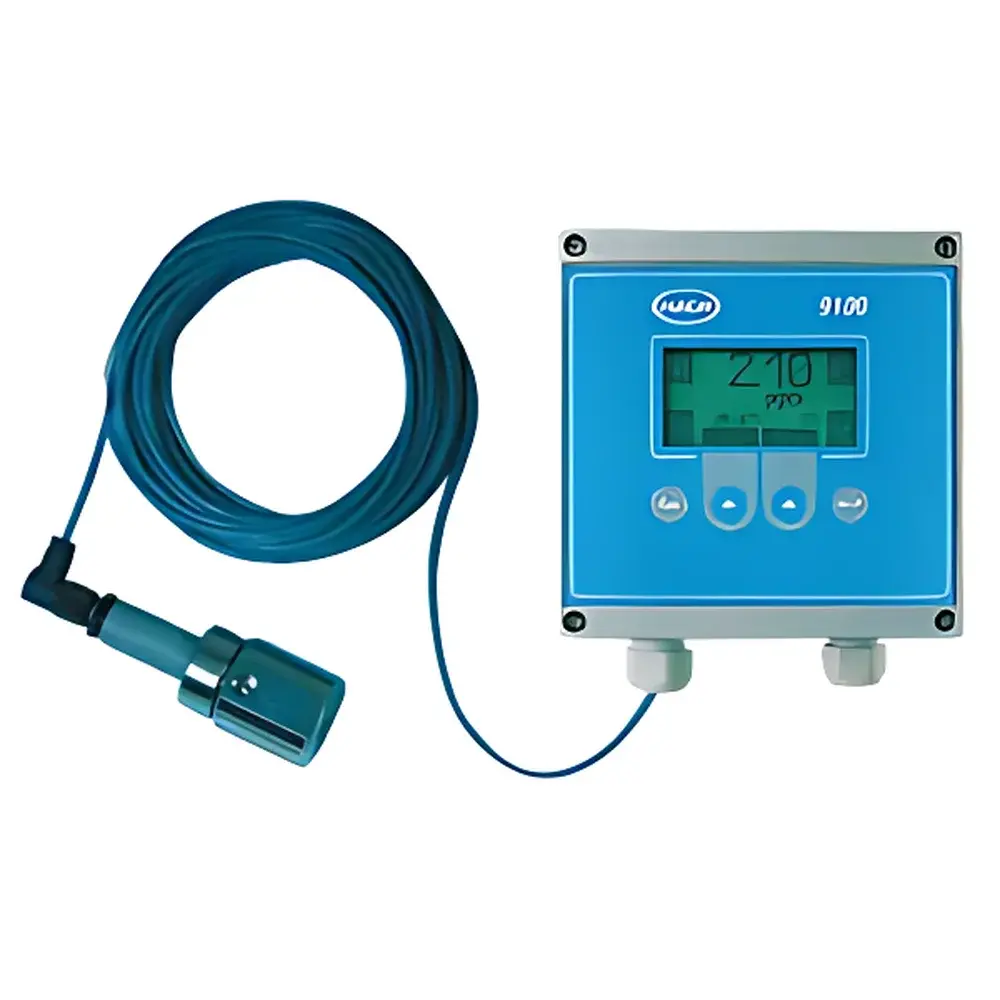
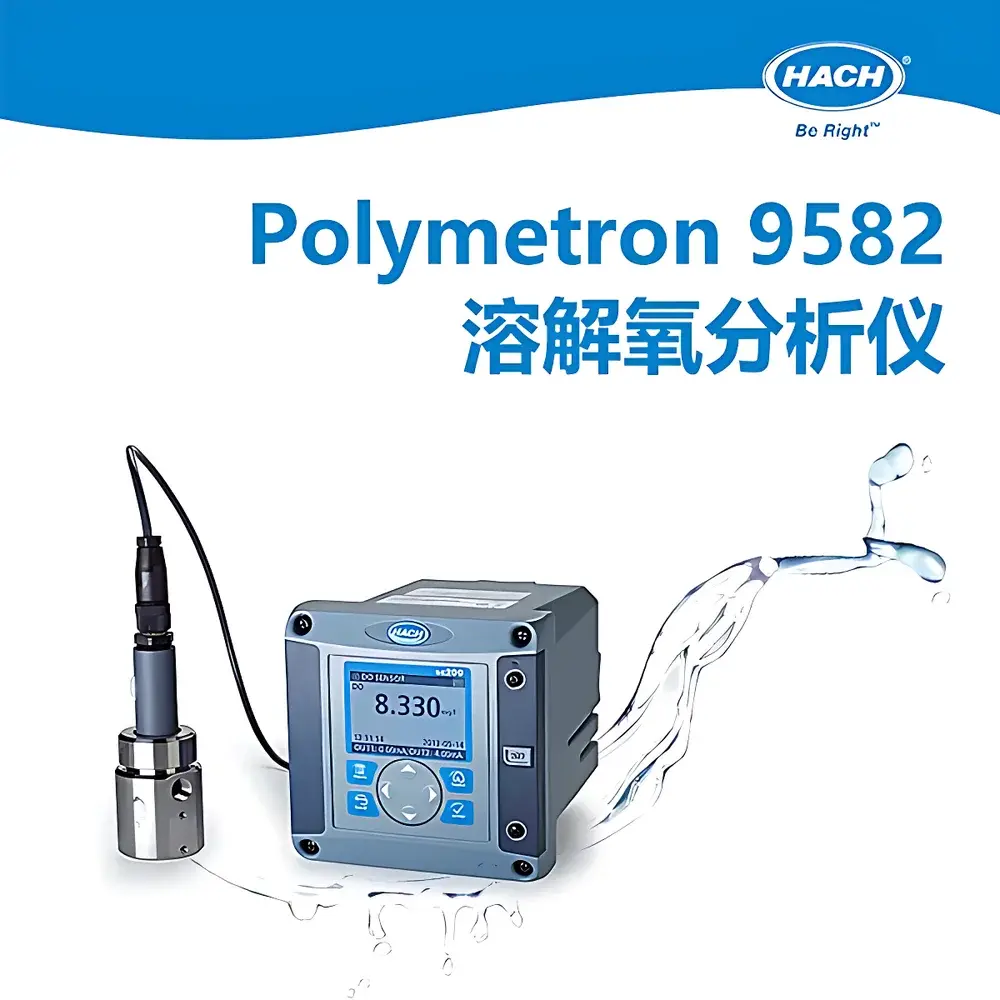
HACH Polymetron 9582 Online Dissolved Oxygen Analyzer
| Brand | HACH |
|---|---|
| Origin | USA |
| Manufacturer | HACH Company |
| Product Type | Imported |
| Model | 9582 |
| Instrument Category | Online Analyzer |
| Measurement Principle | Electrochemical Galvanic Cell Probe |
| Measurement Range | 0–2000 µg/L (ppb) O₂ |
| Accuracy | Not specified by manufacturer |
| Repeatability | ±5% of reading or ±0.5 µg/L O₂ (whichever is greater) |
| Detection Limit | <1 µg/L O₂ |
| Response Time (T₉₀) | ≤90 s |
| Calibration | Two-point (zero + slope) |
| Maintenance Interval | Up to 6 months |
| Analog Outputs | Dual 4–20 mA (O₂ concentration and temperature), max. load 500 Ω |
| Operating Temperature | 0–45 °C |
| Weight | 2.3 kg |
| Relay Outputs | Four programmable relays for high/low alarms and system fault indication |
| Consumables Lifetime | Up to 2 years under typical use |
Overview
The HACH Polymetron 9582 Online Dissolved Oxygen Analyzer is an industrial-grade, galvanic cell-based sensor system engineered for continuous, high-sensitivity measurement of dissolved oxygen (DO) in ultra-pure water streams—particularly where sub-ppb level detection is critical. Designed specifically for demanding applications such as boiler feedwater monitoring in power generation, ultrapure water (UPW) loops in semiconductor fabrication, and pharmaceutical purified water systems, the 9582 leverages a self-polarizing galvanic probe that requires no external bias voltage and delivers stable, drift-free operation over extended intervals. Its measurement principle relies on the electrochemical reduction of molecular oxygen at a noble metal cathode within a sealed, electrolyte-filled cell, generating a current proportional to the partial pressure of O₂ diffusing through a selective gas-permeable membrane. This architecture ensures minimal zero drift, low maintenance dependency, and intrinsic suitability for low-conductivity, low-oxygen environments where traditional polarographic sensors may exhibit instability or slow response.
Key Features
- Premounted, field-replaceable membrane cartridge—membrane exchange completed in under 5 seconds without tools or recalibration.
- Detection limit below 1 µg/L O₂, enabling reliable quantification in deaerated and steam-cycle condensate applications.
- Two-point calibration protocol supporting both air-saturated (ppm-level) and nitrogen-purged (ppb-level) reference points; full transition from ambient-air calibration to process-level ppb verification achieved in less than 15 minutes.
- Dual isolated 4–20 mA analog outputs: one dedicated to DO concentration, the other to integrated Pt1000 temperature measurement—with automatic status flagging (e.g., sensor fault, calibration mode, or signal saturation).
- Four configurable relay outputs compliant with IEC 61000-4 electromagnetic immunity standards, programmable for high/low concentration alarms, temperature deviation alerts, and system diagnostic faults.
- Robust IP65-rated enclosure with stainless steel front panel, rated for continuous operation between 0 °C and 45 °C ambient temperature.
- Consumables—including membrane, electrolyte gel, and cathode—engineered for ≥24 months of service life under typical UPW monitoring conditions, reducing total cost of ownership and operational downtime.
Sample Compatibility & Compliance
The Polymetron 9582 is validated for use in low-conductivity aqueous matrices (typically <1 µS/cm), including demineralized water, condensate return, and ultrapure water per SEMI F63 and ASTM D5127 specifications. It meets applicable requirements for installation in safety-integrated systems per IEC 61508 SIL 2 (when configured with redundant relays and external logic solvers). While not intrinsically safe, it is compatible with hazardous area enclosures (e.g., NEMA 4X, ATEX Zone 2/Class I Div 2 when installed per local electrical codes). The analyzer supports traceable calibration documentation aligned with ISO/IEC 17025 laboratory practices and includes audit-trail-capable event logging suitable for FDA 21 CFR Part 11–regulated environments when paired with HACH’s SCADA-integrated data historian.
Software & Data Management
The 9582 operates autonomously via embedded firmware with non-volatile memory for up to 30 days of 1-minute interval data storage. Configuration, diagnostics, and calibration history are accessible via local LCD interface or remotely through Modbus RTU (RS-485) or HART 7 protocol. When integrated into HACH’s PlantWeb® digital ecosystem or third-party DCS/SCADA platforms, real-time DO trends, relay state logs, and predictive maintenance flags (e.g., membrane aging index, electrolyte depletion warning) are transmitted with timestamped metadata. Firmware updates are performed via secure USB or Modbus register write, preserving configuration integrity and supporting version-controlled change management per GMP Annex 11 guidelines.
Applications
- Power plant boiler feedwater and turbine condensate monitoring to prevent oxidative corrosion of carbon steel and copper alloys.
- Real-time DO control in semiconductor fab UPW distribution networks, ensuring compliance with SEMI C11 and JCIA-14 purity thresholds.
- Pharmaceutical purified water (PW) and water-for-injection (WFI) loop surveillance per USP and EU GMP Annex 1.
- Monitoring of deaerator outlet water and closed-loop cooling systems in petrochemical and refinery utilities.
- Research-grade low-oxygen incubation water circuits requiring long-term stability and minimal calibration intervention.
FAQ
What type of electrochemical cell does the 9582 employ?
It uses a galvanic (self-powered) cell with gold cathode and lead anode, eliminating the need for external polarization voltage and enhancing long-term zero stability.
Can the 9582 be used in high-pressure sample lines?
Yes—when installed with an optional flow-through chamber rated to 10 bar (145 psi), provided sample temperature remains within 0–45 °C and particulate content is filtered to <5 µm.
Is temperature compensation automatic?
Yes—the integrated Pt1000 RTD provides real-time thermal correction per the ISO 5814 oxygen solubility model, with user-selectable compensation algorithms for pure water or saline matrices.
Does the analyzer support remote calibration verification?
It supports automated span-check routines using built-in nitrogen purge solenoid control (when externally plumbed), with results logged and exportable via Modbus.
How is sensor health monitored between calibrations?
The firmware continuously tracks cathode potential decay rate, membrane permeability index, and baseline current noise—triggering maintenance alerts before performance degradation impacts measurement validity.
Related Products







