
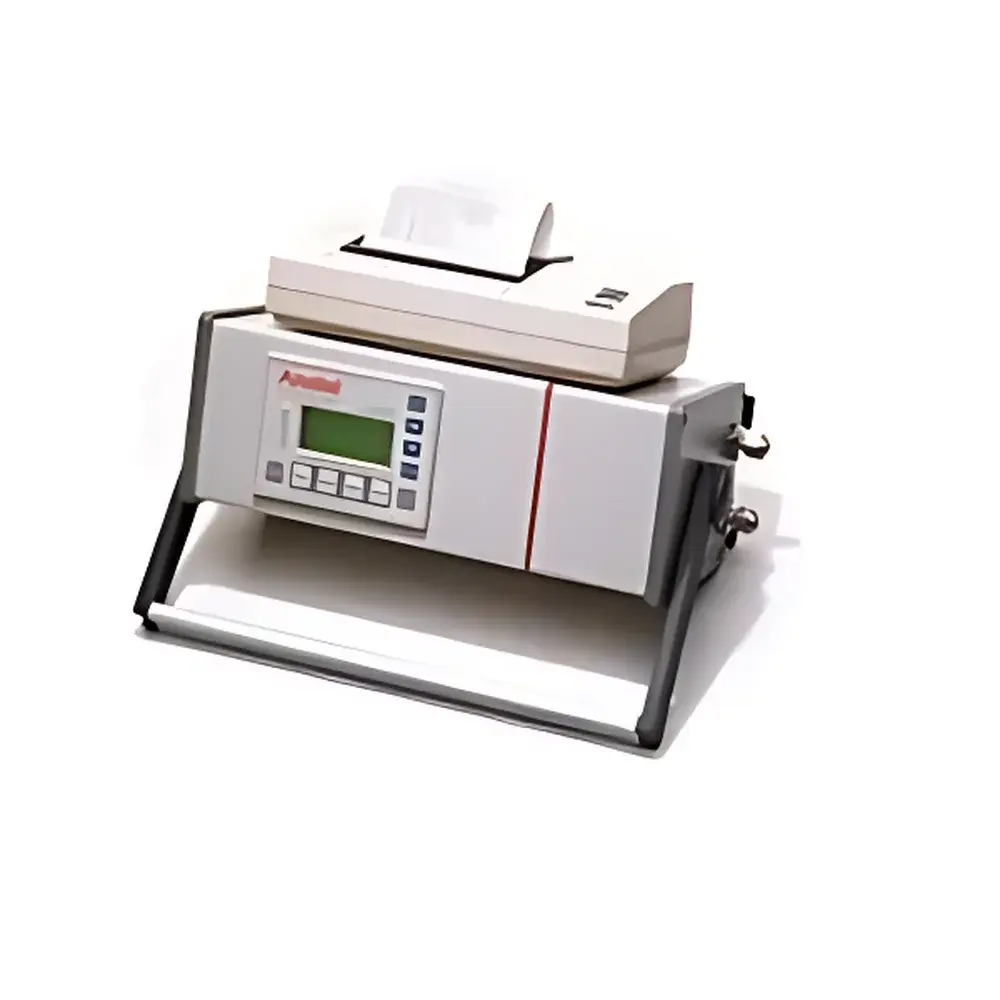
HACH Anatel A-1000 Total Organic Carbon Analyzer
| Brand | HACH |
|---|---|
| Origin | Imported |
| Manufacturer Type | Manufacturer |
| Instrument Type | Online TOC Analyzer |
| Detection Principle | Direct Conductivity Measurement |
| Oxidation Method | UV Photolysis (185/254 nm) |
| Measurement Range | 0.05–1999 ppb C |
| Accuracy | ±0.5 ppb or ±5% of reading, whichever is greater |
| Detection Limit | 0.05 ppb C |
| Repeatability | ±0.05 ppb (for TOC < 5 ppb) |
| Conductivity Range for Sample Inlet | 0.05–5 µS/cm (Auto Mode), 0.05–100 µS/cm (Clean Mode) |
| Maximum Inlet Pressure | < 100 psig (690 kPa) |
| Display Resolution | 0.01 ppb (0.00–19.99 ppb), 0.1 ppb (20.0–199.9 ppb), 1 ppb (200–1999 ppb) |
| Sensor Options | S10, S20, or S20P |
| Communication | RS-485 (Modbus RTU) |
| Data Output | Local print support, real-time analog output (4–20 mA), digital interface |
Overview
The HACH Anatel A-1000 Total Organic Carbon (TOC) Analyzer is an online, real-time analytical instrument engineered for continuous monitoring of ultra-pure water (UPW) systems in semiconductor fabrication, pharmaceutical manufacturing, and biotechnology facilities. It employs direct conductivity detection following ultraviolet (UV) photolysis oxidation—utilizing dual-wavelength UV lamps (185 nm and 254 nm) to mineralize non-purgeable organic carbon into CO₂, which is then quantified via high-sensitivity conductivity measurement in deionized water. This method eliminates interference from inorganic carbon species and avoids reagent consumption or calibration drift associated with persulfate-based oxidation. The A-1000 delivers sub-part-per-trillion-level sensitivity with a proven detection limit of 0.05 ppb C, making it compliant with stringent industry standards including USP , EP 2.2.44, JP 2.59, and ASTM D5904 for pharmaceutical water quality assurance.
Key Features
- Real-time, non-destructive TOC quantification with automatic dual-mode operation: Auto Measurement Mode (optimized for stable UPW streams) and Clean Mode (tolerant of higher conductivity feedwater up to 100 µS/cm)
- Dual-range UV oxidation reactor ensuring complete organic mineralization across the full 0.05–1999 ppb measurement span
- Integrated C80 controller supporting configuration, diagnostics, and multi-sensor aggregation—capable of managing up to eight Anatel sensors on a single network
- Three-tier display resolution logic: 0.01 ppb (0.00–19.99 ppb), 0.1 ppb (20.0–199.9 ppb), and 1 ppb (200–1999 ppb) for optimal readability across dynamic concentration ranges
- Robust flow cell architecture with low-volume detection chamber (< 200 µL), minimizing sample residence time and enhancing response speed to transient contamination events
- Comprehensive alarm and event logging with timestamped audit trail—supports GLP/GMP compliance through configurable data retention and export protocols
Sample Compatibility & Compliance
The A-1000 is validated for use with Type I and Type II pharmaceutical water (PW, WFI, and UPW per USP/EP/JP), as well as rinse water in clean-in-place (CIP) validation studies. Its inlet conductivity tolerance (0.05–5 µS/cm in Auto Mode; extended to 100 µS/cm in Clean Mode) enables deployment across pre-treatment loops, point-of-use locations, and recirculating distribution systems. All wetted materials—including PFA tubing, quartz oxidation chamber, and platinum-coated electrodes—meet USP Class VI and FDA 21 CFR Part 11 requirements for material compatibility and data integrity. System validation documentation includes IQ/OQ/PQ templates aligned with Annex 15 and GAMP 5 guidelines.
Software & Data Management
The embedded firmware supports Modbus RTU over RS-485 for integration into SCADA, DCS, or MES platforms. Analog 4–20 mA outputs provide legacy system compatibility, while optional local thermal printing enables immediate hard-copy verification during qualification runs. Data logging includes raw conductivity values, temperature-compensated TOC results, lamp intensity metrics, and diagnostic flags (e.g., flow fault, pressure deviation, lamp aging). Audit trails are immutable and time-stamped with NTP synchronization capability. Optional Anatel Connect software enables remote configuration, trend analysis, and automated report generation compliant with 21 CFR Part 11 electronic record requirements.
Applications
- Continuous TOC surveillance in semiconductor fab UPW loops where sub-ppb excursions directly impact wafer yield
- Final water-for-injection (WFI) monitoring in sterile pharmaceutical production per EU GMP Annex 1 and FDA guidance
- Validation of steam condensate purity in autoclave and SIP systems
- Leak detection in heat exchangers and storage tanks via baseline deviation analytics
- Supporting ISO 14644-1 cleanroom environmental monitoring programs through integrated data correlation
FAQ
What is the recommended installation environment to ensure long-term sensor stability?
Mount the analyzer in a vibration-isolated location with ambient temperature control (15–30 °C) and minimal electromagnetic interference—vibration mitigation reduces mechanical stress on the conductivity cell and prevents micro-leakage in the sealed detection chamber.
Can the A-1000 be used for wastewater or process streams with high ionic strength?
No—it is designed exclusively for low-conductivity water matrices. For high-salinity or wastewater applications, offline combustion-based TOC analyzers (e.g., Sievers M9) are recommended.
How frequently does the UV lamp require replacement?
Lamp lifetime is rated at ≥12,000 hours under continuous operation; the system monitors lamp output intensity and triggers maintenance alerts when degradation exceeds 15% of nominal irradiance.
Is the A-1000 compliant with FDA 21 CFR Part 11 for electronic records?
Yes—when deployed with Anatel Connect software and configured with user access controls, electronic signatures, and audit trail archiving, the system meets Part 11 requirements for electronic records and signatures in regulated environments.







