
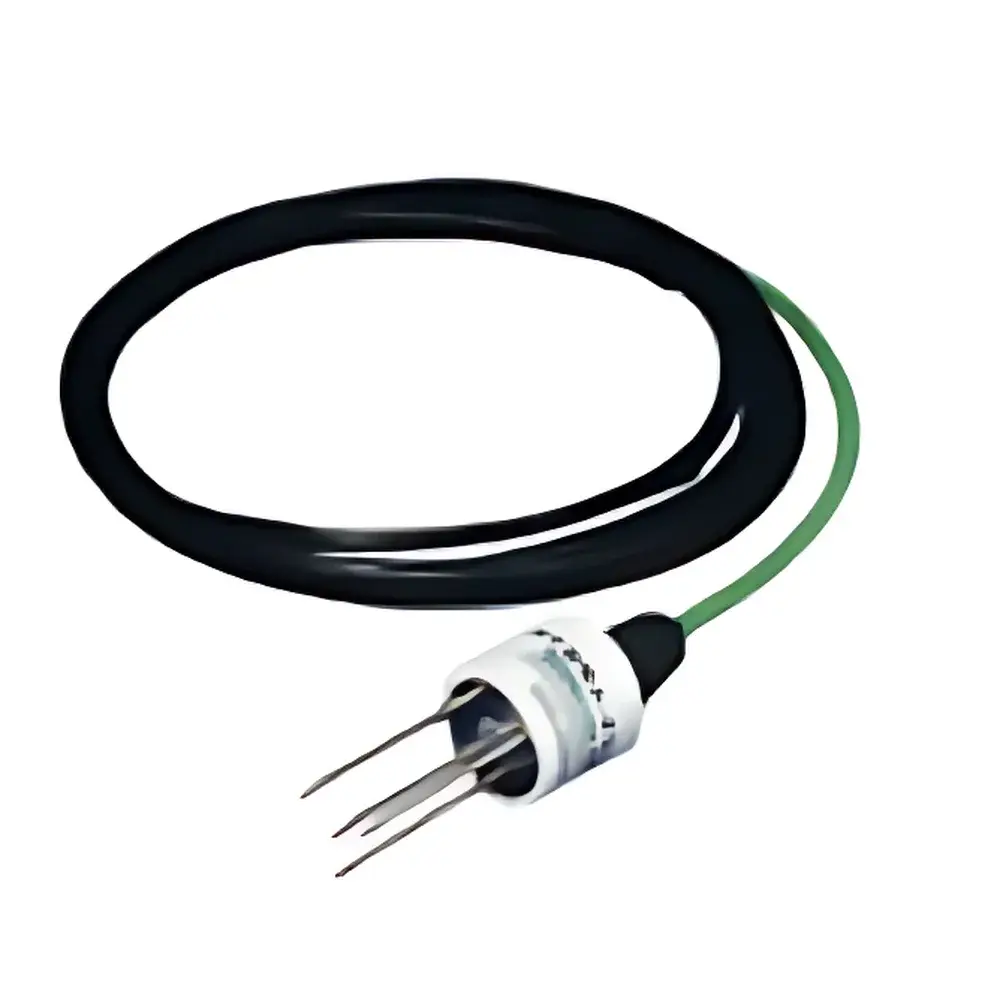
HACH Hydra Probe II Soil Moisture, Temperature & EC Sensor
| Brand | ADCON |
|---|---|
| Model | Hydra Probe II |
| Measurement Parameters | Volumetric Water Content (VWC), Soil Temperature, Electrical Conductivity (EC) |
| Dielectric Constant Range | 1–65 (±1.5% or ±0.2, whichever is greater) |
| VWC Accuracy | ±0.03 m³/m³ (typical mineral soils) |
| EC Range | 0–20 dS/m |
| EC Accuracy | ±2% or ±0.002 dS/m (whichever is greater) |
| Temperature Range | −10°C to +65°C |
| Temp Accuracy | ±0.6°C |
| Probe Dimensions | Ø3.0 cm × 5.7 cm |
| Encapsulated Body | Ø4.2 cm × 12.4 cm |
| Weight | 200 g (probe only) |
| Output | SDI-12 digital interface |
| Power Supply | 6–30 VDC, typical current draw ≤20 mA |
| IP Rating | IP68 (continuous submersion rated) |
| Calibration | Factory-calibrated |
Overview
The HACH Hydra Probe II is a rigorously engineered multi-parameter soil sensor designed for long-term, high-fidelity monitoring of volumetric water content (VWC), soil temperature, and bulk electrical conductivity (EC) in field and laboratory environments. Unlike conventional time-domain reflectometry (TDR) or capacitance-only sensors, the Hydra Probe II employs a dual-frequency dielectric and conductive measurement principle—simultaneously resolving complex permittivity (dielectric constant, εr) and bulk electrical conductivity via high-frequency AC impedance analysis. This dual-parameter approach decouples the influence of soluble salts on dielectric response, enabling robust VWC estimation across variable salinity conditions without empirical correction factors. The probe’s compact cylindrical geometry (3.0 cm diameter × 5.7 cm active length) features a precisely defined sensing volume optimized for shallow-root-zone profiling—particularly effective within the top 10 cm of soil where rapid moisture dynamics occur. Its fully potted, stainless-steel-reinforced housing achieves IP68 ingress protection and withstands continuous immersion, freeze-thaw cycling, and mechanical stress from tillage or animal traffic.
Key Features
- Dual-sensing architecture: Simultaneous high-frequency dielectric constant (εr = 1–65) and bulk EC (0–20 dS/m) acquisition eliminates salinity-induced VWC bias
- Factory-calibrated, zero-maintenance operation: No field recalibration required across standard mineral soils; traceable to NIST-traceable reference standards
- SDI-12 digital interface: Native protocol compliance ensures plug-and-play integration with Campbell Scientific, Onset HOBO, Decagon (now METER), and other SDI-12–compatible data loggers
- Ruggedized encapsulation: Epoxy-potted electronics and corrosion-resistant housing rated for permanent burial and full submersion (IP68)
- Low-power design: Operates continuously at 6–30 VDC with peak current draw ≤20 mA—ideal for solar-powered remote stations
- Thermal stability: Integrated precision thermistor (±0.6°C accuracy) co-located with dielectric/EC electrodes for spatially consistent thermal compensation
Sample Compatibility & Compliance
The Hydra Probe II is validated for use in mineral soils (sand, loam, clay), organic-rich substrates (peat, compost), and engineered growing media. It is unsuitable for saturated rock fractures or highly conductive brines (>25 dS/m). Its measurement methodology aligns with ASTM D5891 (Standard Test Method for Determining Water Content of Soils by Time Domain Reflectometry) and ISO 11272:2017 (Soil quality — Determination of dry matter and water content). While not certified for regulated pharmaceutical or food safety applications, its SDI-12 output structure supports audit-ready data logging under GLP-compliant systems when paired with compliant dataloggers featuring timestamped, non-erasable memory and user-access logs.
Software & Data Management
Data output follows the SDI-12 v1.3 specification: asynchronous ASCII commands return calibrated values as discrete numeric strings (e.g., “+0.245” for VWC in m³/m³, “+22.4” for temperature in °C, “+1.87” for EC in dS/m). No proprietary software is required; raw outputs integrate natively into Python (via pySerial), R (sdilogger package), MATLAB, or commercial platforms including LoggerNet (Campbell), HOBOware Pro (Onset), and ZENTRA Cloud (METER). All measurements include embedded unit identifiers and error flags per SDI-12 standard—enabling automated QA/QC filtering. For long-term deployments, the probe supports sleep-mode command sequences to minimize power consumption between sampling intervals.
Applications
- Irrigation scheduling and deficit irrigation optimization in agronomic research and precision agriculture
- Soil hydrological modeling validation (e.g., HYDRUS-1D, SWAP) requiring concurrent VWC–EC–T time series
- Salinity monitoring in coastal farmland, reclaimed soils, and greenhouse substrates
- Ecohydrological studies of evapotranspiration partitioning and root-zone water flux
- Long-term environmental observatories (LTER, NEON) requiring low-maintenance, multi-decade sensor stability
- Calibration reference for proximal sensing (e.g., cosmic-ray neutron probes, UAV-based thermal-IR)
FAQ
Does the Hydra Probe II require soil-specific calibration?
No. It is factory-calibrated using a multi-soil matrix (sand, silt loam, clay loam) and applies a physics-based dielectric mixing model (e.g., Topp equation variant with EC correction). Site-specific calibration is unnecessary for standard agricultural and ecological soils.
Can it be installed vertically or horizontally?
Yes. Orientation does not affect measurement integrity due to symmetrical electrode geometry and isotropic sensing volume. However, vertical installation is recommended for profile studies; horizontal placement is suitable for layered monitoring or shallow-root-zone focus.
Is frost heave damaging to the probe?
No. The encapsulated body (Ø4.2 cm × 12.4 cm) and flexible cable are engineered to accommodate soil expansion during freezing. Field trials confirm operational continuity after >50 freeze-thaw cycles in silt loam.
What is the maximum cable length for reliable SDI-12 communication?
Up to 200 meters with 22 AWG twisted-pair shielded cable and proper termination; signal integrity degrades beyond this without repeaters due to capacitive loading.
How often should the probe be cleaned or serviced?
None required under normal deployment. The epoxy encapsulation prevents biofilm accumulation or electrolyte leakage. If exposed to heavy clay or manure slurry, gentle rinsing with deionized water prior to storage is sufficient.
Related Products







