
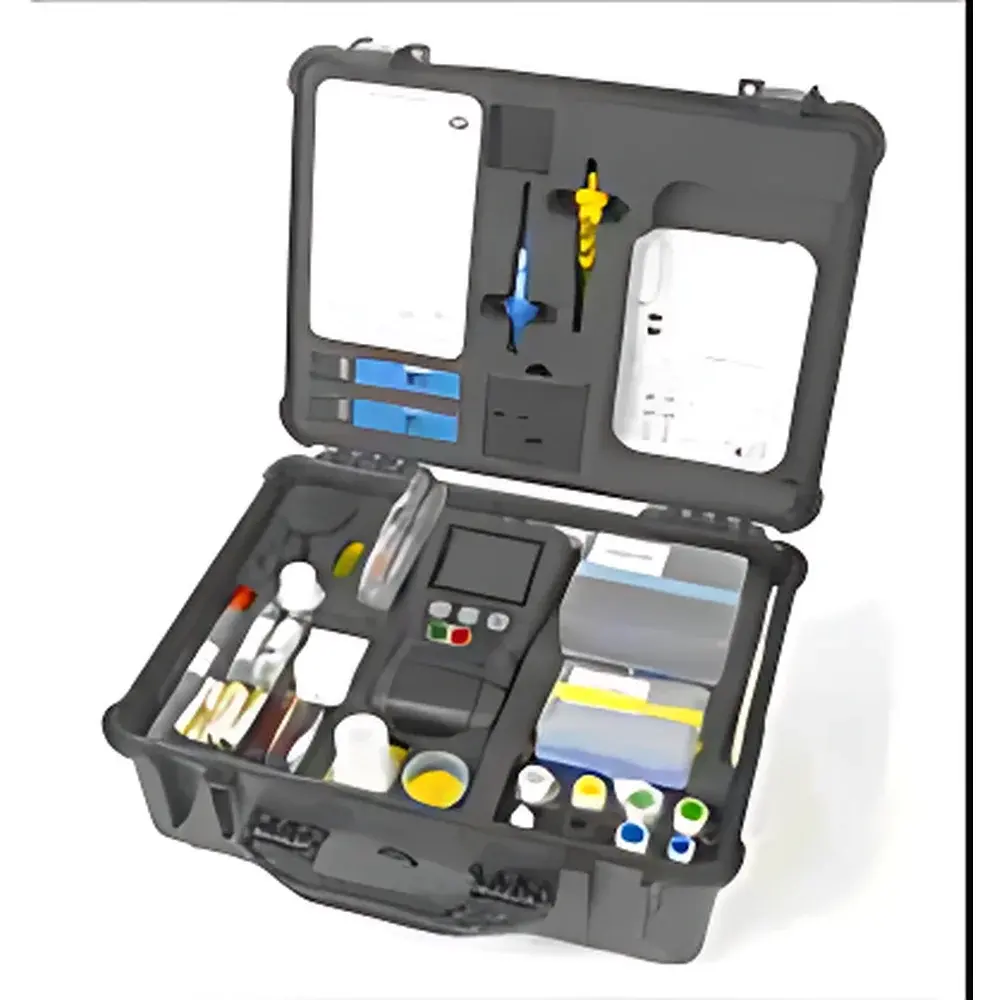
HACH Eclox Portable Water Toxicity Analyzer
| Brand | HACH |
|---|---|
| Origin | USA |
| Manufacturer Type | Manufacturer |
| Origin Category | Imported |
| Model | Eclox |
| Instrument Type | Portable |
| Biological Indicator | *Aliivibrio fischeri* (freeze-dried, ISO 11348-compliant) |
| Operating Temperature Range | −20 °C to +55 °C |
| IP Rating | IP67 |
| Weight | 1.4 kg (instrument only, with batteries) |
| Dimensions | 230 × 77 × 125 mm (instrument) |
| Power Supply | 4 × AA alkaline batteries (≥250 tests per set) |
| Display | Backlit graphical LCD |
| Data Storage | 32 KB non-volatile memory |
| Interface | RS232 serial output |
| Measurement Time | Default 15 s (configurable: 6–20 s) |
| Toxicity Screening Range | 0–100% inhibition (linear response: 10–90%) |
| Screening Assay Duration | 5, 15, or 30 min |
| Certification | CE Marked |
| Bacterial Reagent Storage | −18 °C (12 months) |
| Reagent Shelf Life | Chemical luminescence reagents — 24 months at room temperature |
| Additional Onboard Parameters | Residual chlorine, total chlorine, arsenic (colorimetric), pH, conductivity (TDS), platinum-cobalt color, organophosphate nerve agents, carbamate insecticides |
Overview
The HACH Eclox Portable Water Toxicity Analyzer is an engineered field-deployable instrument designed for rapid, on-site assessment of acute aquatic toxicity using dual independent bioassay principles: bioluminescent bacterial inhibition (LBT) and chemical luminescence-based toxicity screening (CT). Its core measurement principle relies on quantifying the suppression of light emission from metabolically active *Aliivibrio fischeri* (formerly *Vibrio fischeri*) under toxicant exposure — a method standardized under ISO 11348-3:2022. Complementing this, the CT module employs a chemiluminescent reaction system sensitive to redox-active organic contaminants, offering orthogonal detection capability particularly advantageous in turbid, colored, or highly oxidizing matrices where bacterial viability may be compromised. The instrument integrates both assays into a single ruggedized platform without cross-contamination risk, enabling method selection based on sample matrix, regulatory context, or operational constraints — such as emergency response scenarios following natural disasters or industrial spills.
Key Features
- Dual-method architecture supporting both ISO 11348-compliant bioluminescence toxicity testing and chemiluminescence-based screening in one handheld unit
- Pre-formulated, lyophilized *Aliivibrio fischeri* (NRRL B-11777 strain) with documented traceability and performance validation per ISO 11348-1 and -3
- Room-temperature-stable chemiluminescent reagents (24-month shelf life), eliminating cold-chain dependency during transport and storage
- IP67-rated enclosure ensuring operational reliability in rain, dust, high humidity, or temporary submersion (up to 1 m for 30 min)
- Integrated multi-parameter water quality analysis: residual/total chlorine, arsenic (AsIII/AsV), pH, conductivity (converted to TDS), platinum-cobalt color, and qualitative detection of organophosphate nerve agents and carbamate insecticides
- Graphical LCD with backlight for low-light field conditions and intuitive menu navigation
- Onboard data logging (32 KB) with time/date stamping, assay method tagging, and inhibition percentage calculation
- RS232 interface compatible with HACH’s proprietary data management software for GLP-compliant export, audit trail generation, and report formatting
Sample Compatibility & Compliance
The Eclox analyzer accepts raw, filtered, or centrifuged aqueous samples including drinking water, surface water, wastewater effluents, leachates, and emergency response samples. It is validated for use with unfiltered samples up to 50 NTU turbidity in CT mode and ≤10 NTU in LBT mode. Sample volume requirement is 10 mL per assay. The bioluminescence module conforms strictly to ISO 11348-3:2022 for marine and freshwater toxicity assessment. The instrument carries CE marking per Directive 2014/30/EU (EMC) and 2014/35/EU (LVD), and its firmware supports configurable user authentication and electronic signature functionality aligned with FDA 21 CFR Part 11 requirements when used in regulated environments. All reagent lots are supplied with CoA documentation referencing ISO/IEC 17025-accredited stability and potency testing.
Software & Data Management
HACH provides dedicated desktop software for secure data retrieval, visualization, and reporting. The application supports batch export to CSV and PDF formats, automatic calibration verification logs, and inhibition curve fitting (logistic regression) for EC50 estimation where applicable. Audit trails record all user actions — including method selection, parameter edits, and result deletions — with timestamps and operator IDs. Data files include embedded metadata: instrument serial number, firmware version, reagent lot codes, ambient temperature at time of test, and assay duration. The software is validated for use in laboratories operating under ISO/IEC 17025, EPA Method 1604, and WHO Guidelines for Drinking-water Quality (4th ed.) Annex 3 frameworks.
Applications
- Rapid triage during environmental emergencies (e.g., chemical spills, post-disaster water safety assessments)
- Regulatory compliance monitoring for wastewater discharge permits requiring whole-effluent toxicity (WET) screening
- Drinking water utility source protection and distribution system integrity verification
- Pharmaceutical and chemical manufacturing facility effluent pre-discharge screening
- Field validation of treatment efficacy in decentralized water systems
- Academic and governmental research on mixture toxicity, emerging contaminants, and bioavailability modulation
FAQ
Does the Eclox require laboratory-grade calibration standards?
No — it operates via relative inhibition quantification against a concurrent negative control (dilution water) and does not require external calibration curves for screening applications.
Can the same sample be tested sequentially using both LBT and CT methods?
Yes, provided sufficient volume is available and the sample remains stable over the combined assay timeframe (typically <30 min between tests).
Is the freeze-dried bacteria certified for ISO 11348 compliance?
Yes — each lot is tested for luminescence intensity, response reproducibility, and sensitivity to reference toxicants (e.g., 3,5-dichlorophenol), with full documentation traceable to NIST SRM 2710a.
How is data integrity ensured during field use?
All measurements are timestamped, tagged with instrument ID and reagent lot, and stored in non-volatile memory with write-protection logic to prevent accidental overwrites.
What maintenance is required between deployments?
Routine cleaning of the optical cell with deionized water and lint-free wipes; no scheduled recalibration is needed unless physical damage or performance deviation is observed.
Related Products







