
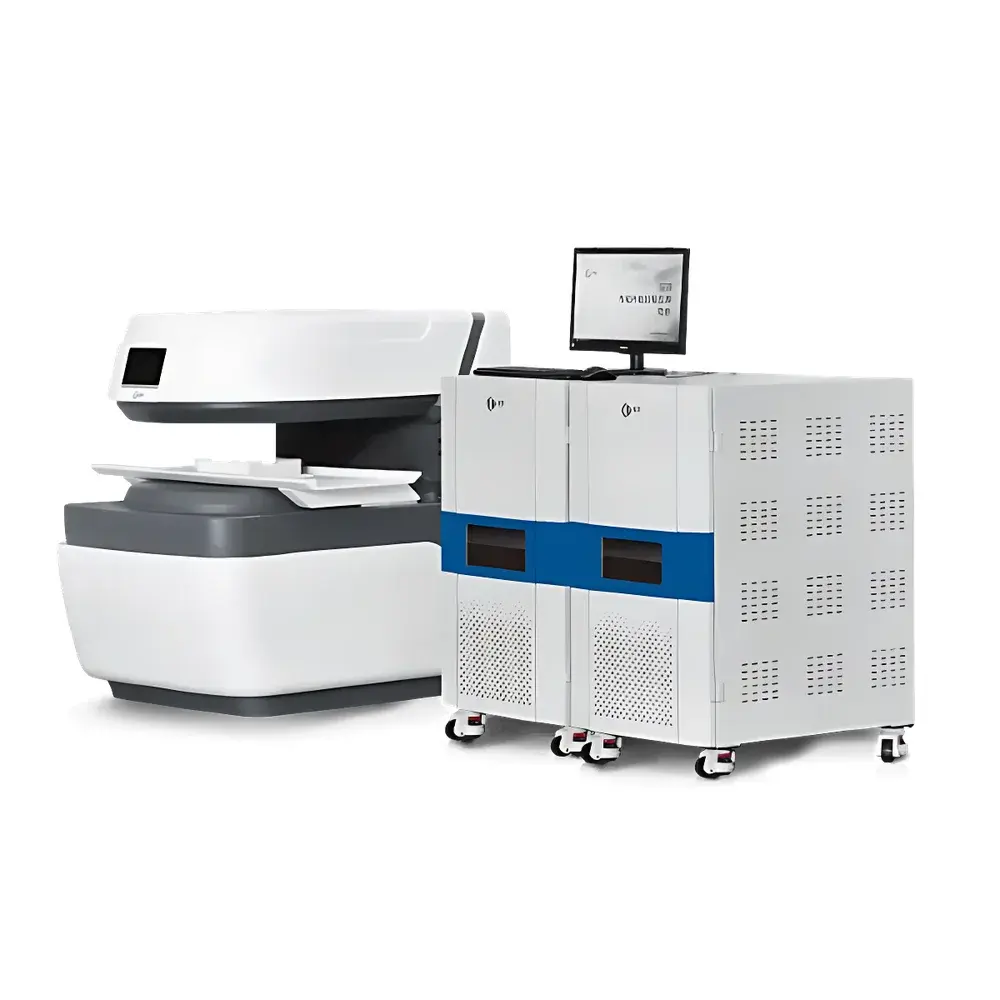
NIUMAG MacroMR12-150H-I-1 Low-Field Nuclear Magnetic Resonance Analyzer for Gas-Hydrate Gas-Liquid Phase Transition Analysis
| Brand | NIUMAG |
|---|---|
| Origin | Jiangsu, China |
| Manufacturer Type | Authorized Distributor |
| Origin Category | Domestic |
| Model | MacroMR12-150H-I-1 |
| Instrument Type | Low-Field NMR Analyzer |
| Sample Type | Solid-Liquid Dual-Phase Compatible |
| Magnetic Field Strength | 0.3 T ± 0.03 T |
| Magnet Homogeneity | ≤50 ppm |
| Magnet Configuration | C-Type Open-Bore |
| Sample Access | Transverse and Longitudinal Orientation |
| Core Sample Diameter Support | 1–4 inches |
| Temperature-Controlled Probe | High-Precision, Gradient-Enabled |
Overview
The NIUMAG MacroMR12-150H-I-1 is a purpose-engineered low-field nuclear magnetic resonance (LF-NMR) analyzer designed specifically for quantitative, non-invasive investigation of gas-hydrate phase behavior—particularly the dynamic interconversion between gaseous, liquid, and solid hydrate phases under controlled thermobaric conditions. Operating at a stable 0.3 T static magnetic field, the system leverages proton (1H) spin relaxation phenomena (T1 and T2) to resolve molecular mobility, phase distribution, and interfacial interactions within heterogeneous porous media such as sediment cores, synthetic hydrate-bearing sediments, and rock analogs. Unlike high-field NMR spectrometers optimized for molecular structure elucidation, this instrument prioritizes robustness, in-situ operability, and time-resolved relaxometry—enabling continuous monitoring of hydrate nucleation, growth, dissociation, and gas/liquid transport kinetics without sample destruction or optical opacity limitations.
Key Features
- C-type open-bore magnet architecture providing unobstructed transverse and longitudinal sample access—critical for integration with high-pressure core holders, temperature jackets, and fluid injection manifolds.
- High-stability, actively temperature-regulated RF probe with integrated gradient capability, ensuring signal reproducibility across extended acquisition windows (hours to days) under variable thermal loads.
- Modular accessory ecosystem including pressure-rated rock core holders (up to 70 MPa), Peltier-based thermal control stages (−20 °C to +80 °C), and multi-port fluid/gas manifolds compatible with CH4, CO2, and mixed-gas systems.
- Native support for multi-parameter acquisition: T1 inversion recovery, T2 CPMG echo trains, diffusion-weighted sequences (D-T2), and proton density mapping—all calibrated against NIST-traceable reference standards.
- Industrial-grade shielding and vibration-damping base plate enabling deployment in laboratory-scale flow loops, triaxial mechanical test rigs, and long-term environmental simulation chambers.
Sample Compatibility & Compliance
The MacroMR12-150H-I-1 accommodates cylindrical geological samples up to 102 mm in diameter and 150 mm in length, including intact sediment cores, consolidated sandstone plugs, and synthetic hydrate-saturated porous media. Its design conforms to ASTM D6988 (Standard Test Method for Determining Pore Size Distribution of Geomaterials by Mercury Intrusion Porosimetry) and ISO 15138 (Petroleum and natural gas industries — Core analysis — Part 2: Routine core analysis) for comparative validation of porosity, saturation, and pore-throat geometry. When operated with certified pressure/temperature accessories, data acquisition satisfies GLP-compliant audit trails per FDA 21 CFR Part 11 requirements—including electronic signature enforcement, parameter change logging, and raw FID storage with metadata embedding (timestamp, shimming status, coil loading, ambient temperature).
Software & Data Management
Acquisition and processing are performed via NIUMAG’s proprietary MesoMR Studio v5.2 platform, which supports batch-mode T1/T2 spectral deconvolution using non-negative least squares (NNLS) and inverse Laplace transform algorithms. All spectra and parametric images are stored in HDF5 format with embedded MIAME-compliant metadata (Minimum Information About a Magnetic Resonance Experiment). The software includes built-in modules for capillary number correlation, relative permeability derivation from saturation-time curves, and automated detection of hydrate onset/dissociation thresholds based on T2 distribution centroid shifts. Export options include CSV, MATLAB .mat, and DICOM-compatible formats for third-party reservoir simulators (e.g., CMG STARS, Eclipse).
Applications
- Gas Hydrate Kinetics: Real-time quantification of CH4 or CO2 hydrate formation/decomposition rates under simulated seafloor or permafrost conditions; differentiation of surface-bound vs. bulk-phase water via T2 lifetime segmentation.
- Multiphase Flow Characterization: In-situ tracking of gas breakthrough, water channeling, and hydrate plug formation during depressurization or thermal stimulation experiments.
- Reservoir Rock Physics: Simultaneous determination of effective porosity, movable-bound fluid ratio, irreducible water saturation, and wettability index from T2 cutoff analysis calibrated against centrifuge and resistivity measurements.
- CO2 Sequestration Research: Competitive adsorption studies between CO2 and CH4 in coal seams and shale matrices; evaluation of residual trapping efficiency following supercritical CO2 injection.
- Flow Assurance Modeling: Input parameter generation for mechanistic hydrate deposition models—including nucleation density, crystal growth velocity, and slurry viscosity estimation from T2 dispersion profiles.
FAQ
What sample preparation is required prior to LF-NMR measurement?
No chemical fixation or drying is needed. Samples must be sealed in pressure-rated holders with defined pore-fluid composition (e.g., synthetic seawater + dissolved gas) and equilibrated to target P/T conditions prior to insertion.
Can the system operate inside an environmental chamber?
Yes—the open C-frame design allows full integration with external climate-controlled enclosures, provided RF shielding integrity is maintained via copper-mesh gasketing at all feedthrough interfaces.
Is T2 relaxation data quantitatively correlated to pore size?
Within well-characterized rock types, empirical and theoretical models (e.g., Brownstein-Tarr, SDR) enable conversion of T2 distributions to pore-size spectra—but independent validation via mercury intrusion or micro-CT remains essential for new lithologies.
Does the instrument support real-time imaging during hydrate dissociation?
Yes—single-slice T2-weighted imaging with 128 × 128 spatial resolution and sub-minute temporal resolution is achievable, permitting visualization of front propagation and localized dissociation heterogeneity.
Are calibration standards included with the system?
A set of five NIST-traceable reference phantoms (doped water/glycerol mixtures spanning T2 = 1–2000 ms) is supplied with initial commissioning, along with SOP documentation for daily probe tuning and field homogeneity verification.






