
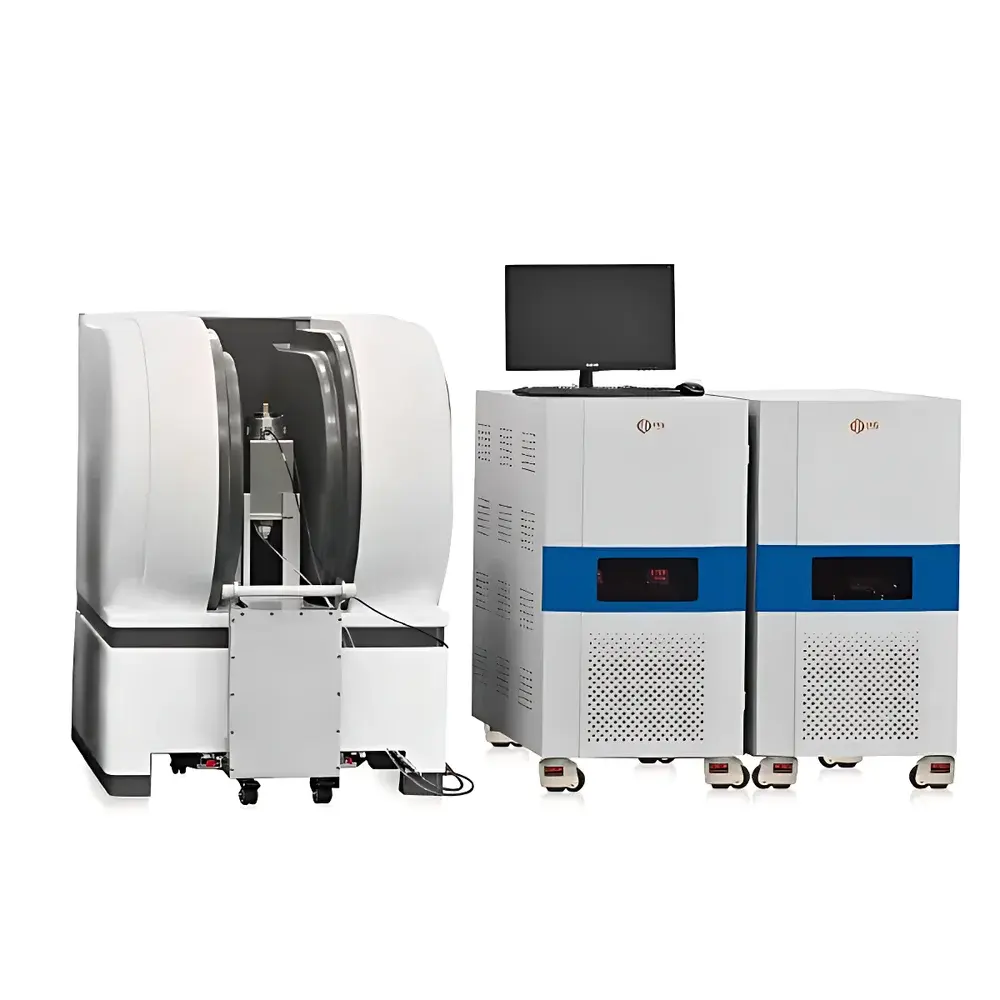
NIUMAG MacroMR12-150V-I Triaxial Low-Field Nuclear Magnetic Resonance Analyzer
| Brand | NIUMAG |
|---|---|
| Origin | Jiangsu, China |
| Manufacturer Type | Authorized Distributor |
| Domestic/Imported | Domestic |
| Model | MacroMR12-150V-I |
| Instrument Type | Low-Field NMR Analyzer |
| Sample Type | Solid-Liquid Coupled (Soil, Rock, Sediment Cores) |
| Magnetic Field Strength | 0.3 T ± 0.03 T |
| Magnet Geometry | C-Shaped Open Permanent Magnet |
| Field Homogeneity | ≤50 ppm over Ø150 mm × H100 mm DSV |
| Sample Access Direction | Vertical |
| Maximum Sample Dimensions | Ø150 mm × 100 mm Height |
Overview
The NIUMAG MacroMR12-150V-I Triaxial Low-Field Nuclear Magnetic Resonance Analyzer is an engineered platform for quantitative, non-invasive characterization of pore fluid behavior in geomaterials under controlled mechanical and thermodynamic stress conditions. Unlike conventional destructive or single-parameter soil testing methods, this system integrates a triaxial loading frame, programmable temperature–pressure environment module, and a high-sensitivity low-field NMR detection unit into a unified hardware architecture. It operates on the physical principles of nuclear magnetic resonance—specifically spin-lattice (T1) and spin-spin (T2) relaxation dynamics—to resolve spatially and temporally resolved distributions of mobile and bound water phases within porous media. The permanent C-shaped magnet (0.3 T) provides stable, maintenance-free field generation suitable for long-duration dynamic experiments—including freeze-thaw cycling, hydraulic infiltration, triaxial compression, and coupled thermo-hydro-mechanical (THM) stimulation. Its vertical sample access and open geometry enable direct integration with custom-designed core holders, pressure vessels, and thermal jackets, supporting true in situ simulation of subsurface geomechanical environments.
Key Features
- C-shaped open magnet design with vertical sample insertion—enables seamless integration with triaxial cells, cryogenic chambers, and fluid injection systems without magnetic interference or mechanical constraint.
- High-stability temperature-controlled RF probe with optimized gradient performance—ensures consistent signal-to-noise ratio across variable sample geometries (Ø25–150 mm) and moisture states (saturated to partially frozen).
- Modular accessory ecosystem—including multi-range triaxial rock/soil holders, high-pressure fluid manifolds, Peltier-based thermal control units (−40 °C to +80 °C), and gas-permeable sample capsules—for reproducible multi-field coupling (stress, temperature, fluid chemistry, gas saturation).
- Dedicated pulse sequence library for geological NMR applications: inversion-recovery (T1), Carr–Purcell–Meiboom–Gill (T2), diffusion-weighted (D-T2), and 2D T1-T2 correlation mapping—calibrated for clay-rich, silty, and fractured media.
- Robust cabinet-integrated mechanical architecture—designed for vibration isolation, electromagnetic shielding, and thermal drift compensation in laboratory and field-deployable settings.
Sample Compatibility & Compliance
The MacroMR12-150V-I accommodates intact soil cores, consolidated rock specimens, sediment columns, and composite geomaterials up to Ø150 mm × 100 mm in dimension. Its open C-magnet configuration permits real-time monitoring during active mechanical loading (up to 10 MPa confining pressure) and thermal cycling (±0.1 °C stability). All data acquisition protocols adhere to ASTM D4643 (Standard Test Method for Determining Water Content of Soil by Nuclear Magnetic Resonance), ISO 17892-7 (Geotechnical Investigation and Testing — Laboratory Testing of Soil — Part 7: Determination of Water Content), and USP General Chapter <1058> for analytical instrument qualification. Audit trails, user access controls, and electronic signature support are implemented in accordance with FDA 21 CFR Part 11 requirements for regulated research environments. System validation documentation—including IQ/OQ/PQ templates—is available upon request for GLP/GMP-aligned laboratories.
Software & Data Management
Control and analysis are executed via NIUMAG’s proprietary MagicScan Pro software suite, built on a modular, scriptable framework compatible with Python 3.9+ and MATLAB APIs. The interface supports automated experiment sequencing (e.g., stepwise pressure ramping followed by T2 acquisition at each stage), batch processing of multi-dimensional relaxation spectra, and voxel-wise parametric mapping (T2, D, M0). Raw FID data are stored in vendor-neutral HDF5 format with embedded metadata (field strength, temperature, pressure, sequence parameters), ensuring full traceability and third-party interoperability. Integrated reporting tools generate ASTM-compliant PDF reports with embedded spectral overlays, statistical summaries (mean T2, porosity distribution skewness), and time-series animations of fluid redistribution. Data export supports CSV, NIfTI, and DICOM formats for cross-platform visualization and machine learning preprocessing.
Applications
- Pore Structure Quantification: Total porosity, pore size distribution (via T2 cutoff calibration), layered porosity profiling, and nano-pore analysis in frozen soils using T1-ρ correlation.
- Water Phase Dynamics: Unfrozen water content quantification in permafrost, spatially resolved moisture migration during infiltration/drainage, and phase transition kinetics during freeze-thaw cycles.
- Multi-Field Coupled Processes: THM-driven pore collapse, stress-induced preferential flow path development, capillary barrier formation, and solute transport retardation mapped via longitudinal relaxation dispersion.
- Microstructural Damage Assessment: Non-destructive evaluation of crack initiation and propagation during triaxial compression, thermal shock, acid/salt corrosion, and cyclic freezing—correlated with T2 shortening and signal amplitude loss.
FAQ
What sample sizes and geometries are supported?
The system accepts cylindrical samples from Ø25 mm to Ø150 mm in diameter and up to 100 mm in height. Custom sample holders accommodate irregular shapes and segmented core sections with integrated pressure ports and thermocouple feedthroughs.
Can the system operate under elevated confining pressure?
Yes—when paired with NIUMAG’s optional triaxial cell (up to 10 MPa confining pressure) and high-pressure fluid delivery module, full stress–fluid–temperature coupling is achievable without compromising NMR sensitivity.
Is 2D T1–T2 correlation available out-of-the-box?
Yes—the standard pulse sequence library includes robust, noise-suppressed 2D correlation acquisition with user-adjustable echo spacing and inversion times, validated for clay–water and ice–soil interfaces.
How is temperature controlled during NMR acquisition?
A dedicated high-stability RF probe with integrated Peltier elements maintains ±0.1 °C uniformity across the sensitive volume, independently of external environmental fluctuations.
Does the system comply with regulatory data integrity standards?
Yes—MagicScan Pro implements role-based access control, electronic signatures, audit trail logging, and secure data encryption aligned with FDA 21 CFR Part 11 and EU Annex 11 requirements for regulated research use.






