NIUMAG VTMR-r Variable-Temperature Nuclear Magnetic Resonance Analyzer for Rubber Crosslink Density
| Brand | NIUMAG |
|---|---|
| Origin | Jiangsu, China |
| Manufacturer Type | Authorized Distributor |
| Country of Origin | China |
| Model | VTMR-r |
| Pricing | Available Upon Request |
| Magnet Type | Permanent Magnet |
| Magnetic Field Strength | 0.5 ± 0.05 T |
| Sample Detection Volume | Ø8.5 mm × H20 mm |
| Standard Temperature Range | Ambient to 130 °C |
| Optional High-Temp Module | Ambient to 200 °C |
Overview
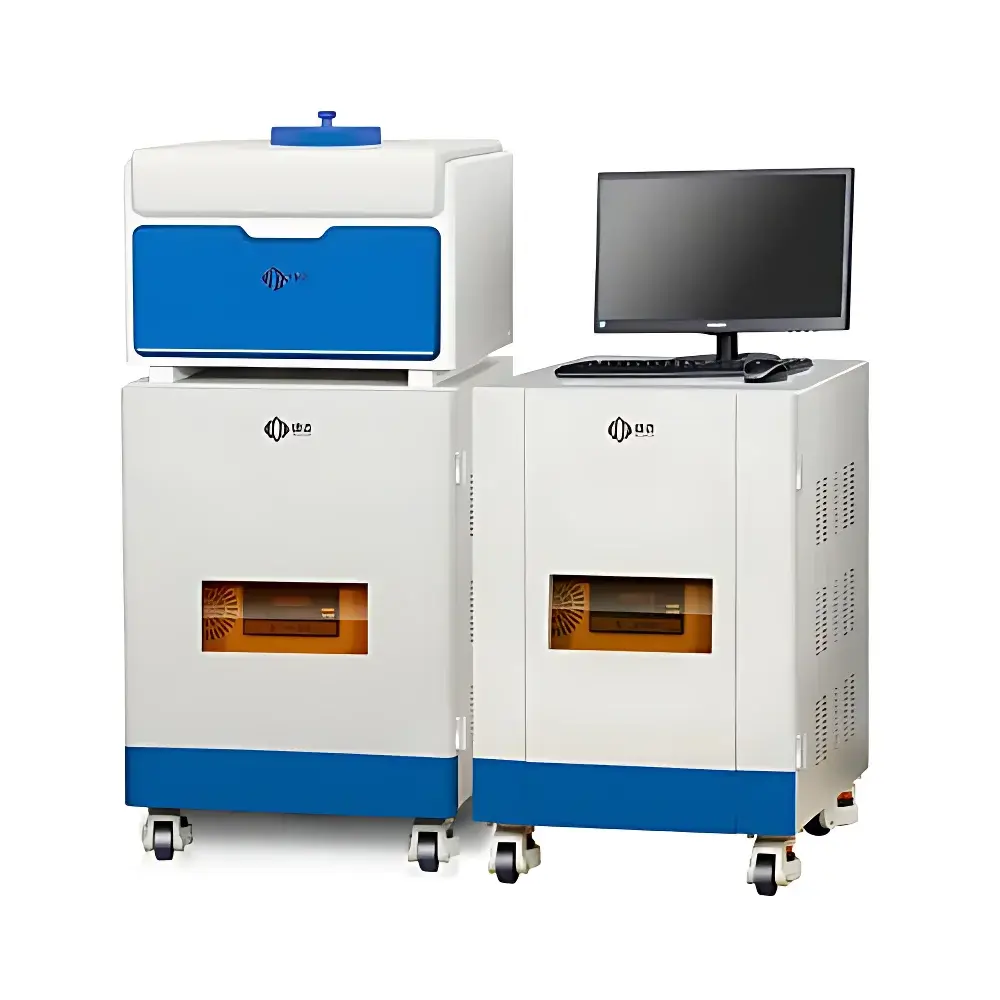
The NIUMAG VTMR-r is a dedicated benchtop variable-temperature nuclear magnetic resonance (VT-NMR) analyzer engineered for quantitative assessment of crosslink density in elastomeric materials. It operates on the physical principle of 1H transverse relaxation (T2) measurement, leveraging dipolar coupling between proton spins in rubber networks. As crosslinks restrict segmental mobility, the resulting reduction in T2 relaxation time correlates directly with crosslink concentration. By acquiring multi-exponential T2 decay curves under controlled thermal conditions, the VTMR-r distinguishes between physical (e.g., crystallite- or filler-induced) and chemical (e.g., sulfur- or peroxide-derived) crosslinks—enabling separation of total, chemical, and physical crosslink densities in vulcanized rubber compounds. This capability supports fundamental structure–property relationship studies and meets the technical requirements of polymer physics laboratories engaged in rubber formulation development, process optimization, and quality assurance.
Key Features
- Stable permanent magnet system delivering a homogeneous 0.5 ± 0.05 T field—optimized for high signal-to-noise ratio in 1H NMR detection of elastomer samples.
- Precisely regulated temperature control from ambient to 130 °C (standard), with an optional upgrade path to 200 °C for accelerated aging simulations and high-temperature vulcanizate characterization.
- Dedicated sample geometry: cylindrical detection volume of Ø8.5 mm × 20 mm height—compatible with standard cured rubber dumbbells, compression-molded discs, and uncured compound slugs.
- Integrated pulse sequence library including CPMG (Carr–Purcell–Meiboom–Gill) for robust T2 distribution analysis, with automated baseline correction and non-negative least-squares (NNLS) inversion.
- Modular architecture supporting optional MRI add-on for spatially resolved crosslink heterogeneity mapping—useful for assessing dispersion uniformity of curatives or fillers.
Sample Compatibility & Compliance
The VTMR-r accommodates raw rubber compounds (e.g., NR, SBR, EPDM, FKM), semi-cured intermediates, and fully vulcanized test specimens without chemical labeling or destructive preparation. Its non-invasive, solvent-free methodology complies with ISO 17987:2021 (Rubber—Determination of crosslink density by NMR), ASTM D8256-22 (Standard Test Method for Crosslink Density of Vulcanized Rubber by Low-Field NMR), and aligns with GLP-compliant data integrity expectations. All temperature ramps and acquisition parameters are logged with timestamped metadata, satisfying traceability requirements for internal QA/QC and external audit readiness.
Software & Data Management
The proprietary VTMR Analysis Suite provides full workflow automation—from parameter setup and thermal equilibration monitoring to T2 spectrum deconvolution and crosslink density calculation using Flory–Rehner-based models. Raw FID and processed T2 distributions are stored in HDF5 format with embedded instrument configuration and calibration history. The software supports 21 CFR Part 11–compliant user access control, electronic signatures, and audit trail generation. Export options include CSV, PDF reports, and direct integration with LIMS via RESTful API.
Applications
- Quantifying the effect of accelerator type, sulfur loading, and curing time on chemical crosslink formation in sulfur-vulcanized systems.
- Evaluating the contribution of silica–silane coupling to physical network reinforcement in green tire treads.
- Correlating T2 heterogeneity with fatigue resistance and hysteresis loss in dynamic mechanical testing.
- Monitoring crosslink degradation during thermal aging or ozone exposure protocols.
- Validating batch-to-batch consistency of masterbatch dispersion in compound manufacturing.
FAQ
How does VTMR-r differentiate chemical from physical crosslinks?
It acquires T2 decay at multiple temperatures and applies constrained spectral fitting to resolve short-T2 components (immobilized chains near covalent crosslinks) versus intermediate-T2 components (reversible physical associations). Chemical crosslink density is derived from the temperature-invariant fraction.
Is sample preparation required before measurement?
No cutting, drying, or solvent extraction is needed. Samples must be geometrically compatible with the Ø8.5 mm × 20 mm cavity and free of ferromagnetic contaminants.
Can the system be validated against reference methods like equilibrium swelling?
Yes—NIUMAG provides correlation protocols aligned with ISO 1817 and ASTM D471 for method equivalence verification and laboratory accreditation.
What maintenance is required for the permanent magnet?
None beyond routine environmental monitoring (stable ambient temperature, low vibration, no strong RF sources nearby); the magnet requires no cryogens or power supply.
Is remote operation supported?
Yes—the system supports secure remote login, real-time acquisition monitoring, and collaborative data review via encrypted web interface.