
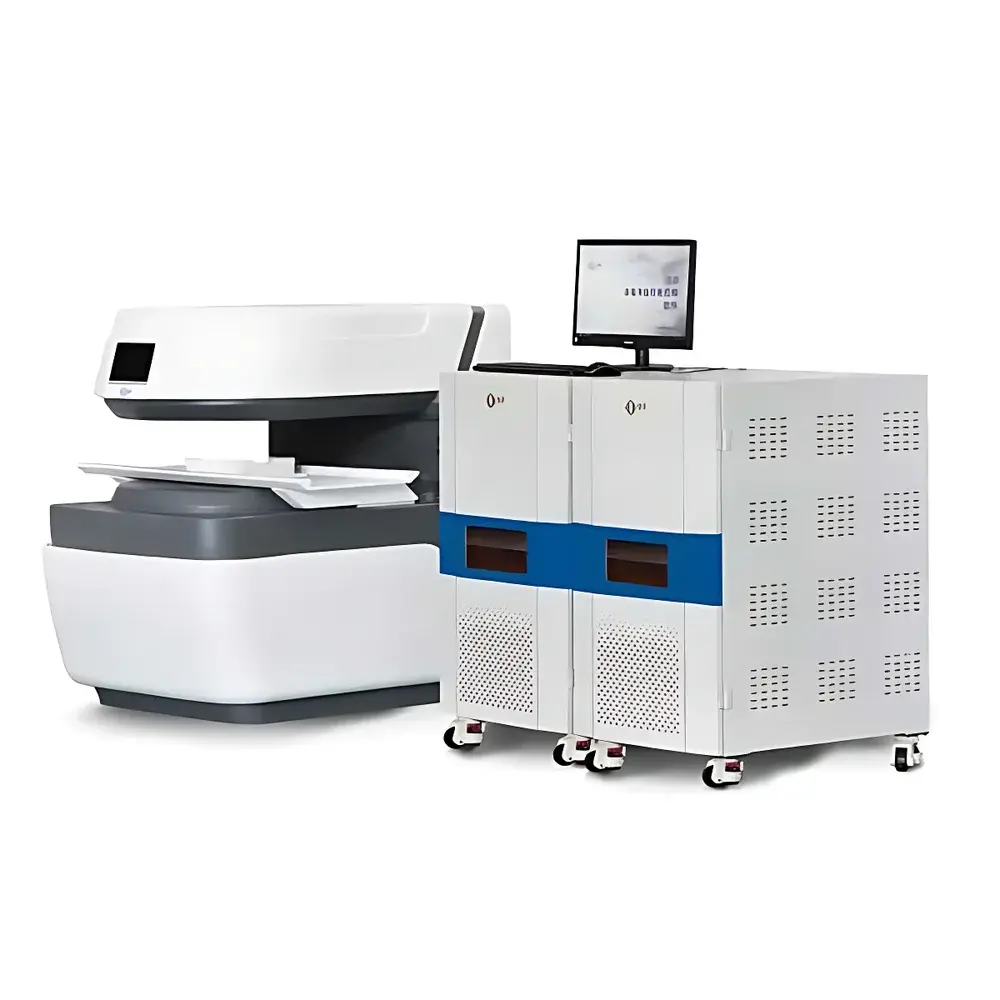
NIUMAG MacroMR- Online Displacement NMR Analyzer
| Brand | NIUMAG |
|---|---|
| Origin | Jiangsu, China |
| Manufacturer Type | Authorized Distributor |
| Product Category | Domestic |
| Model | MacroMR- |
| Instrument Type | Low-Field Nuclear Magnetic Resonance (LF-NMR) Analyzer |
| Sample Mode | Solid–Liquid Dual Compatibility |
| Operating Principle | Pulsed Fourier Transform NMR |
Overview
The NIUMAG MacroMR- Online Displacement NMR Analyzer is a purpose-built low-field nuclear magnetic resonance (LF-NMR) platform engineered for real-time, non-invasive monitoring of fluid displacement processes in porous media—primarily targeting upstream petroleum research, reservoir core analysis, and enhanced oil recovery (EOR) mechanism studies. Unlike conventional benchtop NMR spectrometers optimized for molecular structure elucidation, the MacroMR- implements time-domain pulsed Fourier transform (PFT) methodology to quantify proton relaxation dynamics (T2, T1, and T1–T2 correlation) under dynamic flow and simulated reservoir conditions. Its C-shaped permanent magnet architecture—constructed from high-coercivity neodymium-iron-boron (NdFeB) material—delivers a stable, homogeneous 0.3 ± 0.05 T static field over a large open-access bore, enabling integration with custom displacement cells, pressure vessels, and temperature-controlled flow loops. The system operates without cryogens or RF shielding rooms, making it suitable for laboratory-scale core flooding experiments, long-term process monitoring, and method development aligned with ASTM D7269 (Standard Test Method for Determining Pore Size Distribution of Rock Core Using NMR), ISO 17892-12 (Geotechnical investigation and testing — Laboratory testing of soil — Part 12: Determination of water content by nuclear magnetic resonance), and internal GLP-compliant workflows.
Key Features
- C-type open-bore permanent magnet design with ≥200 mm vertical access aperture—facilitates rapid insertion/removal of large-diameter core holders (up to Ø100 mm × L300 mm) and modular displacement cells
- Full-digital broadband NMR spectrometer with 1H frequency tuning range 12.8 MHz ± 1 MHz, pulse width resolution ≤10 ns, and phase stability <0.1° RMS over 24 h
- Integrated high-precision temperature-controlled probe (±0.1 °C stability over 25–80 °C) with active shimming and automatic frequency lock
- Modular hardware expansion interface supporting optional high-pressure (up to 70 MPa), low-temperature (−40 °C), and multi-dimensional (T1–T2, D–T2) acquisition modules
- Push-pull sample loading mechanism with mechanical position repeatability <±5 µm—critical for longitudinal profiling and spatially resolved saturation mapping
Sample Compatibility & Compliance
The MacroMR- accepts cylindrical rock cores (standard sizes: Ø25 mm × 50 mm, Ø38 mm × 76 mm, Ø100 mm × 150 mm), sandpacks, cementitious materials, shale plugs, and synthetic porous media. It supports simultaneous liquid-phase (brine, crude oil, polymer solutions, CO2-saturated fluids) and solid-phase (clay-rich matrices, kerogen-bearing samples) interrogation without destructive preparation. All hardware and firmware comply with IEC 61000-6-3 (EMC emission standards) and IEC 61000-6-2 (immunity requirements). Data acquisition protocols are configurable to meet audit-trail requirements under FDA 21 CFR Part 11 when paired with validated software configurations; raw FID data storage adheres to NMR-ML v2.0 metadata schema conventions.
Software & Data Management
Control and analysis are executed via NIUMAG’s proprietary NMR-Studio Pro platform—a Windows-based application featuring dual-mode operation: (i) real-time streaming mode for continuous T2 distribution updates during active flooding (sampling interval down to 1 s), and (ii) batch processing mode supporting inverse Laplace transformation (non-negative least squares + regularization), multi-exponential deconvolution, and diffusion-relaxation correlation mapping. All processed datasets export to CSV, HDF5, and Bruker TopSpin-compatible formats. Audit logs record operator ID, timestamp, pulse sequence parameters, calibration history, and instrument environmental readings (temperature, field drift)—enabling full traceability per ISO/IEC 17025:2017 Clause 7.7.
Applications
- Dynamic saturation tracking during water/gas/polymer flooding—quantifying residual oil saturation (Sorw), movable fluid fraction, and capillary number effects
- Pore-scale wettability assessment via spontaneous imbibition kinetics and contact angle estimation from T2 shift analysis
- Permeability prediction using Coates–Timur and SDR models calibrated against Darcy-flow measurements
- Methane adsorption/desorption isotherms in coal and shale under elevated pressures (with HP module)
- Gas hydrate nucleation and dissociation kinetics monitored at sub-zero temperatures (with LT module)
- Micro-fracture propagation imaging via T2-weighted slice-selective spin echo sequences
FAQ
What is the minimum detectable fluid saturation in a sandstone core?
Detection limit depends on porosity and signal-to-noise ratio (SNR); typical quantification threshold is 0.5 vol% water or hydrocarbon phase in >5% porosity media at standard operating conditions.
Can the system operate continuously during a 72-hour core flood experiment?
Yes—the spectrometer supports unattended acquisition with automated sequence triggering, thermal drift compensation, and watchdog-restart functionality.
Is T1–T2 correlation available as standard or requires optional module?
T1–T2 mapping is an optional upgrade requiring the Multi-Dimensional NMR Module and extended acquisition time per slice.
Does the system support third-party flow controllers or pressure transducers?
Yes—via analog voltage (0–10 V) and digital RS485 interfaces; integration templates are provided for common vendors (e.g., Parker, Bronkhorst, GE Druck).
What maintenance is required for the permanent magnet?
None—NdFeB magnets require no power, cooling, or periodic realignment; annual field homogeneity verification using a calibrated Hall probe is recommended.



