
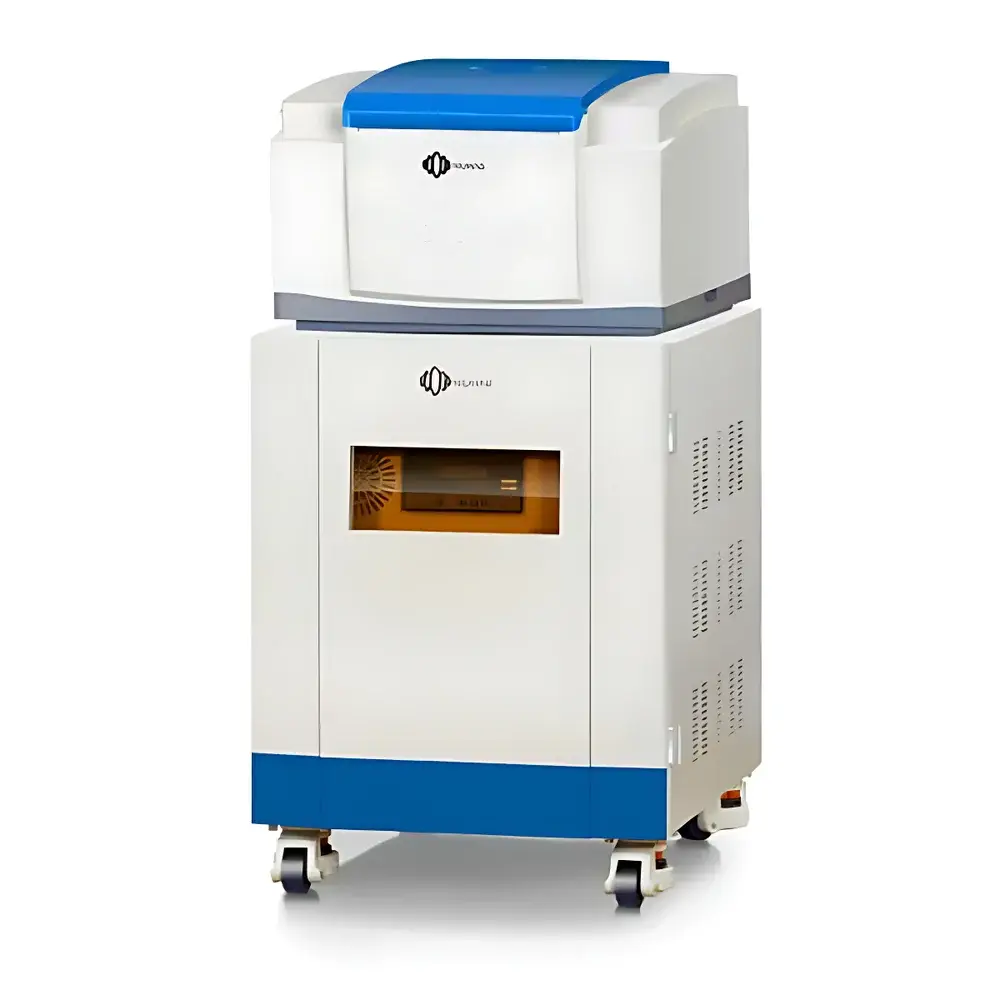
NIUMAG MicroMR+ Multidimensional Low-Field Nuclear Magnetic Resonance Core Analyzer
| Brand | NIUMAG |
|---|---|
| Origin | Jiangsu, China |
| Manufacturer Type | Authorized Distributor |
| Product Category | Domestic |
| Model | MicroMR+ |
| Instrument Type | Low-Field NMR Analyzer |
| Sample Type | Solid-Liquid Dual-Mode |
| Operating Frequency | 12 MHz |
| Data Acquisition Method | Fourier Transform |
| Magnet Type | Permanent Magnet |
| Magnetic Field Strength | 0.28 ± 0.05 T |
| Field Homogeneity | 300 ppm (25 mm × 25 mm × 25 mm) |
| Field Stability | < 300 Hz/hour |
| RF Transmitter Power | > 300 W peak-to-peak, linearity distortion < 0.3% |
| Diffusion Gradient Strength | up to 18 G/cm (peak) |
| Standard Probe Coil Diameter | 25 mm |
| Optional Probe Coil Diameter | 10 mm |
| Effective Sample Volume | Ø25.4 mm × H25 mm |
| Power Supply | 220 V, 50 Hz |
| Operating Temperature | 22–28 °C |
| Relative Humidity | 30–70 % |
Overview
The NIUMAG MicroMR+ Multidimensional Low-Field Nuclear Magnetic Resonance Core Analyzer is a benchtop, permanent-magnet-based NMR system engineered for quantitative petrophysical characterization of reservoir rock cores. Operating at a proton Larmor frequency of 12 MHz (corresponding to a static magnetic field strength of 0.28 ± 0.05 T), the instrument employs pulsed low-field NMR spectroscopy—specifically spin-echo and diffusion-weighted sequences—to non-invasively probe hydrogen-bearing fluid phases (e.g., water, oil, hydrocarbons) within porous media. Unlike high-field NMR systems, this platform prioritizes robustness, operational simplicity, and cost-effective deployment in core analysis laboratories, geological service centers, and upstream R&D facilities. Its design adheres to fundamental NMR principles: transverse relaxation (T₂), longitudinal relaxation (T₁), diffusion-relaxation (D–T₂), and inversion-recovery (IR) contrast enable decoupled quantification of porosity, movable fluid saturation, permeability proxies, pore-size distribution, and wettability indicators—without chemical alteration or sample destruction.
Key Features
- Integrated permanent magnet architecture with field stability < 300 Hz/hour and homogeneity of 300 ppm over a 25 mm cubic volume—optimized for reproducible core plug measurements.
- Dual-mode probe configuration: standard 25 mm diameter coil (accommodating Ø25.4 mm × 25 mm core plugs) and optional 10 mm coil for small-diameter or irregular samples.
- High-fidelity RF subsystem: >300 W peak-to-peak output power with <0.3% harmonic distortion ensures precise pulse fidelity across CPMG, IR-CPMG, PGSE-CPMG, and SEG-CPMG sequences.
- Programmable gradient amplifier delivering up to 18 G/cm peak gradient strength for diffusion-encoded experiments, enabling fluid typing and bound vs. free fluid discrimination.
- Comprehensive pulse sequence library—including FID, Hahn echo, IR, IR-SE, IR-CPMG, PGSE-CPMG, and SES—accessible via intuitive GUI-driven acquisition software.
- Benchtop footprint (< 0.8 m²) with passive thermal management; no cryogens, no superconducting magnets, no RF shielding room required.
Sample Compatibility & Compliance
The MicroMR+ accepts cylindrical rock core plugs (standard Ø25.4 mm × 25 mm), cuttings, shale fragments, and saturated sedimentary samples without pretreatment. It supports both brine-saturated and hydrocarbon-saturated configurations under ambient pressure and temperature-controlled conditions (22–28 °C). The system complies with ISO 10113 (petrophysical testing of reservoir rocks) and aligns with ASTM D6988 (standard test method for determining pore size distribution of geotextiles using capillary flow porometry—NMR-derived analogues). While not certified for GLP/GMP production environments, its data traceability framework—including timestamped parameter logs, raw FID/echo train export (ASCII/CSV), and audit-ready sequence metadata—supports internal QA/QC protocols and regulatory pre-submission studies per USP and FDA 21 CFR Part 11 requirements when deployed with validated SOPs.
Software & Data Management
NIUMAG’s proprietary NMR Analysis Suite provides full control over pulse programming, real-time signal monitoring, and multidimensional data reconstruction. All sequences are implemented in hardware-timed FPGA logic, ensuring sub-microsecond timing resolution. The software exports fully calibrated T₂ distributions, D–T₂ maps, and T₁–T₂ correlation spectra in standardized formats (e.g., HDF5, MATLAB .mat). Batch processing pipelines support automated porosity integration (using known bulk density and grain density inputs), permeability estimation via SDR (Schlumberger-Doll Research) or Coates models, and saturation calculation from multi-echo decay amplitudes. Raw data files retain full phase and magnitude information, enabling third-party reprocessing in MATLAB, Python (nmrglue, pyspecdata), or commercial platforms like Delta NMR.
Applications
- Core flooding simulation support: time-resolved monitoring of fluid redistribution during imbibition/drainage cycles.
- Low-permeability reservoir evaluation: differentiation of clay-bound water, capillary-bound water, and free fluid using T₂ cutoff calibration.
- Nuclear magnetic resonance logging (NMR-Log) calibration: establishing lab-to-wellbore transfer functions for downhole tool response modeling.
- Enhanced oil recovery (EOR) screening: quantifying surfactant-induced wettability shifts via T₁/T₂ ratio trends.
- Shale gas resource assessment: characterizing kerogen-hosted hydrocarbon mobility through diffusion-weighted CPMG analysis.
- Geomechanical property correlation: linking T₂ distribution skewness to microfracture density and stress history.
FAQ
What sample preparation is required prior to measurement?
No chemical treatment, drying, or vacuum saturation is mandatory. Samples are typically measured in their native saturated state or after controlled brine/oil saturation under ambient pressure.
Can the MicroMR+ distinguish between oil and water in mixed-saturation cores?
Yes—through combined T₁–T₂ correlation or diffusion–relaxation (D–T₂) mapping, provided sufficient spectral separation exists in relaxation times or molecular diffusivity.
Is the system compatible with industry-standard petrophysical modeling workflows?
Yes—exported T₂ distributions and saturation-weighted parameters integrate directly into Petrel, Techlog, and IHS Kingdom via CSV or HDF5 import modules.
Does the instrument require external cooling or RF shielding?
No—permanent magnet design eliminates cryogenic infrastructure; RF emissions comply with CISPR 11 Class B limits, permitting operation in standard laboratory environments.
How is data integrity ensured during long-duration CPMG acquisitions?
Hardware-level temperature monitoring of probe and magnet housing triggers automatic acquisition suspension if drift exceeds ±0.5 °C; all echo trains include real-time SNR estimation and outlier rejection flags.





