
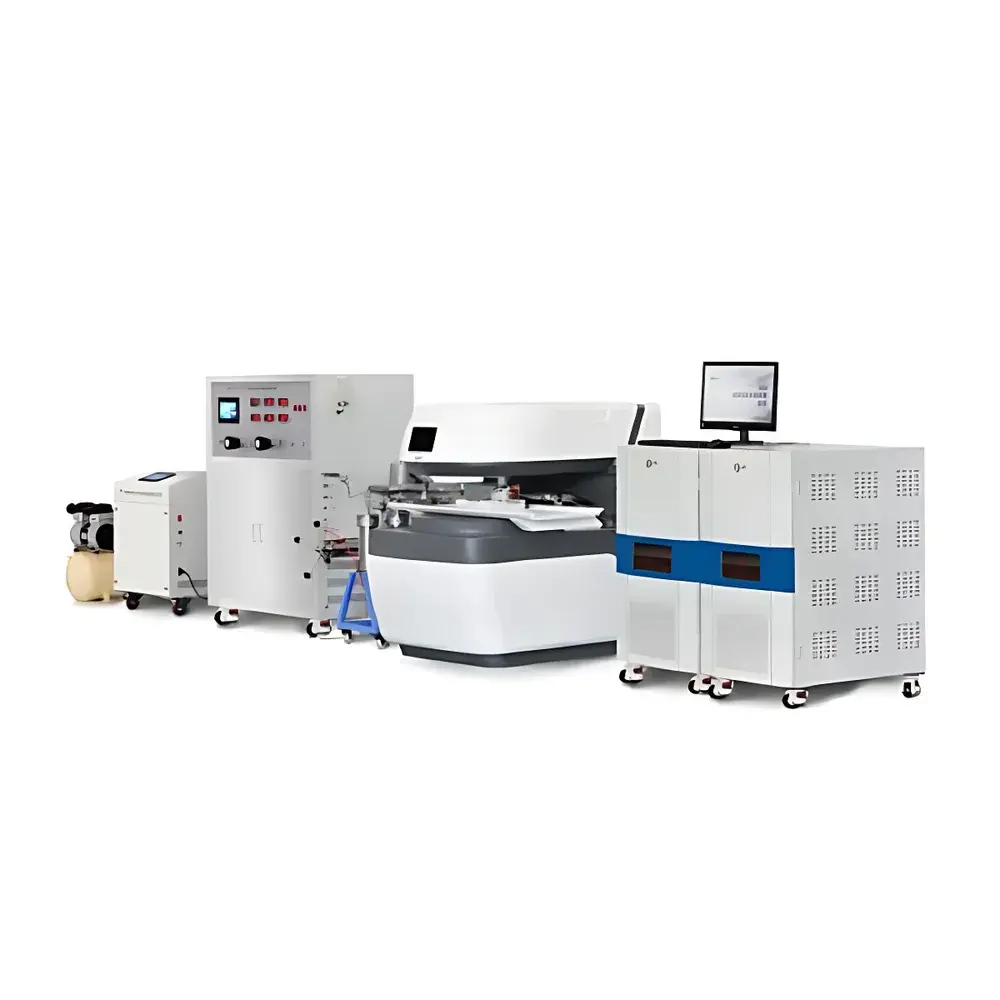
NIUMAG MacroMR12 Series High-Temperature & High-Pressure In-Situ Simulated NMR Analyzer
| Brand | NIUMAG |
|---|---|
| Origin | Jiangsu, China |
| Manufacturer Type | Authorized Distributor |
| Origin Category | Domestic |
| Model | MacroMR12 |
| Quotation | Upon Request |
| Instrument Type | Low-Field NMR Analyzer |
| Sample Type | Solid-Liquid Dual-Phase |
| Operating Mode | Pulsed Fourier Transform |
| Magnet Type | Permanent Magnet |
| Magnetic Field Strength | 0.3 ± 0.05 T |
| Magnet Geometry | C-Shaped Open Configuration |
| Sample Temperature Range | Ambient to 100 °C |
| Optional Constant-Pressure/Constant-Flow Displacement Pump (0–40 MPa, Pressure Accuracy | ±0.25% FS |
| Flow Rate | 0.1–15 mL/min, Flow Accuracy: ±0.1 mL) |
| Optional Gas Booster System (Max Boost Pressure | ≤25 MPa) |
Overview
The NIUMAG MacroMR12 Series is a purpose-engineered low-field nuclear magnetic resonance (NMR) analyzer designed for in-situ, high-temperature and high-pressure (HT/HP) simulation of reservoir conditions during dynamic fluid displacement experiments. Unlike conventional benchtop NMR systems optimized for static sample characterization, the MacroMR12 integrates a robust C-shaped permanent magnet (0.3 ± 0.05 T) with modular environmental control modules—enabling real-time, non-invasive monitoring of pore-scale fluid dynamics under geologically relevant stress and thermal states. Its operating principle relies on pulsed Fourier transform (PFT) NMR methodology, where spin-echo decay (T₂ relaxation) and diffusion-weighted (D-T₂) measurements are acquired during active fluid injection, pressure cycling, or temperature ramping. This allows quantitative tracking of fluid saturation, mobility partitioning, pore-throat accessibility, and interfacial displacement behavior—critical parameters for reservoir engineering, enhanced oil recovery (EOR), and unconventional resource evaluation.
Key Features
- C-shaped open permanent magnet architecture with large access aperture (≥120 mm clear bore), enabling straightforward integration of core holders, triaxial cells, and custom HP/HT flow-through accessories.
- Modular environmental interface design supporting seamless coupling of optional high-precision displacement pumps (0–40 MPa, ±0.25% full-scale pressure accuracy), gas booster systems (≤25 MPa), and programmable temperature controllers (ambient to 100 °C).
- High-stability temperature-regulated RF probe with active thermal shielding, minimizing baseline drift and ensuring reproducible T₂ distribution acquisition across extended experimental runs (≥72 h continuous operation).
- Integrated pulse sequence library compliant with standard NMR petrophysical protocols—including CPMG (Carr–Purcell–Meiboom–Gill), IR (inversion recovery), and stimulated echo diffusion encoding—for simultaneous quantification of porosity, saturation, permeability proxies, and wettability indicators.
- Compact footprint and electromagnetic interference (EMI)-shielded enclosure suitable for laboratory-scale core flooding rigs, pilot-scale flow loops, and controlled-environment testing chambers.
Sample Compatibility & Compliance
The MacroMR12 accommodates cylindrical rock core samples up to Ø50 × 100 mm, as well as custom-designed porous media cells for sandpacks, proppant packs, or fractured shale analogs. It supports solid–liquid dual-phase analysis—enabling concurrent detection of bound vs. movable water, hydrocarbon phase distribution, and clay-bound fluid signals. All hardware and firmware comply with IEC 61000-6-3 (EMC emissions) and IEC 61000-6-2 (immunity) standards. Data acquisition workflows adhere to GLP principles, with audit-trail-enabled software logging of instrument parameters, calibration history, and user actions—supporting traceability requirements under ISO/IEC 17025 and ASTM D6913 (standard test methods for particle-size distribution of soils via sedimentation). While not FDA-cleared, its data structure and metadata tagging are compatible with 21 CFR Part 11-compliant LIMS environments when deployed in regulated R&D settings.
Software & Data Management
The proprietary MacroMR Studio v4.x software provides end-to-end control—from pulse sequence selection and parameter optimization to real-time visualization of relaxation spectra, saturation maps, and dynamic saturation profiles. Raw FID data are stored in vendor-neutral HDF5 format with embedded metadata (temperature, pressure, time stamp, sequence ID). Batch processing pipelines support automated T₂ cutoff determination per ASTM D7260, multi-exponential inversion using NNLS (non-negative least squares), and empirical permeability estimation via SDR (Schlumberger–Doll Research) and Timur–Coates models. Export options include CSV, MATLAB .mat, and PNG/PDF reports with customizable templates aligned with internal QA/QC checklists and peer-reviewed publication standards.
Applications
- Reservoir Petrophysics: Quantitative porosity mapping, T₂-based pore-size distribution, movable/irreducible fluid saturation, capillary pressure curve derivation, and wettability assessment via spontaneous imbibition NMR.
- Unconventional Resource Evaluation: Isothermal adsorption/desorption kinetics of CH₄/CO₂ on shale and coal matrices; hydrate nucleation/growth inhibition studies; supercritical CO₂–brine displacement efficiency; and competitive gas adsorption selectivity modeling.
- Dynamic EOR Process Monitoring: Real-time tracking of polymer slug propagation, surfactant-induced wettability alteration, acidizing-induced pore network remodeling, and hydraulic fracture conductivity evolution under confining stress.
- Mechanical–Chemical Coupling Studies: Triaxial compression damage progression correlated with NMR-derived permeability loss; imbibition-driven microcrack activation; and stress-dependent relative permeability hysteresis quantification.
FAQ
What is the maximum allowable confining pressure for core flooding experiments using the MacroMR12?
The system itself does not impose a direct pressure limit; however, when integrated with the optional constant-pressure displacement pump (rated to 40 MPa) and compatible core holders (e.g., Hassler-type cells with Viton or Kalrez seals), typical operational limits range from 10 to 35 MPa depending on sample geometry and seal material thermal stability.
Can the MacroMR12 distinguish between light hydrocarbons and formation water in situ?
Yes—through differential T₂ relaxation times and diffusion coefficients, combined with spectral deconvolution algorithms, the system resolves overlapping signals from mobile oil (T₂ > 100 ms), capillary-bound water (T₂ = 1–10 ms), and clay-bound water (T₂ < 1 ms), particularly under controlled temperature and salinity conditions.
Is the instrument suitable for regulatory submission data packages?
While the MacroMR12 is not a GMP-certified production instrument, its software audit trail, raw data integrity, and protocol documentation capabilities meet the evidentiary requirements for preclinical and exploratory research data referenced in API RP 40, ISO 10113, and USP analytical instrument qualification frameworks.





