
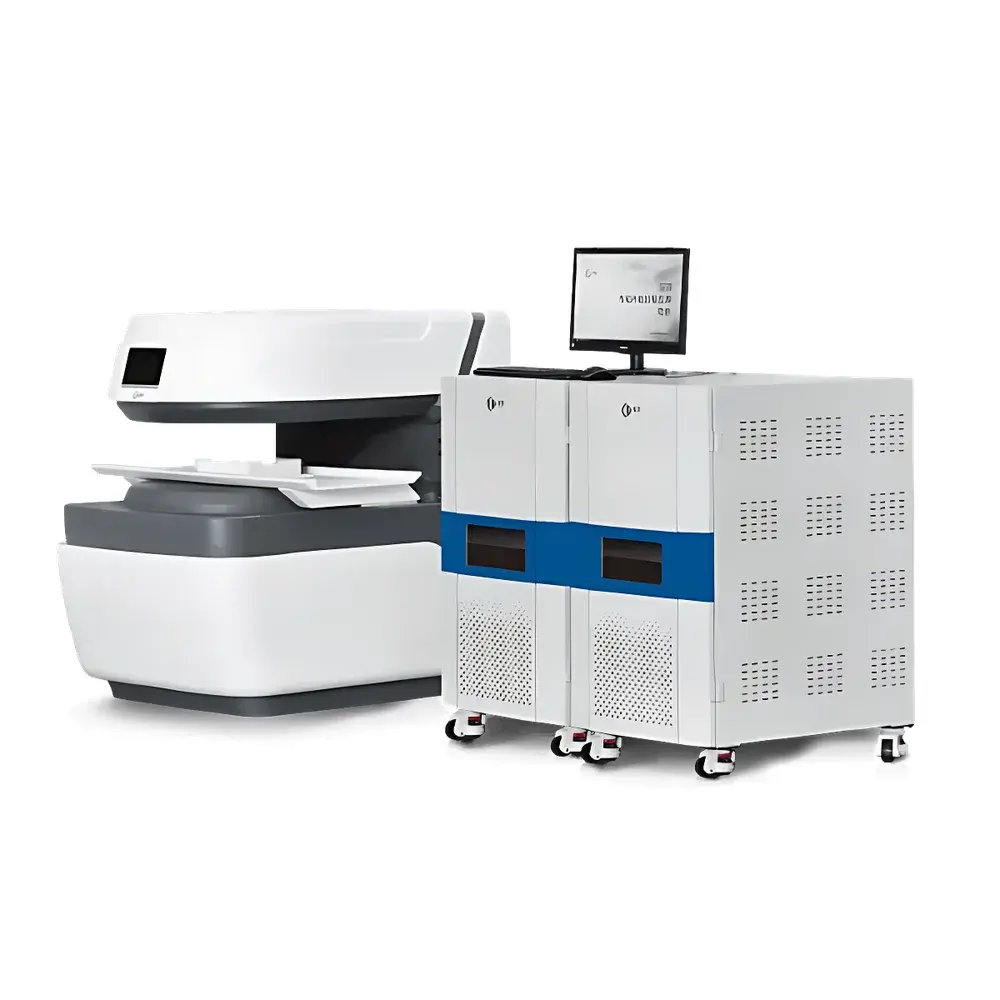
NIUMAG MacroMR12-150H-I Low-Field Nuclear Magnetic Resonance Analyzer for CO₂ Hydrate Characterization
| Brand | NIUMAG |
|---|---|
| Origin | Jiangsu, China |
| Manufacturer Type | Authorized Distributor |
| Product Category | Domestic |
| Model | MacroMR12-150H-I |
| Instrument Type | Low-Field NMR Analyzer |
| Sample Compatibility | Solid-Liquid Dual-Phase |
| Magnetic Field Strength | 0.3 T ± 0.03 T |
| Magnet Homogeneity | ≤50 ppm |
| Magnet Configuration | C-Shaped Open-Bore Permanent Magnet |
| Bore Diameter | 150 mm |
| Sample Access | Horizontal & Vertical Insertion |
| Core Sample Capacity | 25–102 mm (1–4 inch) diameter |
| Magnet Material | NdFeB Permanent Magnet |
| System Architecture | Fully Digital NMR Spectrometer Platform |
| Core Capabilities | T₁/T₂ Relaxometry, Proton Density Mapping, T₁-/T₂-Weighted Imaging |
| Environmental Simulation Support | Temperature Control, Confining Pressure, Fluid/Gas Injection (via optional accessories) |
Overview
The NIUMAG MacroMR12-150H-I is a purpose-built low-field nuclear magnetic resonance (LF-NMR) analyzer engineered for quantitative, non-invasive characterization of CO₂ hydrates in porous media—particularly geological cores and sediment analogs. Operating at a stable 0.3 T static magnetic field generated by a high-uniformity C-shaped NdFeB permanent magnet, the system leverages the intrinsic sensitivity of hydrogen nuclei (¹H) to local molecular mobility and phase state. In CO₂ hydrate systems, water protons residing in crystalline hydrate lattices exhibit significantly shortened transverse relaxation times (T₂) compared to those in bulk or capillary-bound water. By acquiring multi-echo Carr–Purcell–Meiboom–Gill (CPMG) decay trains and inversion-recovery (IR) sequences, the instrument resolves distinct T₂ and T₁ distributions, enabling unambiguous discrimination between hydrate-bound water, pore water, and ice-like phases. This physical basis allows for absolute quantification of CO₂ hydrate saturation, spatial mapping of hydrate distribution via NMR imaging, and dynamic monitoring of formation/dissociation kinetics under controlled thermobaric conditions.
Key Features
- C-shaped open-bore magnet design with 150 mm clear bore aperture, optimized for rapid, stress-free insertion of intact rock cores up to 4 inches (102 mm) in diameter and 300 mm in length.
- Integrated high-precision temperature-controlled probe (±0.1 °C stability) with programmable ramping, compatible with external pressure vessels and fluid circulation modules for in situ CCS-relevant simulation.
- Fully digital spectrometer architecture featuring 16-bit ADC, real-time pulse sequence compilation, and sub-microsecond timing resolution—ensuring high signal fidelity and reproducibility across long-duration experiments.
- Dual-mode operation: quantitative relaxometry (T₁, T₂, diffusion-weighted) and 2D/3D NMR imaging (spin-echo, gradient-echo, and inversion-recovery weighted contrasts), all accessible via a unified graphical interface.
- Modular accessory ecosystem including custom-designed core holders with integrated pressure ports, heating jackets, and gas-permeable end caps—enabling simultaneous control of confining pressure (up to 70 MPa), pore pressure, temperature (−20 to +80 °C), and CO₂ saturation history.
Sample Compatibility & Compliance
The MacroMR12-150H-I accommodates heterogeneous solid–liquid samples without pretreatment or destructive sectioning—including saturated sandstone, shale, clay-rich sediments, synthetic hydrate-bearing gels, and packed-bed reactors. Its non-destructive nature preserves sample integrity throughout repeated measurements, supporting longitudinal studies of hydrate evolution. The system complies with ISO/IEC 17025 requirements for measurement uncertainty estimation in laboratory testing. Data acquisition workflows are configurable to meet GLP documentation standards, including electronic audit trails, user access controls, and metadata tagging per ASTM D7260 and ISO 11358-1 for polymer and hydrate phase analysis. While not FDA-cleared, its architecture supports 21 CFR Part 11-compliant data archiving when deployed with validated third-party LIMS integration.
Software & Data Management
NIUMAG’s proprietary MultiQ™ software provides an intuitive, scriptable environment for pulse sequence design, real-time visualization, and advanced spectral deconvolution. Built-in algorithms apply constrained non-negative least squares (CNLLS) fitting to extract physically meaningful T₂ distributions, while voxel-wise imaging reconstruction employs iterative SENSE-based parallel processing. All raw FIDs, processed spectra, and image stacks are stored in vendor-neutral HDF5 format with embedded MIAME-compliant metadata (sample ID, field strength, temperature, pressure, sequence parameters). Export options include CSV, NIfTI, and DICOM—facilitating interoperability with MATLAB, Python (NumPy/SciPy), and commercial reservoir simulation platforms such as CMG and TOUGH+HYDRATE.
Applications
- CO₂ Hydrate Storage Assessment: Quantification of hydrate saturation and spatial heterogeneity in analog reservoir rocks under geologically relevant P–T paths; evaluation of hydrate stability windows and dissociation thresholds.
- Pore-Scale CCUS Process Monitoring: Real-time tracking of CO₂ injection, hydrate nucleation fronts, and residual saturation during cyclic pressurization/depressurization—critical for predicting long-term storage security.
- Reservoir Rock Physics: Simultaneous determination of porosity, permeability proxies (e.g., T₂ cutoff-based movable fluid fraction), wettability indices (via spontaneous imbibition NMR), and capillary pressure curves.
- Enhanced Gas Recovery & Competitive Adsorption: In-situ comparison of CH₄ release kinetics during CO₂ injection into natural gas hydrate analogs; quantification of CO₂/CH₄ selectivity in dual-gas systems.
- Geomechanical–Hydrate Coupling: Integration with triaxial cells to correlate hydrate saturation changes with acoustic velocity, elastic moduli, and fracture propagation behavior under confining stress.
FAQ
What sample sizes can the MacroMR12-150H-I accommodate?
Standard configuration supports cylindrical samples from 25 mm to 102 mm in diameter and up to 300 mm in length. Custom cavity inserts enable analysis of irregular geometries and small-volume sediment plugs.
Is the system capable of real-time monitoring during CO₂ injection experiments?
Yes—when coupled with optional pressure-regulated gas delivery modules and temperature-controlled chambers, the system acquires sequential relaxometry or imaging datasets at user-defined intervals (minimum 30-second repetition time), capturing kinetic evolution without interrupting experimental conditions.
Can T₁–T₂ correlation maps be generated to distinguish hydrate phases from free water or ice?
Yes—the instrument supports joint 2D T₁–T₂ inversion using regularized singular value decomposition (SVD), resolving overlapping relaxation populations based on their distinct correlation signatures in porous media.
Does the system support diffusion-relaxation (D–T₂) analysis for pore geometry characterization?
Yes—pulsed field gradient (PFG) capabilities are integrated, enabling measurement of apparent diffusion coefficients alongside T₂ distributions to infer pore throat size distributions and tortuosity.
Are calibration protocols and reference standards provided for quantitative hydrate saturation?
NIUMAG supplies traceable water-filled quartz standards and certified rock reference materials (e.g., Berea sandstone) with documented porosity and surface relaxivity values, supporting method validation per ISO 10119 and ASTM D6913.





