
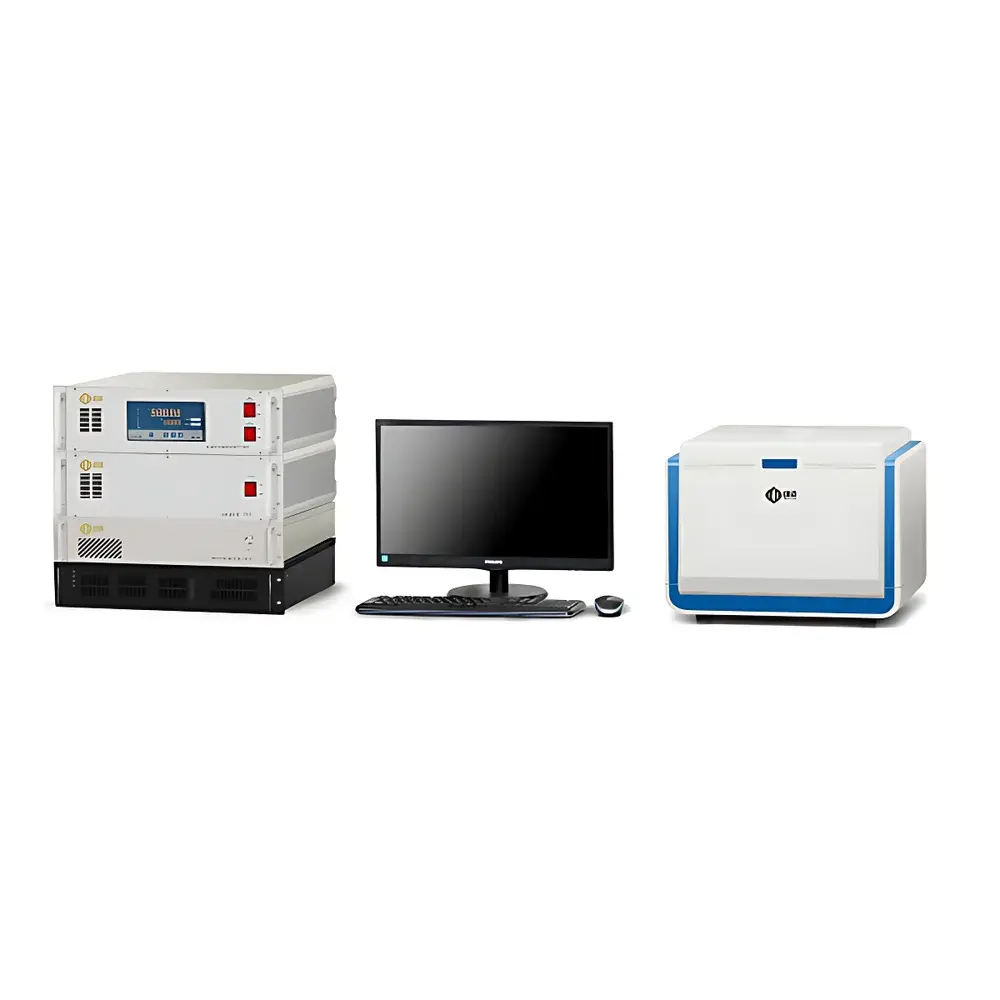
NIUMAG EDUMR20-015V-I Educational Nuclear Magnetic Resonance (NMR) Teaching System
| Brand | NIUMAG |
|---|---|
| Origin | Jiangsu, China |
| Manufacturer Type | Authorized Distributor |
| Product Category | Domestic |
| Model | EDUMR20-015V-I |
| Pricing | Upon Request |
Overview
The NIUMAG EDUMR20-015V-I Educational Nuclear Magnetic Resonance (NMR) Teaching System is a purpose-built benchtop NMR platform engineered for undergraduate and graduate laboratory instruction in physics, biomedical engineering, medical imaging, and analytical sciences. Unlike simplified demonstration kits, this system implements core pulsed NMR principles—including spin excitation, RF pulse sequencing, free induction decay (FID) acquisition, and Fourier-based signal reconstruction—using real hardware components aligned with clinical MRI architecture. It operates at a static magnetic field strength of 0.5 T (21.3 MHz for 1H), generated by a permanent magnet array, and employs a broadband RF transceiver with configurable pulse widths, flip angles, and repetition times. The system supports both continuous-wave (CW) and pulsed NMR modes, enabling direct comparison of classical resonance detection methods with modern time-domain spectroscopy techniques. Its design bridges theoretical instruction with hands-on experimentation, allowing students to observe Larmor precession, measure T1 and T2 relaxation times, and correlate spectral features with molecular mobility—key competencies required in ISO/IEC 17025-accredited analytical laboratories and FDA-regulated diagnostic device development workflows.
Key Features
- Hardware Open Architecture: Fully accessible RF coil assembly, gradient driver circuits, and analog front-end electronics permit oscilloscope-based signal monitoring, multimeter-assisted calibration, and component-level troubleshooting—supporting curriculum-aligned lab exercises in electromagnetic instrumentation and analog circuit design.
- K-Space Data Export: Raw k-space datasets are natively exportable in MATLAB-compatible .mat format, enabling student-led implementation of reconstruction algorithms including inverse Fourier transform, parallel imaging (SENSE), compressed sensing, and deep learning–based denoising models.
- Dual-Mode Operation: Switch seamlessly between CW NMR mode (for resonance frequency sweeps and field homogeneity mapping) and pulsed NMR mode (for spin echo, inversion recovery, and gradient echo sequences).
- Modular Pulse Sequence Library: Includes 12 pre-validated sequences (e.g., SE, IR, GRE, CPMG) with editable parameters (TR, TE, TI, FOV, matrix size), compliant with DICOM Part 10 file structure for interoperability with PACS-integrated teaching environments.
- Integrated Safety & Compliance Framework: Meets IEC 61000-4-3 (EMI immunity) and GB/T 18268.1–2010 (industrial EMC standards); includes hardware interlocks, RF exposure monitoring, and magnetic field containment shielding suitable for classroom deployment.
Sample Compatibility & Compliance
The EDUMR20-015V-I accepts standard 15 mm outer-diameter glass NMR tubes and accommodates aqueous, organic, and polymer-based phantoms—including doped agarose gels, MnCl2-doped water, and silicone oil emulsions—for quantitative relaxation time calibration. All experimental protocols align with ASTM E2830-19 (Standard Guide for NMR Spectroscopy Education) and support GLP-compliant documentation practices via timestamped audit logs and user-authenticated session records. The system’s RF subsystem complies with ICNIRP 2020 guidelines for occupational exposure limits, and its mechanical enclosure conforms to IP20 ingress protection requirements for educational facility use.
Software & Data Management
The included NIUMAG EduSoft v3.2 platform provides a dual-interface environment: a GUI-driven acquisition console for real-time parameter adjustment and preview imaging, and a Python API (PyEDUMR) for script-based experiment automation and batch processing. All acquired data—including raw FIDs, magnitude/phase images, and parameter metadata—are stored in hierarchical HDF5 files with embedded provenance tracking (operator ID, timestamp, sequence ID, hardware configuration hash). Software supports 21 CFR Part 11–compliant electronic signatures, role-based access control (instructor/student/admin), and automated backup to network-attached storage (NAS) or cloud repositories via SFTP. Export modules generate PDF lab reports with embedded spectra, reconstructed images, and statistical summaries of relaxation fitting residuals.
Applications
- Undergraduate physics labs: Visualizing spin dynamics, measuring gyromagnetic ratio (γ), and validating Bloch equations through controlled T1/T2 experiments.
- Biomedical engineering curricula: Designing and testing pulse sequences for artifact suppression, simulating motion-induced phase errors, and evaluating SNR vs. voxel size trade-offs.
- Medical imaging programs: Mapping B0 inhomogeneity using field mapping sequences, reconstructing MR angiography (MRA) projections from TOF data, and analyzing contrast agent kinetics in phantom circulation models.
- Materials science education: Characterizing polymer chain mobility via T2 dispersion analysis and correlating porosity measurements (from diffusion-weighted NMR) with SEM-derived microstructure.
- Signal processing courses: Implementing FIR/IIR filters on raw k-space data, benchmarking iterative reconstruction convergence rates, and validating image quality metrics (PSNR, SSIM, CNR) against ground-truth phantoms.
FAQ
Does the EDUMR20-015V-I support multi-nucleus experiments beyond 1H?
Yes—it is configured for broadband operation from 1–30 MHz, enabling optional 19F, 31P, and 23Na experiments with appropriate probe tuning and RF calibration.
Can raw k-space data be imported into third-party reconstruction toolkits such as Berkeley Advanced Reconstruction Toolbox (BART)?
Yes—data exports include Cartesian k-space coordinates, trajectory metadata, and coil sensitivity maps in BART-compatible format (.cfl), with documented header conventions.
Is the system compatible with existing university LMS platforms like Moodle or Canvas?
Yes—EduSoft supports SCORM 1.2 package generation for embedding interactive NMR simulation modules and auto-graded quiz assessments directly within LMS course shells.
What maintenance and calibration services are available for institutional deployments?
NIUMAG offers annual on-site magnet shimming verification, RF coil Q-factor certification, and software update subscriptions with version-controlled release notes and ISO 9001–certified documentation.
How does the EDUMR20-015V-I meet safety requirements for installation in non-shielded academic buildings?
The permanent magnet design generates a confined fringe field (< 0.5 mT at 1 m distance), eliminating the need for passive ferromagnetic shielding; full safety documentation—including magnetic field contour maps and access control zone specifications—is provided with each unit.




