
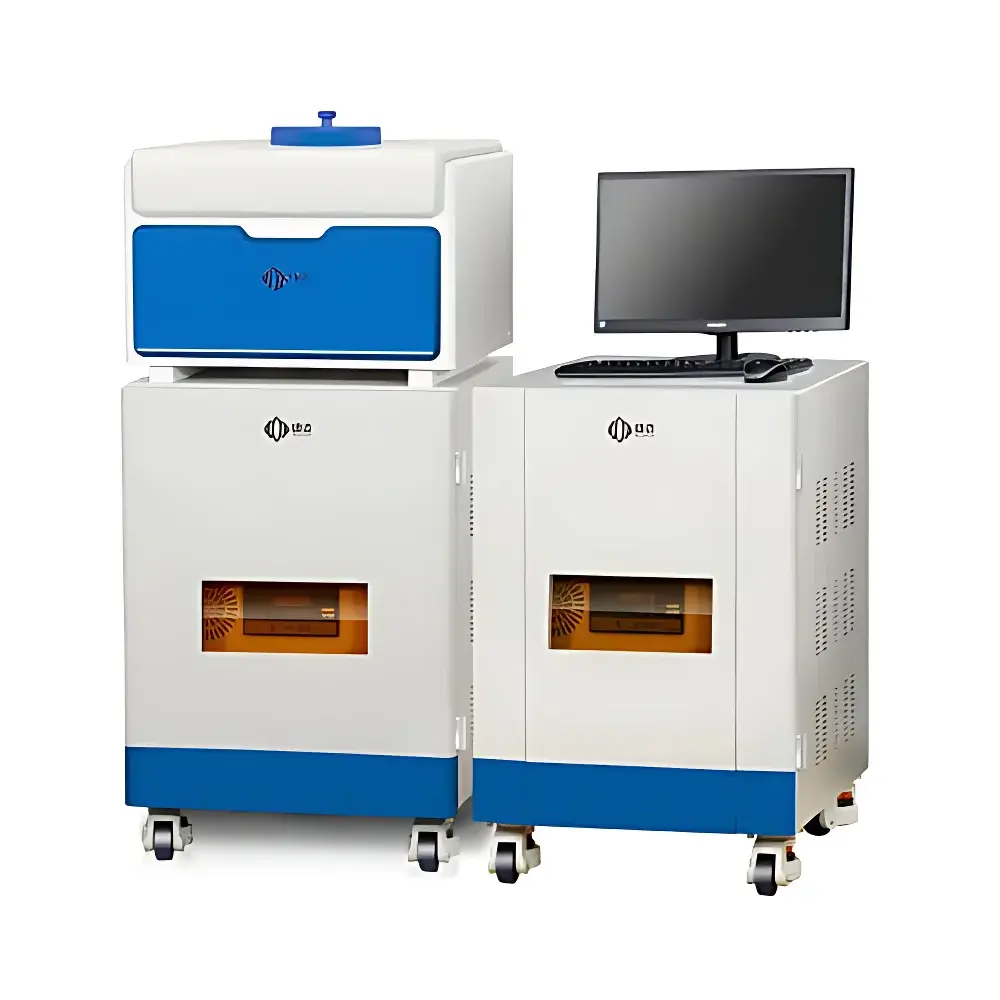
NIUMAG MesoMR21-040V High-Performance 2D Low-Field Nuclear Magnetic Resonance Analyzer
| Brand | NIUMAG |
|---|---|
| Origin | Shanghai, China |
| Model | MesoMR21-040V |
| Magnet Field Strength | 0.50 ± 0.03 T |
| Operating Frequency | ~21.3 MHz (¹H) |
| Sample Orientation | Vertical (longitudinal) |
| Probe Options | 25 mm (1″), 38 mm (1.5″), and ≤10 mm diameter RF coils |
| Sample Type | Solid–liquid dual-phase (rock core, shale, porous media) |
| Instrument Class | Low-field NMR spectrometer |
Overview
The NIUMAG MesoMR21-040V is a purpose-engineered low-field nuclear magnetic resonance (NMR) analyzer optimized for quantitative petrophysical characterization and hydrogen-bearing fluid identification in unconventional reservoirs. Operating at a static magnetic field of 0.50 ± 0.03 T (corresponding to a ¹H Larmor frequency of ~21.3 MHz), it leverages robust pulsed NMR methodology—including spin-echo, inversion-recovery, and specialized 2D T₁–T₂ correlation sequences—to resolve relaxation heterogeneity in complex porous media. Unlike high-field NMR systems designed for molecular structure elucidation, the MesoMR21-040V emphasizes signal fidelity in short-T₂ regimes (<1 ms), enabling reliable detection of bound fluids, organic matter, and immobile hydrocarbons in low-porosity, low-permeability formations such as shale, tight sandstone, and carbonate reservoirs. Its vertical magnet geometry accommodates standard core plugs (25 mm and 38 mm diameter) as well as custom sub-10 mm samples—critical for heterogeneous or limited-volume geological specimens.
Key Features
- Optimized 2D T₁–T₂ correlation acquisition with enhanced sensitivity for short-relaxation components, achieved via customized pulse sequences and high-duty-cycle RF amplification.
- Dual-mode capability: simultaneous support for single-echo (T₂ distribution), inversion-recovery (T₁ distribution), and joint T₁–T₂ mapping—enabling discrimination among kerogen, adsorbed oil, movable oil, structural water, and free water based on characteristic T₁/T₂ ratios.
- Modular probe system with interchangeable RF coils (25 mm, 38 mm, and ≤10 mm inner diameter), each calibrated for homogeneous B₁ field and matched impedance across the operating frequency band.
- Integrated temperature-controlled probe option (±0.1 °C stability) for controlled saturation-state experiments and thermal relaxation studies in reservoir simulation workflows.
- Engineered for reproducibility in routine core analysis: automated shimming, real-time SNR monitoring, and hardware-level phase correction minimize operator dependency and measurement drift.
Sample Compatibility & Compliance
The MesoMR21-040V accepts intact or sectioned rock core samples conforming to API RP 40 and ASTM D6988 standards for core preparation. Its vertical bore design supports both air-dried and brine-saturated configurations, with optional vacuum saturation rigs compatible with industry-standard pore-fluid protocols. Data acquisition and processing workflows align with GLP principles: audit trails, user-access controls, and electronic signatures are supported through optional software modules compliant with FDA 21 CFR Part 11 requirements. All T₂ cutoffs, T₁–T₂ cross-peak assignments, and porosity-permeability correlations adhere to established petrophysical interpretation frameworks referenced in SPWLA and Petrophysics journal guidelines.
Software & Data Management
Acquisition and post-processing are performed using NIUMAG’s proprietary MesoMR Studio v4.x platform—a Windows-based application featuring scriptable sequence development (via Python API), batch-mode 2D inverse Laplace transformation (non-negative least squares with Tikhonov regularization), and integrated petrophysical modeling (e.g., SDR, Coates, and Timur–Coates permeability models). Raw FID data are stored in vendor-neutral HDF5 format with embedded metadata (pulse sequence parameters, field homogeneity maps, temperature logs). Export options include CSV, MATLAB .mat, and SEG-Y-compatible binary for integration into reservoir simulation environments (e.g., PETREL, CMG, or RESOLVE). Software validation documentation—including IQ/OQ/PQ reports and traceable calibration certificates—is provided per customer request to support GMP-aligned laboratory accreditation.
Applications
- Quantitative pore-size distribution estimation from T₂ spectra using surface relaxivity (ρ₂) calibration against mercury intrusion capillary pressure (MICP) data.
- Fluid typing in shales via T₁–T₂ correlation: kerogen exhibits T₁/T₂ ≈ 1–2; adsorbed oil shows T₁/T₂ ≈ 3–5; free oil yields T₁/T₂ > 8; structural water displays T₁/T₂ < 1.
- Evaluation of movable vs. irreducible hydrocarbon saturation under controlled drainage/imbibition cycles, supporting EOR screening and recovery factor modeling.
- Organic richness assessment (TOC proxy) through hydrogen index (HI) derived from integrated ¹H signal amplitude and Rock-Eval–calibrated T₂ cutoffs.
- Low-field NMR method transfer studies for regulatory submissions requiring orthogonal analytical verification (e.g., USP for solid-state dispersion characterization).
FAQ
What distinguishes the MesoMR21-040V from conventional low-field NMR analyzers?
It incorporates field-optimized gradient coils and a high-bandwidth digitizer (≥100 MS/s) specifically to capture rapid decay signals from clay-bound water and kerogen-associated protons—features not present in general-purpose 2 MHz or 5 MHz systems.
Can T₁–T₂ data be correlated with other petrophysical measurements?
Yes. The system supports synchronized acquisition with resistivity, acoustic velocity, and micro-CT scanning via TTL-triggered external hardware interfaces, facilitating multimodal dataset alignment for machine learning–based facies classification.
Is method validation support available for regulated laboratories?
NIUMAG provides full validation packages—including installation qualification (IQ), operational qualification (OQ), performance qualification (PQ), and SOP templates—for compliance with ISO/IEC 17025 and internal QA/QC requirements.
How is magnet homogeneity maintained during long-term operation?
The permanent magnet assembly includes passive shimming elements and an active temperature-stabilized enclosure (±0.05 °C), ensuring field drift < 0.01 ppm/h over continuous 72-h acquisitions.
Does the system support variable-temperature experiments?
With the optional Peltier-cooled probe module, temperature control ranges from 5 °C to 60 °C, enabling Arrhenius-based activation energy analysis of fluid mobility and wettability transitions.





