
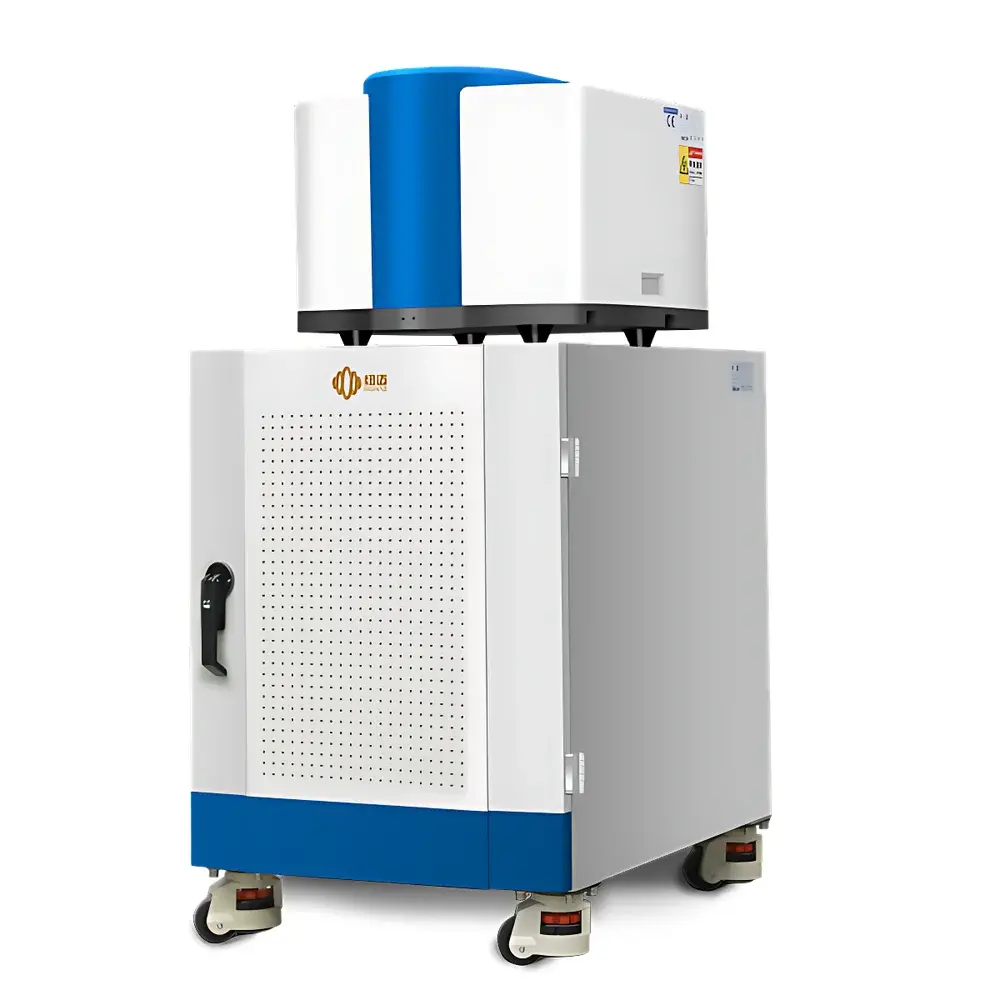
NIUMAG PQ001 Desktop Low-Field Nuclear Magnetic Resonance Analyzer
| Brand | NIUMAG |
|---|---|
| Origin | Shanghai, China |
| Instrument Type | Low-Field NMR Analyzer |
| Sample Compatibility | Solid-Liquid Dual-Phase |
| Magnet Type | Permanent Magnet |
| Magnetic Field Strength | 0.5 ± 0.08 T |
| Larmor Frequency | 21.3 MHz |
| Probe Coil Diameter | 25 mm |
| Effective Sample Volume | Ø25 mm × H35 mm |
| Compliance | GB/T 6504–2008 (Fiber Oil Content) |
Overview
The NIUMAG PQ001 Desktop Low-Field Nuclear Magnetic Resonance (NMR) Analyzer is a compact, benchtop instrument engineered for quantitative relaxation-time-based analysis of hydrogen-bearing compounds in heterogeneous solid and liquid samples. Operating at a static magnetic field of 0.5 ± 0.08 T (corresponding to a 1H Larmor frequency of 21.3 MHz), the PQ001 leverages pulsed NMR principles—specifically spin-echo (CPMG) and inversion-recovery sequences—to extract T2, T1, and diffusion-weighted relaxation distributions. Unlike high-field NMR spectrometers designed for molecular structure elucidation, the PQ001 is purpose-built for industrial process control and routine quality assurance, where rapid, non-destructive, and calibration-free quantification of mobile vs. immobilized proton populations is required. Its permanent magnet architecture ensures operational stability without cryogens or active shimming, making it suitable for environments ranging from food production QC labs to agricultural research stations and polymer R&D facilities.
Key Features
- Compact desktop footprint (W × D × H ≈ 450 × 380 × 320 mm) with integrated magnet, RF probe, and console—no external chiller or power conditioning required.
- High-reproducibility T2 decay acquisition with signal-to-noise ratio (SNR) > 80:1 under standard test conditions (e.g., distilled water, 25 °C).
- Dual-mode operation: single-pulse saturation-recovery for T1 mapping and multi-echo CPMG for robust T2 distribution analysis.
- Probe optimized for Ø25 mm × H35 mm cylindrical sample geometry; accommodates standard NMR tubes (10–25 mm OD), custom inserts, and unpacked bulk solids.
- Temperature-stabilized magnet housing maintains field homogeneity within ±0.05% over ambient range 15–35 °C.
- Firmware supports automated sequence selection, real-time echo train visualization, and batch processing of up to 99 samples per session.
Sample Compatibility & Compliance
The PQ001 is validated for direct measurement of hydrogen-containing phases across diverse matrices without chemical extraction or solvent use. It routinely analyzes edible oils in seeds (e.g., soybean, rapeseed), moisture distribution in cereal grains and dried fruits, solid fat content (SFC) in cocoa butter and margarine (per ISO 8587 and AOCS Cd 16b-93 methodologies), and oil-on-fiber content in synthetic textiles (fully compliant with GB/T 6504–2008). Sample preparation requires only representative sub-sampling and insertion into the probe—no grinding, drying, or derivatization. The system meets general electrical safety requirements per IEC 61010-1 and electromagnetic compatibility per CISPR 11 Group 1 Class B. While not certified for GMP-regulated pharmaceutical release testing, its data integrity features support GLP-aligned workflows.
Software & Data Management
The proprietary NMReDATA v4.x software provides full control of pulse sequence parameters (τ, TE, TR, number of echoes), real-time FFT-based spectral preview, and automated T2 inversion using non-negative least squares (NNLS) with regularization. All raw FID and processed relaxation spectra are stored in HDF5 format with embedded metadata (operator ID, timestamp, sample ID, acquisition parameters). Audit trails record user actions—including parameter edits and data exports—with optional password-protected administrator mode. Export options include CSV (relaxation times, amplitudes, integral areas), PNG/PDF reports, and XML-compatible structured output for integration into LIMS via REST API. Software validation documentation (IQ/OQ protocols) is available upon request for regulated environments.
Applications
- Food & Agriculture: Quantitative oil/water ratio in nuts, legumes, and dairy emulsions; monitoring starch gelatinization kinetics; detecting adulteration in olive oil blends.
- Materials Science: Characterizing pore-size distribution in catalysts and zeolites; assessing crosslink density in rubber compounds via T2 cutoff analysis.
- Pharmaceutical Excipients: Measuring hydration state and polymorphic transition in cellulose derivatives and spray-dried lactose.
- Textiles & Fibers: Rapid determination of oil content on PET, nylon, and acrylic fibers per national standard GB/T 6504–2008.
- Geoscience: Porosity and bound/free fluid index estimation in core plug samples (up to 25 mm diameter).
FAQ
Is the PQ001 suitable for quantitative SFC measurement according to ISO 8587?
Yes—the instrument’s T2 temperature ramp protocol (–40 °C to +40 °C at 1 °C/min) aligns with ISO 8587 Annex A for solid fat content profiling. Calibration curves are established using reference standards traceable to NIST SRM 1940.
Can the PQ001 analyze powdered or granular samples without packing?
Yes—loose powders, pellets, and irregular solids can be measured directly if they fit within the Ø25 mm × H35 mm detection volume. Signal uniformity may require rotational averaging or multiple orientations for anisotropic materials.
Does the system support 2D NMR experiments such as T1–T2 correlation?
No—the PQ001 is a dedicated 1D relaxation analyzer. It does not implement phase-encoded gradient pulses required for 2D inverse Laplace methods.
What maintenance is required for the permanent magnet?
None beyond periodic verification of field homogeneity using a reference sample (e.g., doped water phantom). No cryogen refills, shimming coils, or RF amplifier recalibration are necessary during normal operation.
Is remote access or network deployment supported?
Yes—NMReDATA includes optional TCP/IP server mode for centralized instrument monitoring and scheduled acquisitions across local area networks, compatible with Windows-based enterprise IT infrastructure.




