
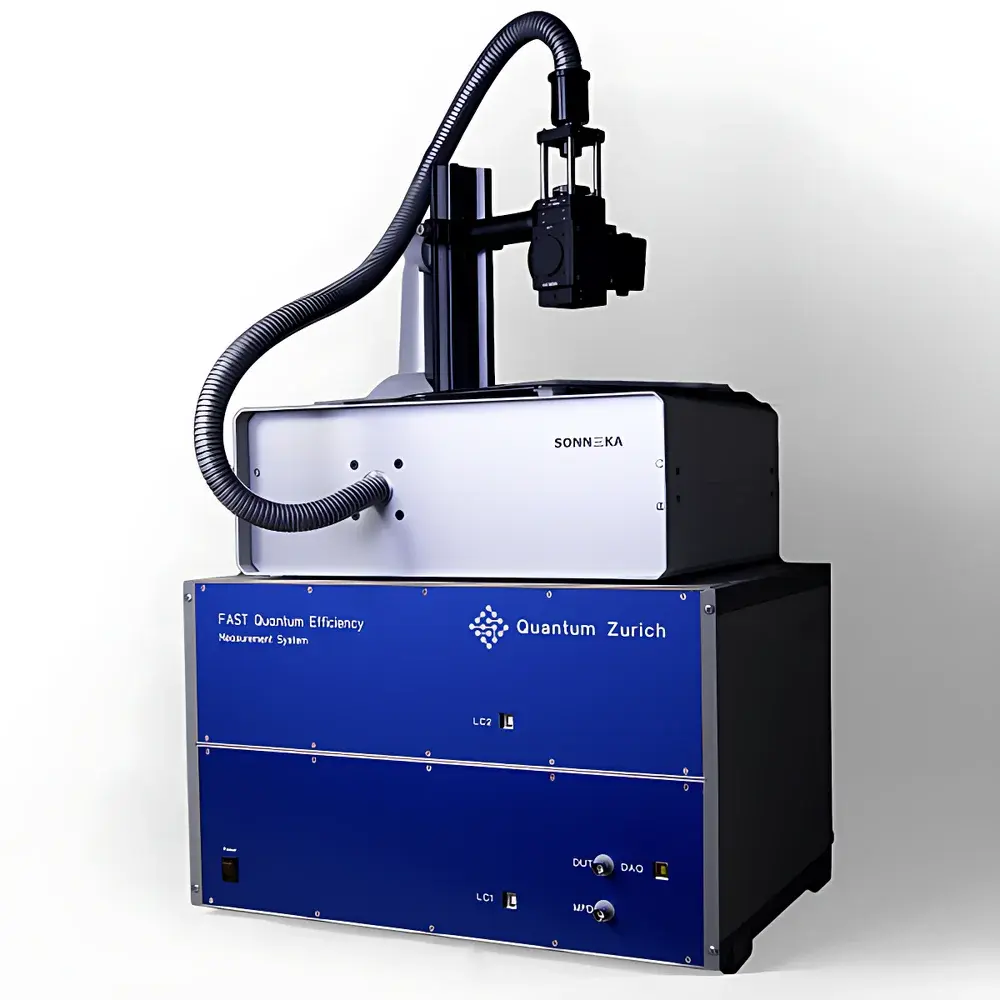
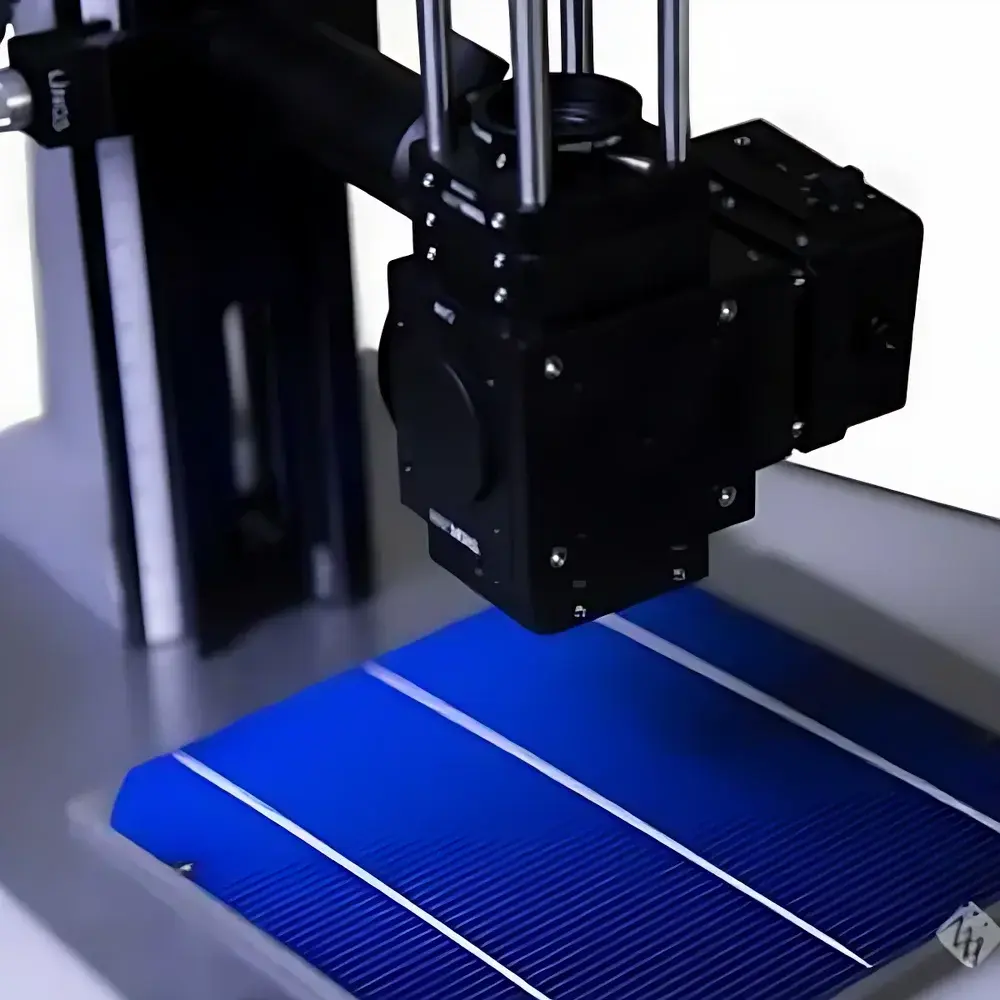
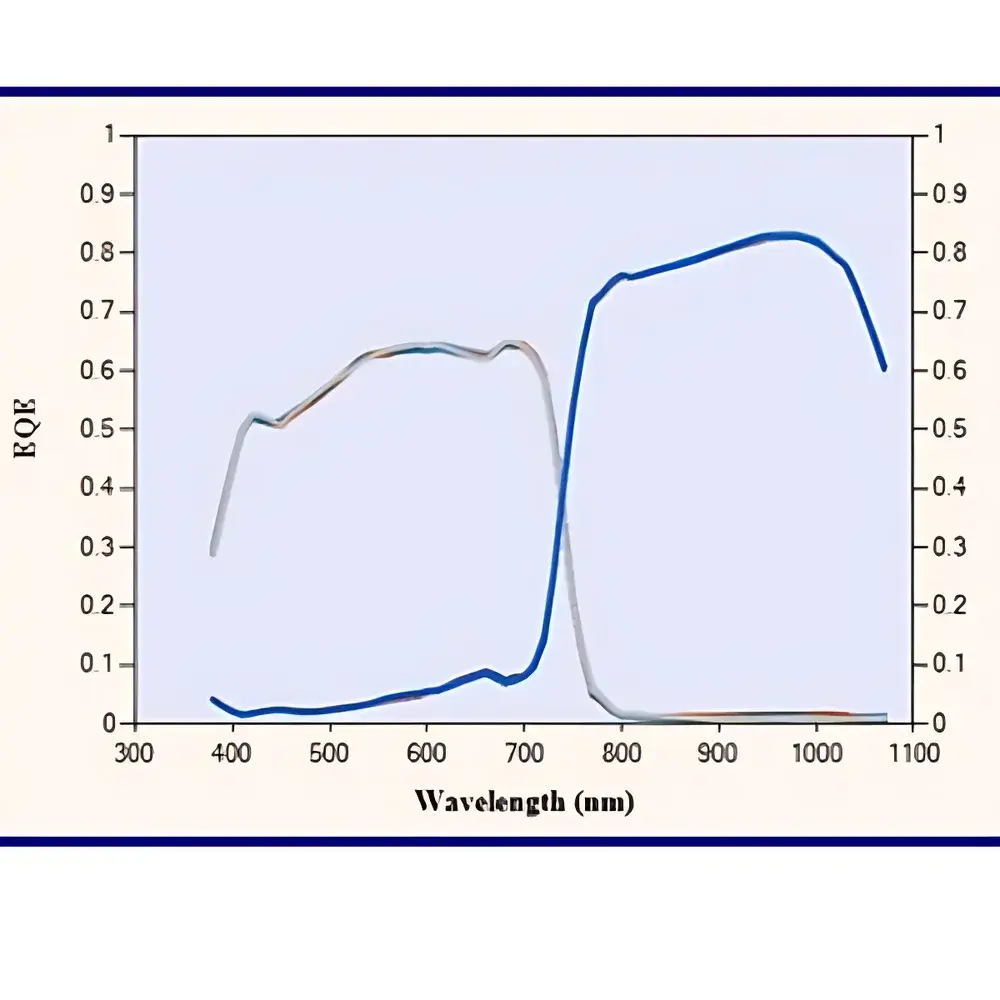
Quantum Zurich Fast EQE In-Situ Quantum Efficiency Measurement System
| Brand | Quantum Zurich |
|---|---|
| Origin | Switzerland |
| Model | Fast EQE |
| Measurement Mode | AC |
| Spectral Range | 300–1200 nm |
| Spot Size | 2–12 mm (1 mm optional) |
| Measurement Time per QE Curve | ≤8 s |
| Excitation Source | Multichannel LED Array |
| Bias Light Options | Red, Blue, White (software-controlled) |
| Calibration Compatibility | NIST-traceable reference diodes |
| Configuration Flexibility | Vertical & Horizontal Sample Mounting |
| Operational Modes | In-situ, Real-time, Long-term Stability, Offline, Glovebox-Integrated, Production-Line Ready |
| IQE Extension Support | Yes |
Overview
The Quantum Zurich Fast EQE In-Situ Quantum Efficiency Measurement System is an engineered solution for rapid, high-fidelity external quantum efficiency (EQE) characterization of photovoltaic devices. Unlike conventional monochromator-based systems relying on sequential wavelength scanning and lock-in amplification, the Fast EQE employs a parallel, multi-channel LED excitation architecture coupled with synchronous AC detection and real-time fast Fourier transform (FFT) signal processing. This architecture eliminates mechanical wavelength selection, chopper wheels, and external reference detectors—reducing measurement latency while preserving spectral fidelity and signal-to-noise ratio. Designed for both R&D laboratories and pilot-line integration, the system delivers full-spectrum EQE curves (300–1200 nm) in ≤8 seconds per acquisition, enabling dynamic monitoring of device performance under operational conditions—including bias illumination, applied voltage, and environmental control (e.g., inside inert-atmosphere gloveboxes). Its core principle rests on simultaneous multi-wavelength photoresponse quantification via phase-sensitive AC photocurrent detection, ensuring traceable, reproducible results aligned with ISO 18575 and ASTM E1021 standards for spectral responsivity calibration.
Key Features
- Parallel multi-LED excitation array with independent on/off control per wavelength channel
- Real-time optical power monitoring at each LED channel using calibrated photodiodes
- Integrated bias light sources (red, blue, white) with software-defined intensity and timing
- Built-in programmable DC bias voltage source (±10 V, 100 mA max) for Jsc and Voc-dependent EQE mapping
- Graphical user interface with one-click measurement workflow, spectral overlay, and AM1.5G-weighted Jsc calculation
- Modular mechanical design supporting vertical and horizontal sample orientation without recalibration
- NIST-traceable calibration protocol using certified reference photodiodes (e.g., Hamamatsu S1337 series)
- Compact footprint (<600 × 450 × 300 mm) optimized for space-constrained cleanrooms and glovebox integration
- Production-ready I/O interfaces (TTL triggers, analog voltage outputs, Ethernet API) for inline process monitoring
Sample Compatibility & Compliance
The Fast EQE accommodates a broad range of photovoltaic architectures including single-junction silicon (c-Si, HIT), thin-film technologies (CIGS, CdTe), perovskite and perovskite/silicon tandems, organic photovoltaics (OPV), and calibrated reference photodiodes. Sample holders accept standard 25 × 25 mm to 156 × 156 mm substrates with adjustable Z-height and tilt compensation. All optical and electronic subsystems comply with IEC 61215-2 MQT 10.1 (spectral response testing) and support GLP/GMP documentation workflows through audit-trail-enabled software logging. Calibration procedures follow ISO/IEC 17025 requirements for measurement uncertainty estimation, and raw data export supports FDA 21 CFR Part 11-compliant electronic signatures when deployed with validated LIMS environments.
Software & Data Management
The system runs on a dedicated Windows-based application with native support for Python and MATLAB APIs. Data acquisition, processing, and visualization are unified within a single environment featuring time-stamped metadata tagging (sample ID, operator, ambient T/RH, calibration date), batch processing queues, and automated report generation (PDF/CSV/XLSX). FFT-based noise rejection ensures stable low-current measurements down to 10 pA resolution. Raw time-domain photocurrent waveforms and amplitude/phase spectra are retained for post-acquisition reprocessing. Software includes built-in AM1.5G spectral weighting, EQE-to-absorptance conversion modules, and IQE derivation workflows requiring reflectance/transmittance inputs from complementary instrumentation.
Applications
- Rapid screening of perovskite/silicon tandem cells during layer optimization and interface engineering
- In-situ degradation studies under continuous illumination and bias stress (ISOS-L-2 protocols)
- Process window validation for roll-to-roll or vacuum-deposited thin-film solar cells
- Calibration transfer between lab-scale EQE tools and production metrology stations
- High-throughput qualification of photodiode arrays for scientific imaging sensors
- Correlation of EQE shifts with electrochemical impedance spectroscopy (EIS) or transient photocurrent measurements
FAQ
Does the Fast EQE require external lock-in amplifiers or monochromators?
No. The system integrates synchronized LED drivers, transimpedance amplifiers, and embedded FFT processors to replace discrete lock-in and monochromator hardware.
Can it measure internal quantum efficiency (IQE)?
Yes—when paired with a reflectance/transmittance module (optional accessory), the software calculates IQE using measured R(λ) and T(λ) spectra.
Is glovebox integration supported out of the box?
Yes. The system features feedthrough-compatible cabling, compact form factor, and inert-gas purge ports for direct mounting inside standard nitrogen-purged gloveboxes.
What is the uncertainty budget for EQE values at 600 nm?
Typical expanded uncertainty (k=2) is ±1.8% across the 400–900 nm range when using factory-calibrated LEDs and NIST-traceable reference diodes.
How is long-term stability verified?
Built-in drift-compensation algorithms monitor LED output stability in real time; optional daily auto-calibration routines use integrated reference photodiodes to correct for thermal and aging effects.



