kSA Emissometer Graphite Disk Emissivity Mapping System
| Brand | k-Space |
|---|---|
| Origin | USA |
| Manufacturer Status | Authorized Distributor |
| Product Origin | Imported |
| Model | kSA Emissometer |
| Pricing | Upon Request |
Overview
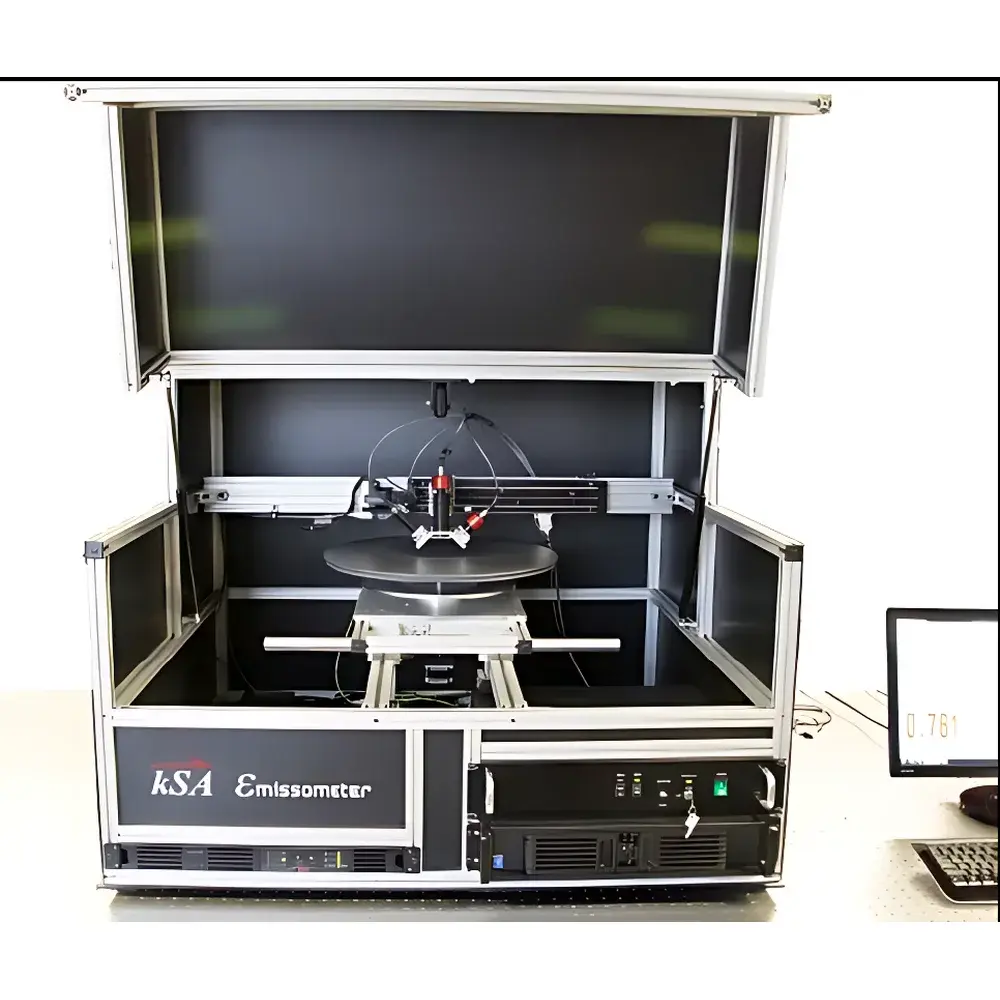
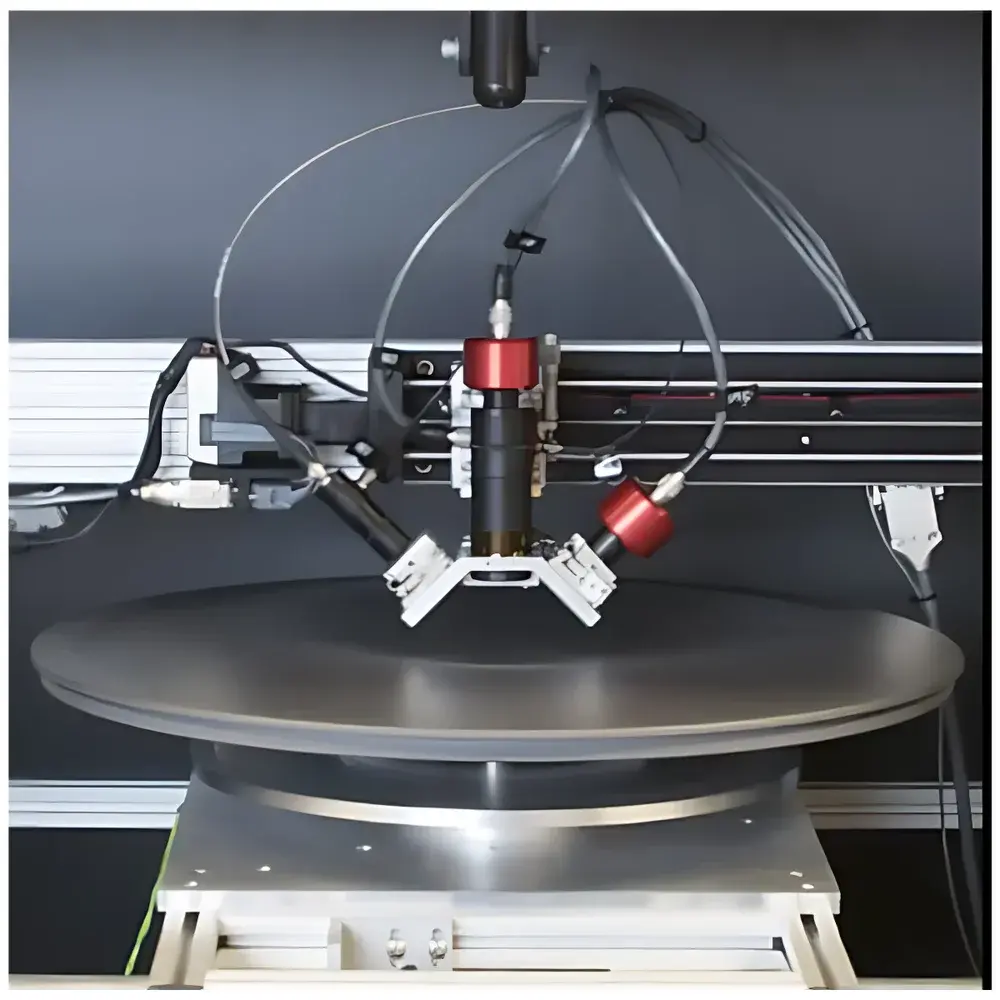
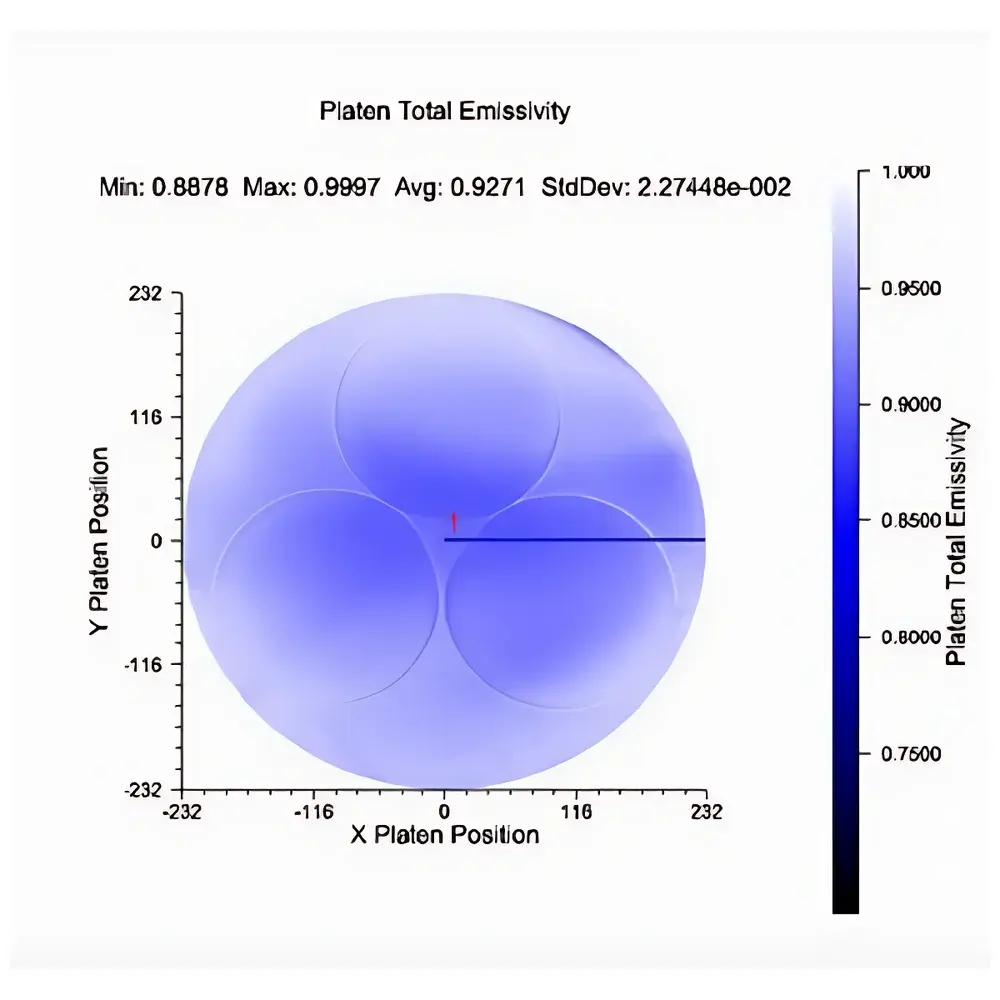
The kSA Emissometer Graphite Disk Emissivity Mapping System is a precision offline optical metrology instrument engineered for quantitative, spatially resolved characterization of thermal emissivity, specular reflectance, and diffuse reflectance across graphite susceptor disks used in high-temperature semiconductor and epitaxial growth processes—particularly metalorganic chemical vapor deposition (MOCVD) and molecular beam epitaxy (MBE). It operates on the principle of calibrated near-infrared (NIR) bidirectional reflectance distribution function (BRDF) measurement, combined with Planck’s law-based emissivity derivation under controlled ambient conditions. By illuminating the rotating graphite disk with monochromatic NIR light (660 nm or 940 nm), and simultaneously acquiring synchronized dual-channel radiometric signals from co-located specular and diffuse detectors, the system reconstructs full 2D emissivity maps with sub-millimeter spatial fidelity. This enables non-contact, non-destructive assessment of surface condition heterogeneity—including oxidation gradients, coating uniformity, micro-roughness variations, localized contamination, and subsurface defect signatures—that directly influence thermal coupling, temperature uniformity, and crystal growth reproducibility.
Key Features
- Dual-sensor optical architecture with independent specular and diffuse detection channels, enabling simultaneous acquisition of reflectance components required for accurate emissivity calculation via Kirchhoff’s law.
- Motorized rotation stage with programmable angular resolution down to 0.1°, coupled with high-precision radial translation (0.05 mm step resolution), supporting customizable mapping grids over diameters up to 700 mm.
- Modular NIR illumination source with selectable wavelengths (660 nm for higher sensitivity to surface oxides; 940 nm for deeper penetration and reduced scattering in graphitic substrates).
- Optimized spot size of 2 mm diameter ensures consistent signal-to-noise ratio across curvature-varying disk geometries without defocusing artifacts.
- Offline benchtop configuration with ergonomic loading interface—designed for rapid disk insertion/removal in cleanroom or tool maintenance environments.
- Embedded calibration routines traceable to NIST-traceable reflectance standards; includes drift compensation algorithms for long-duration scans.
Sample Compatibility & Compliance
The system accommodates standard commercial graphite susceptors (e.g., Poco AXF-5Q, SGL SIGRABOND® series) with diameters from 100 mm to 700 mm and thicknesses up to 30 mm. It supports both flat and slightly concave/convex disk profiles typical in MOCVD hardware. All optical and mechanical subsystems comply with IEC 61000-6-2 (EMC immunity) and IEC 61000-6-4 (EMC emissions) standards. Measurement methodology aligns with ASTM E1933-19 (“Standard Test Methods for Measuring and Compensating for Emissivity Using Infrared Imaging Systems”) and ISO 18434-1:2008 (Condition monitoring — Thermography — Part 1: General procedures). Data integrity protocols support GLP/GMP-aligned workflows, including user-access controls, audit trail logging, and electronic signature readiness per FDA 21 CFR Part 11 requirements when integrated with validated LIMS environments.
Software & Data Management
The kSA Emissometer Control Suite is a Windows-based application developed specifically for process engineers and metrology technicians. It provides intuitive scan parameter definition (radial step, angular increment, dwell time, wavelength selection), real-time preview of reflectance signals, and automated emissivity conversion using configurable emissivity models (e.g., gray-body approximation, two-band method). Output formats include georeferenced TIFF and HDF5 files containing emissivity, specular/diffuse reflectance, and raw detector voltage matrices. Batch processing tools enable comparative analysis across multiple disks, statistical reporting (mean, std dev, min/max per zone), and overlay with thermal simulation meshes. All data files embed EXIF-style metadata (timestamp, operator ID, calibration ID, environmental conditions) and are compatible with MATLAB, Python (via h5py), and industry-standard SPC platforms.
Applications
- Pre-installation qualification of graphite susceptors to identify oxidation hotspots, coating delamination, or machining-induced subsurface damage prior to chamber integration.
- Root-cause analysis of wafer temperature non-uniformity during epitaxial growth by correlating emissivity maps with post-growth wafer bow, thickness variation, or photoluminescence intensity gradients.
- Process validation for graphite reconditioning cycles (e.g., acid etching, plasma cleaning, high-temp annealing) by quantifying emissivity recovery and spatial homogenization.
- Supporting DOE studies on susceptor aging mechanisms—tracking emissivity drift over hundreds of growth runs to establish predictive maintenance thresholds.
- Calibration reference generation for in-situ pyrometry systems, where known emissivity distributions improve absolute temperature accuracy in reactor modeling.
FAQ
Is the kSA Emissometer suitable for in-situ measurements inside a vacuum chamber?
No—it is designed exclusively as an offline metrology tool for ambient-pressure, room-temperature evaluation of removed graphite disks.
Can the system measure emissivity at elevated temperatures?
No—the measurement is performed at ambient temperature; emissivity values are interpreted as proxies for high-temperature behavior based on material-specific temperature dependence models.
Does the software support automated pass/fail grading against user-defined emissivity thresholds?
Yes—customizable zoning and thresholding rules can be defined per disk region (center, mid-radius, edge), with visual flagging and exportable compliance reports.
What maintenance is required for long-term measurement stability?
Annual recalibration using certified reflectance standards is recommended; optical path cleaning and motor encoder verification should be performed quarterly in high-utilization environments.
How does the system handle graphite disks with non-uniform surface curvature?
The dual-detector geometry and auto-focus algorithm compensate for local height variations within ±2 mm; for severely warped disks (>3 mm deviation), optional height-mapping add-on modules are available.