
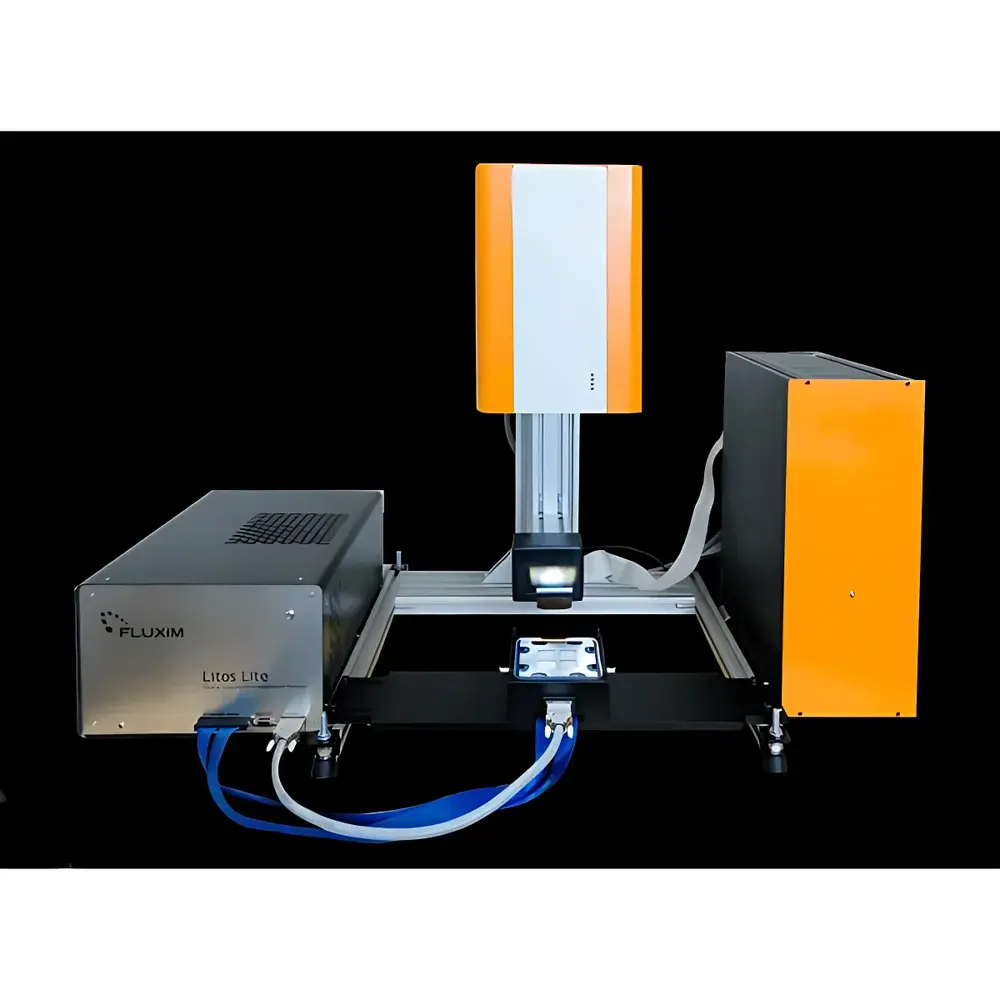
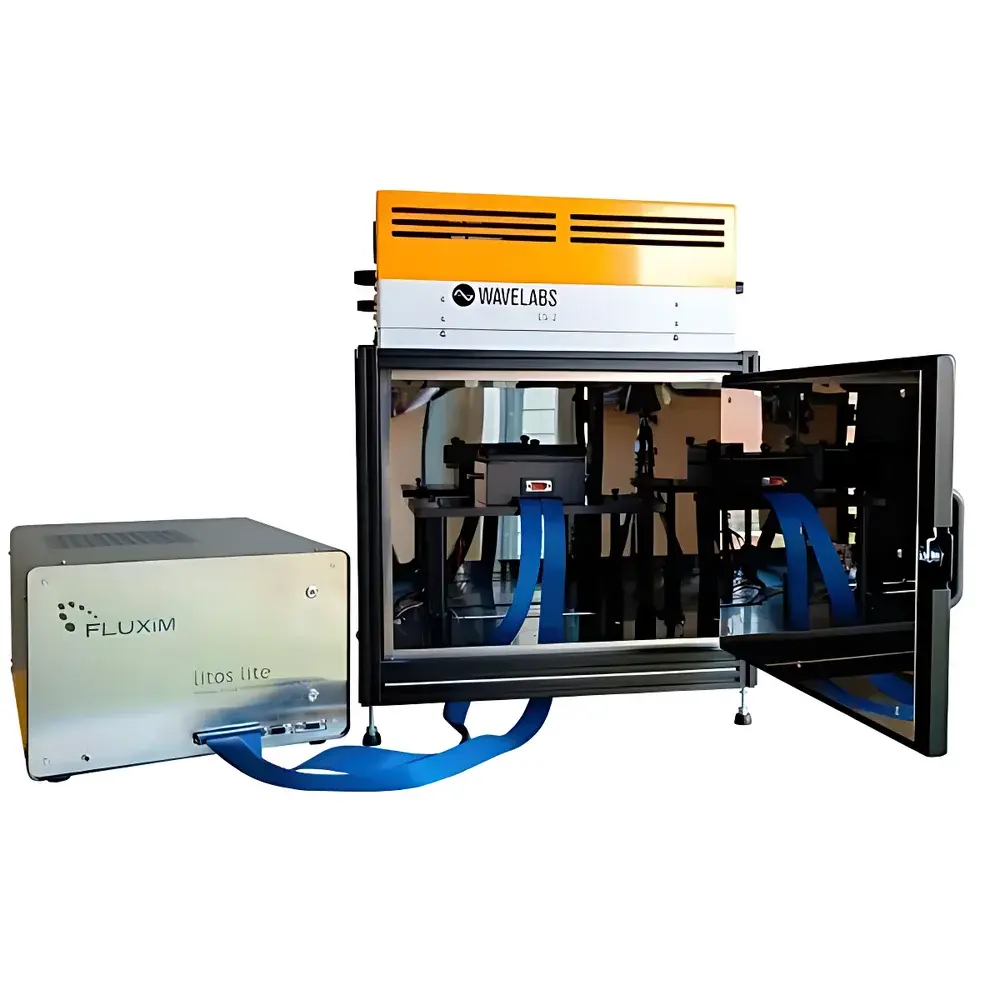
Fluxim Litos Lite Multi-Channel Solar Cell Stability Measurement System
| Brand | Fluxim |
|---|---|
| Origin | Switzerland |
| Model | Litos Lite |
| Light Source Type | Steady-State LED Solar Simulator |
| Spectral Class | AAA (IEC 60904-9 Ed. 3) |
| Number of Independent Test Channels | 56 |
| Voltage Scan Range | ±10 V |
| Maximum Current per Channel | 50 mA |
| Spectral Tunability | Yes (A++/A-Class adjustable) |
| LED Lifetime | >10,000 h |
| Temperature Control Range | RT to 150 °C |
| Environmental Control | O₂ and RH regulation |
| Compliance | ISOS-L, ISOS-O, ISOS-D protocols |
| Feedback Control | Real-time irradiance stabilization |
| Measurement Modes | J-V sweeps, MPPT, Voc, Jsc, long-term stability tracking |
Overview
The Fluxim Litos Lite Multi-Channel Solar Cell Stability Measurement System is an engineered platform designed for high-fidelity, accelerated stability assessment of emerging photovoltaic technologies—including perovskite, organic, dye-sensitized, and tandem solar cells—under rigorously controlled environmental and illumination conditions. At its core, the system integrates a certified AAA-class (IEC 60904-9 Ed. 3) steady-state LED solar simulator with spectral tunability across A++ to A-class fidelity, enabling reproducible spectral matching to AM1.5G or user-defined spectra. Unlike pulsed or flash-based simulators, the Litos Lite’s continuous-wave LED architecture eliminates transient thermal artifacts and enables true real-time tracking of degradation kinetics during extended operation. Its fully enclosed, modular test chamber supports precise regulation of temperature (RT to 150 °C), relative humidity (RH), and oxygen partial pressure—key parameters defined in the International Summit on Organic Photovoltaic Stability (ISOS) protocols (ISOS-L, ISOS-O, ISOS-D). This ensures data comparability across laboratories and alignment with peer-reviewed stability reporting standards.
Key Features
- 56 independently addressable measurement channels, each equipped with dedicated source-measure units (SMUs) supporting simultaneous J-V sweeps, open-circuit voltage (Voc), short-circuit current density (Jsc), and maximum power point tracking (MPPT) under constant illumination.
- Steady-state LED illumination with integrated real-time irradiance feedback control—maintaining intensity stability better than ±0.5% over 1,000 hours—critical for distinguishing intrinsic degradation from measurement drift.
- Spectral tunability via programmable LED driver firmware; users can adjust spectral weightings to emulate varying atmospheric conditions or match specific device absorption profiles.
- ±10 V voltage sweep range and 50 mA per-channel current capacity accommodate both low-current thin-film devices and higher-current silicon-perovskite tandems.
- Thermal management system with PID-controlled heating plates and optional liquid-cooled stage support for isothermal testing at elevated temperatures up to 150 °C.
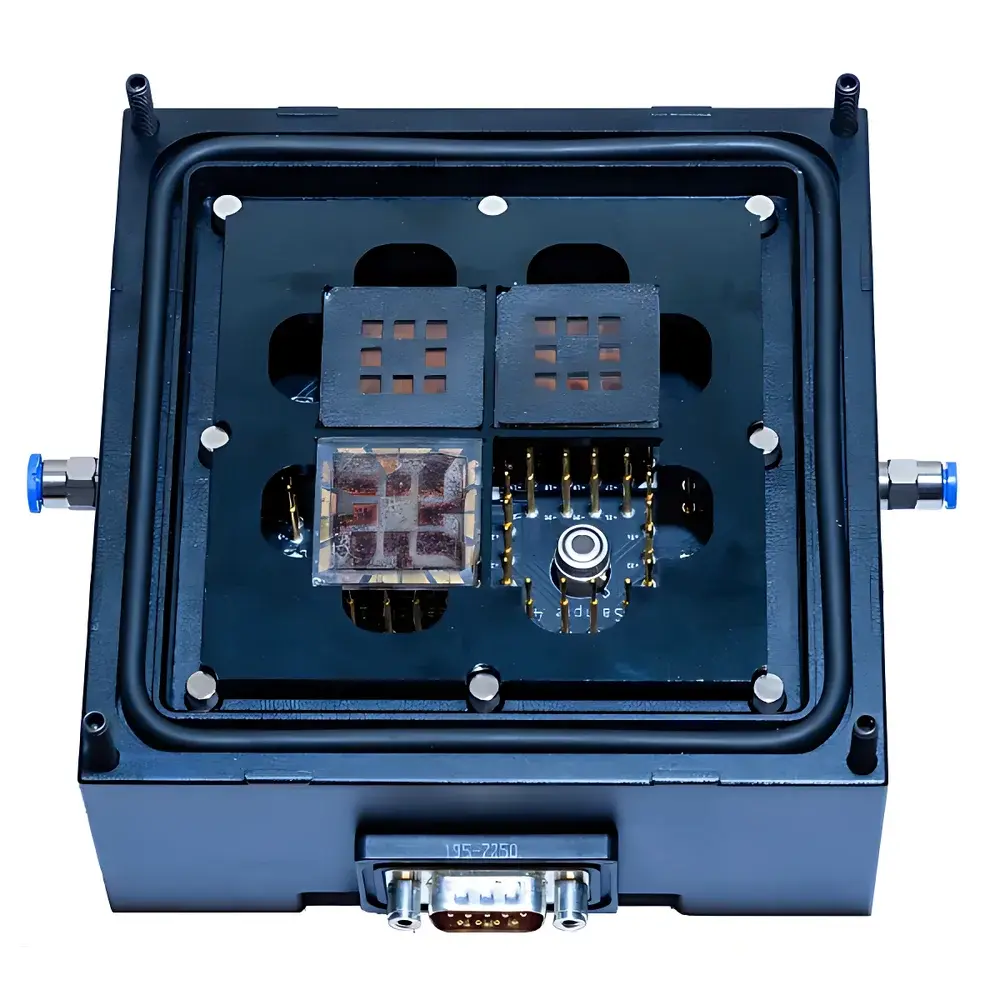
- Gas-tight chamber with dual mass flow controllers (MFCs) for independent regulation of O₂ concentration (ppm–21% range) and RH (5–95% non-condensing), with integrated sensors traceable to NIST standards.
Sample Compatibility & Compliance
The Litos Lite accommodates standard 1 cm² active-area devices mounted on industry-compatible substrates (glass/ITO, flexible PET/PEN, metal foils) using spring-loaded or vacuum-contact probe fixtures. All electrical interfaces comply with IEEE 1547-2018 grounding and isolation requirements. Environmental controls meet ISOS-L-1 (light-induced degradation), ISOS-O-1 (oxygen exposure), and ISOS-D-1 (damp heat) test definitions. Data acquisition adheres to GLP-compliant timestamping, sensor calibration logging, and metadata tagging (e.g., ambient T/RH, lamp intensity, spectral irradiance distribution). Optional audit-trail module supports FDA 21 CFR Part 11 compliance for regulated R&D environments.
Software & Data Management
Control and analysis are performed via Fluxim’s proprietary StabilityStudio software—a Python- and Qt-based application supporting scriptable experiment sequencing, real-time dashboard visualization, and automated ISOS-compliant report generation (PDF/CSV/XLSX). Raw data streams (voltage, current, temperature, RH, O₂) are stored in HDF5 format with embedded metadata (sensor IDs, calibration dates, instrument firmware versions). The software includes built-in degradation modeling tools: T80/T90 lifetime extrapolation, Arrhenius activation energy fitting, and Weibull distribution analysis for failure mode identification. Export modules interface with MATLAB, Origin, and Jupyter for advanced statistical modeling.
Applications
- Accelerated aging studies under ISOS-defined stressors (light, heat, humidity, oxygen) for perovskite PV stability benchmarking.
- Screening of interfacial layers, encapsulation schemes, and charge transport materials via parallelized channel testing.
- Real-time MPPT optimization under varying spectral conditions to evaluate operational stability in realistic outdoor scenarios.
- Correlation of J-V hysteresis evolution with environmental parameter shifts—enabling mechanistic degradation pathway analysis.
- Supporting DOE SunShot and EU Horizon stability validation requirements for technology readiness level (TRL) advancement.
FAQ
Does the Litos Lite support in situ spectroelectrochemical measurements?
No—optical access is limited to top-illumination geometry; integration with external spectrometers requires custom chamber modification.
Can the system operate under inert atmosphere only?
Yes—N₂ or Ar purging is supported via MFC-controlled gas inlet; residual O₂ levels <1 ppm achievable with optional getter cartridge.
Is remote monitoring available?
Yes—StabilityStudio includes secure WebSocket API and TLS-encrypted web dashboard for off-site experiment supervision and alarm notifications.
What calibration standards are provided with the system?
NIST-traceable Si reference cell (certified by PTB), calibrated thermocouples (Class 1), and RH sensor calibration kit (±1.5% RH accuracy) are included.
How is data integrity ensured during multi-week stability runs?
Continuous checksum verification, redundant storage (local SSD + network-attached backup), and cyclic redundancy check (CRC32) on all HDF5 datasets prevent silent corruption.





