LaVision FlowMaster®-Adaptive Particle Image Velocimeter (PIV)
| Brand | LaVision GmbH |
|---|---|
| Origin | Germany |
| Model | FlowMaster®-Adaptive |
| Measurement Domain | 2D/3D Planar |
| Measurement Frequency | Low-Frequency |
| Velocity Range | 0–2 km/s |
| Accuracy | ±1% |
| Measurement Area | 1 m × 1 m |
Overview
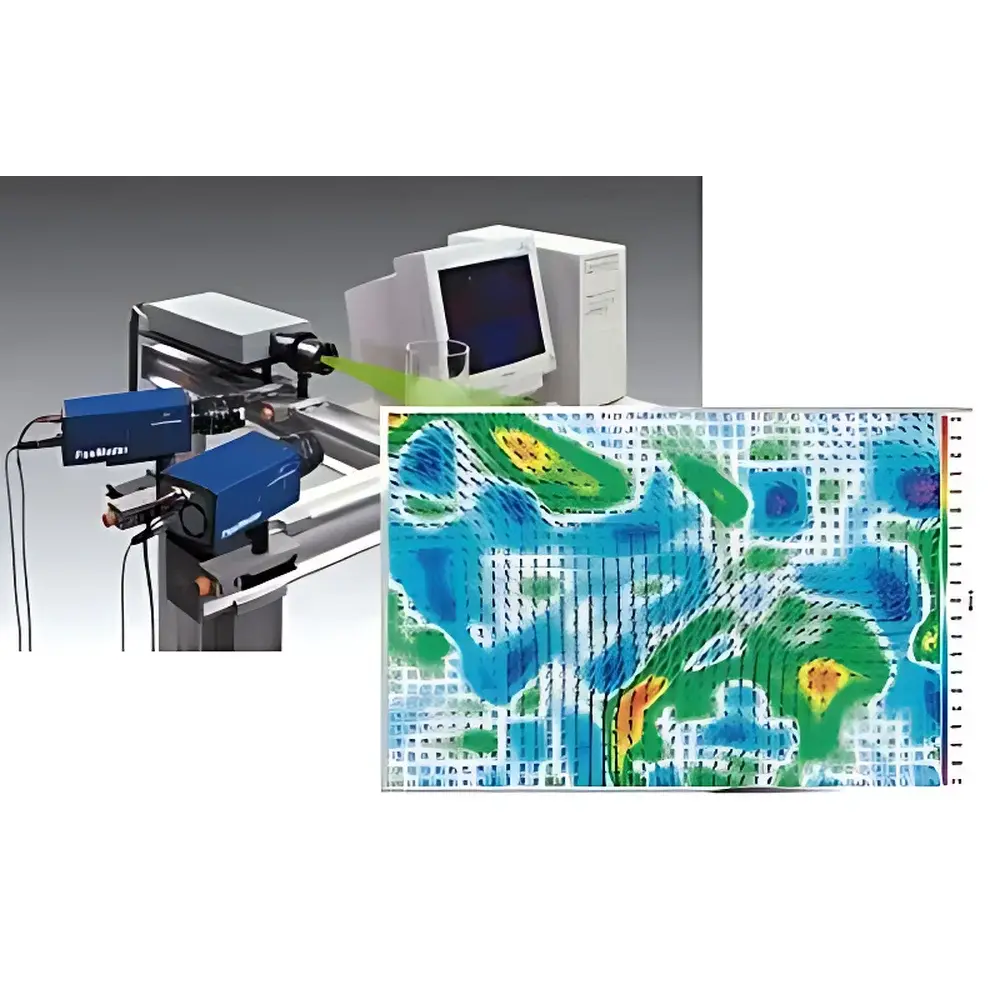
The LaVision FlowMaster®-Adaptive Particle Image Velocimeter is a high-fidelity, research-grade planar velocimetry system engineered for quantitative fluid dynamics analysis in complex, transient, and gradient-rich flow fields. Based on the principle of double-pulse laser illumination and cross-correlation of particle-seeded image pairs, this PIV system implements adaptive interrogation window sizing and shaping—dynamically optimized per local flow region—to overcome fundamental limitations of conventional fixed-grid PIV processing. Unlike static interrogation schemes, the Adaptive PIV algorithm evaluates local velocity gradients, out-of-plane displacement magnitude, particle image density, contrast-to-noise ratio (CNR), and correlation peak quality in real time, then computes spatially varying interrogation window dimensions and aspect ratios to simultaneously maximize spatial resolution, measurement accuracy, and robustness across heterogeneous flow domains—including near-wall regions, shear layers, vortex cores, and boundary layer transition zones.
Key Features
- Automated, pixel-level adaptive interrogation window generation—no manual parameter tuning required for optimal correlation performance.
- Real-time feedback during experimental setup: automatic assessment of seeding density, image focus, dynamic range, and inter-frame time delay (Δt) optimization.
- Multi-criteria adaptive decision engine integrating local velocity gradient magnitude, particle image signal fidelity, and correlation peak asymmetry/width metrics.
- Elliptical and anisotropic interrogation windows aligned orthogonal to dominant local shear direction—enhancing resolution along gradient-normal axes while preserving sufficient displacement sampling in flow-aligned directions.
- Support for both 2D planar and stereoscopic 3D PIV configurations with synchronized dual-camera acquisition and calibration traceability per ISO 5725 and VDI/VDE 2634 Part 2.
- Fully integrated hardware-software architecture including high-repetition-rate Nd:YAG lasers, sCMOS imaging platforms, and motorized optical alignment modules.
Sample Compatibility & Compliance
The FlowMaster®-Adaptive PIV system is compatible with standard polyamide, hollow glass, or titanium dioxide tracer particles (1–50 µm diameter) suspended in gaseous or liquid media—including water, air, oil, and combustion environments. It supports non-intrusive, whole-field velocity vector mapping without flow disturbance. The system complies with IEC 61000-6-3 (EMC emission standards), laser safety class 4 per EN 60825-1, and optical path calibration protocols traceable to NIST and PTB reference standards. Data acquisition and post-processing workflows adhere to GLP principles; audit trails, user access control, and electronic signature support are available via optional FDA 21 CFR Part 11-compliant software modules.
Software & Data Management
DaVis® 10.3 software serves as the unified platform for acquisition, real-time visualization, adaptive processing, and export. It features GPU-accelerated correlation algorithms, multi-threaded batch processing, and hierarchical data storage compliant with HDF5 v1.12 format. All adaptive parameters—including local window size, shape, rotation angle, and Δt assignment—are logged with metadata tags and timestamped per frame. Export options include ASCII, Tecplot PLT, Paraview VTU, and MATLAB .mat formats. Version-controlled script templates enable reproducible analysis pipelines across laboratories, supporting ISO/IEC 17025 accreditation requirements for measurement uncertainty quantification.
Applications
- Aerodynamic development: Boundary layer characterization on airfoils, turbine blades, and automotive underbodies.
- Combustion diagnostics: Flame front propagation, turbulent premixed flame wrinkling, and exhaust gas recirculation (EGR) mixing studies.
- Biomedical fluid mechanics: Hemodynamic analysis in patient-specific vascular models and microfluidic organ-on-chip devices.
- Environmental hydraulics: Sediment transport modeling, open-channel turbulence, and coastal wave-current interaction.
- Industrial process optimization: Mixing efficiency evaluation in stirred tanks, spray atomization dynamics, and jet impingement cooling.
FAQ
How does Adaptive PIV differ from conventional multi-pass recursive PIV?
Adaptive PIV does not rely on iterative refinement of a globally fixed window grid. Instead, it performs single-pass, spatially resolved interrogation window definition based on local image and flow physics metrics—eliminating convergence artifacts and reducing computational overhead by up to 40% compared to recursive approaches.
Can the system operate in unsteady or periodically varying flows?
Yes. The adaptive algorithm recalculates interrogation parameters for every frame pair, making it inherently suitable for fully transient, chaotic, or phase-locked periodic flows where spatial structure evolves dynamically.
Is third-party camera or laser integration supported?
The system supports GenICam-compliant sCMOS cameras and Q-switched Nd:YAG lasers with TTL synchronization. Custom drivers and timing SDKs are provided for OEM integration under NDA.
What uncertainty estimation methods are implemented?
DaVis® includes built-in uncertainty propagation using the correlation peak ratio (CPR), root-mean-square (RMS) peak width, and synthetic image validation tools per ASME MFC-22M and ISO/TR 29922 guidelines.
Does the system support volumetric (tomographic) PIV extensions?
While the FlowMaster®-Adaptive platform is optimized for planar PIV, its modular architecture allows integration with LaVision’s Tomo-PIV add-ons (e.g., four-camera systems with MART reconstruction) through shared DaVis® infrastructure and calibration frameworks.