
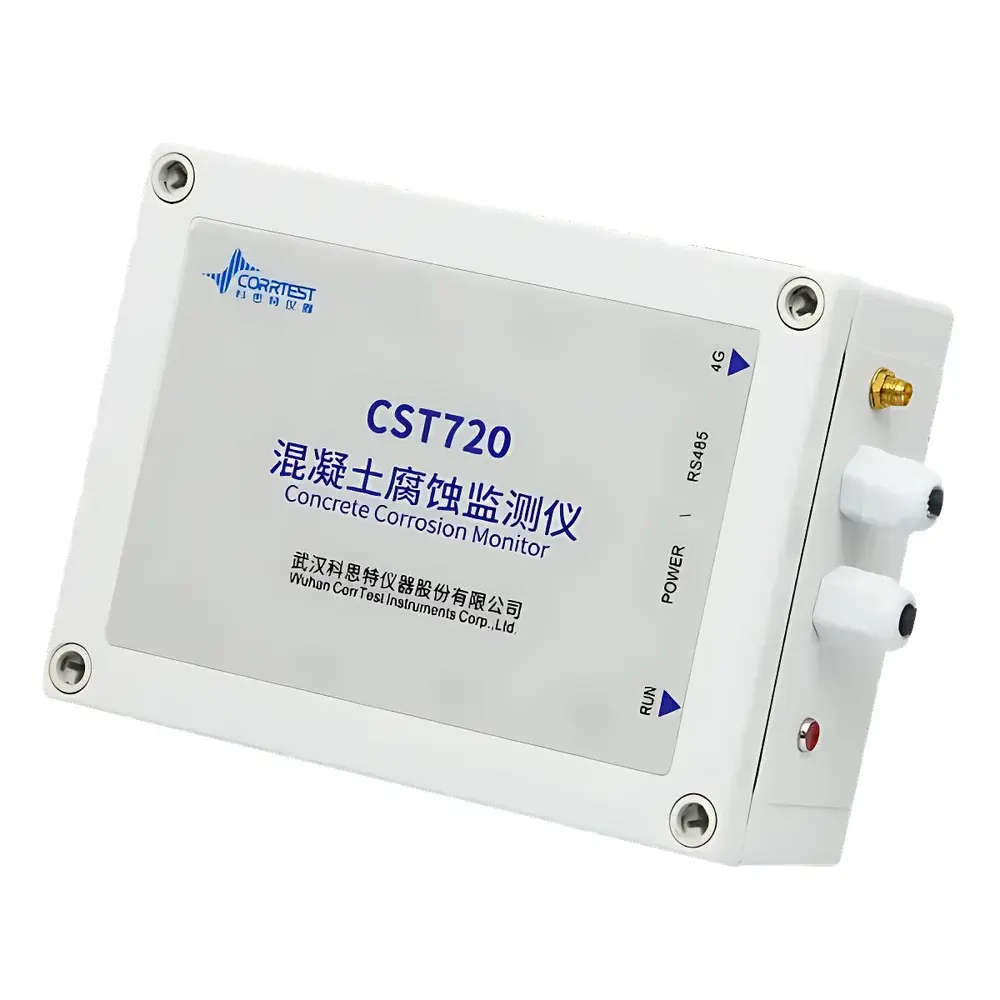
CorrTest CST720 Concrete Corrosion Monitoring System
| Brand | CorrTest |
|---|---|
| Origin | Hubei, China |
| Model | CST720 |
| Power Supply | DC 12 V |
| Communication | RS485 (Modbus RTU) |
| Data Storage | 2 MB (up to 20,000 records) |
| Operating Temperature | −30 °C to +60 °C |
| Operating Humidity | ≤95% RH (non-condensing) |
| Enclosure Rating | IP65 |
| Instrument Dimensions | 180 × 130 × 60 mm |
| Probe Dimensions | Φ54 × 116 mm |
| Weight | 1.5 kg |
| Input Impedance | 1 × 10¹¹ Ω |
| Corrosion Rate Range | 0–10 mm/a |
| Half-Cell Potential Range | −2.5 V to +2.5 V |
| Potential Accuracy | ±0.5% FS |
| Potential Resolution | 0.1 mV |
| pH Range | 4.00–14.00 |
| pH Accuracy | ±10% FS |
| pH Resolution | 0.01 |
| Cl⁻ Range | 1 × 10⁻⁴ – 0.1 mol/L |
| Cl⁻ Accuracy | ±10% FS |
| Cl⁻ Resolution | 1 × 10⁻⁵ mol/L |
| Resistivity Range | 10 Ω·cm – 100 kΩ·cm |
| Resistivity Accuracy | ±0.5% FS |
| Resistivity Resolution | 0.1 Ω·cm |
| Real-Time Clock Drift | <1 min/month |
| Integrated Sensors | MnO₂ reference electrode, Ag/AgCl chloride ISE, conductivity electrode, corrosion working electrode, Pt auxiliary electrode, NTC temperature sensor |
Overview
The CorrTest CST720 Concrete Corrosion Monitoring System is an engineered solution for long-term, in-situ electrochemical and physicochemical assessment of reinforced concrete infrastructure. It operates on a multi-parameter, multi-sensor principle grounded in ASTM C876 (half-cell potential), ASTM C1202 (rapid chloride permeability), and ISO 16701 (electrochemical corrosion rate measurement). The system continuously acquires five interrelated parameters—rebar half-cell potential, concrete resistivity, chloride ion activity (Cl⁻), pore solution pH, and temperature—to quantify the thermodynamic driving force and kinetic conditions governing steel depassivation and active corrosion. Unlike intermittent manual surveys, the CST720 enables autonomous, time-synchronized data acquisition at user-defined intervals (1 min to 24 h), supporting predictive modeling of service life per fib Model Code 2010 and EN 206 durability frameworks.
Key Features
- Integrated CP-72 composite probe with co-located MnO₂ reference electrode, solid-state chloride-selective electrode (ISE), pH glass electrode, four-electrode resistivity cell, and dual-working-electrode corrosion sensor—designed for simultaneous, spatially aligned measurement within a single 54 mm diameter borehole.
- High-input-impedance (>10¹¹ Ω) analog front-end optimized for low-current electrochemical signals, minimizing polarization error during potential and corrosion rate measurements.
- Non-volatile memory (2 MB) with timestamped storage of up to 20,000 full parameter sets, retaining integrity during power interruption or network downtime.
- RS485 interface compliant with Modbus RTU protocol (slave ID configurable), enabling seamless integration into SCADA, BMS, or cloud-based structural health monitoring (SHM) platforms.
- IP65-rated enclosure with UV-stabilized engineering polymer housing, rated for continuous outdoor deployment across −30 °C to +60 °C ambient conditions and high-humidity environments without condensation.
- Embedded real-time clock with drift <1 minute/month, ensuring traceable temporal alignment across distributed sensor nodes in multi-point monitoring networks.
Sample Compatibility & Compliance
The CST720 is validated for use in ordinary Portland cement (OPC), blended cements (e.g., slag, fly ash), and high-performance concrete (HPC) matrices with w/c ratios from 0.35 to 0.65. Its CP-72 probe meets ASTM C876 requirements for reference electrode stability and response time in concrete with resistivity >1 kΩ·cm. Chloride ISE calibration is traceable to NIST SRM 3142a (KCl solutions); pH electrode performance conforms to ISO 17025-accredited calibration protocols. The system supports audit-ready data logging compliant with GLP principles, including operator ID, configuration change logs, and measurement metadata—facilitating regulatory review under ISO 9001, ISO/IEC 17025, and infrastructure asset management standards (e.g., PAS 55, ISO 55000).
Software & Data Management
SKit Corrosion Monitoring Software provides configuration, visualization, and export functionality via Windows-based PC interface. Users define measurement schedules, set alarm thresholds (e.g., potential 0.4 mol/m³, resistivity < 5 kΩ·cm), and generate trend reports aligned with EN 1504-9 durability assessment criteria. Raw data exports support CSV, Excel, and SQLite formats; time-series plots include dual-Y axes for cross-parameter correlation analysis (e.g., Cl⁻ vs. potential, resistivity vs. corrosion rate). All configuration changes and data transfers are logged with digital timestamps and user attribution—supporting 21 CFR Part 11–compatible electronic record integrity when deployed in regulated civil infrastructure projects.
Applications
- Long-term durability monitoring of marine-exposed bridges, port structures, and coastal highways where chloride ingress drives reinforcement corrosion.
- Performance validation of corrosion-inhibiting admixtures (e.g., calcium nitrite) and surface-applied protective coatings (e.g., silanes, epoxy overlays).
- Condition assessment of aging infrastructure—including post-tensioned bridges and nuclear containment structures—prior to rehabilitation planning.
- Field validation of numerical diffusion models (e.g., Fick’s second law simulations) using time-resolved Cl⁻ and pH profiles from embedded probes.
- Research-grade data acquisition for accelerated laboratory testing (e.g., ASTM G109, RILEM TC 116-PCD) correlating electrochemical outputs with gravimetric mass loss and microstructural analysis (SEM/EDS).
FAQ
What reference electrode does the CP-72 probe use, and why is MnO₂ selected over Ag/AgCl?
The CP-72 employs a manganese dioxide (MnO₂) reference electrode, which exhibits superior long-term stability in alkaline concrete pore solution (pH >12.5) and minimal chloride sensitivity—unlike Ag/AgCl electrodes that suffer from AgCl precipitation and drift in high-Cl⁻ environments.
Can the CST720 measure instantaneous corrosion current density (icorr)?
Yes—via linear polarization resistance (LPR) using the integrated three-electrode corrosion sensor. The instrument applies ±10 mV polarization around OCP and calculates icorr from slope of the current–potential curve, then converts to penetration rate (mm/a) using Faraday’s law and steel density.
Is probe calibration required before installation?
Yes—pH and Cl⁻ electrodes require two-point calibration using certified buffer and standard solutions; resistivity and potential channels are factory-calibrated but benefit from field verification against known reference samples prior to embedment.
How is data security ensured during remote transmission?
While the base RS485/Modbus interface lacks native encryption, the system supports integration with industrial gateways offering TLS 1.2 tunneling or MQTT-SN with AES-128 payload encryption—enabling secure telemetry in IIoT deployments.
Does the CST720 comply with ISO 12627 for corrosion monitoring systems?
It aligns with functional requirements of ISO 12627-1 (general principles) and ISO 12627-2 (performance criteria for embedded sensors), though formal certification requires third-party validation per project-specific QA/QC protocols.





