
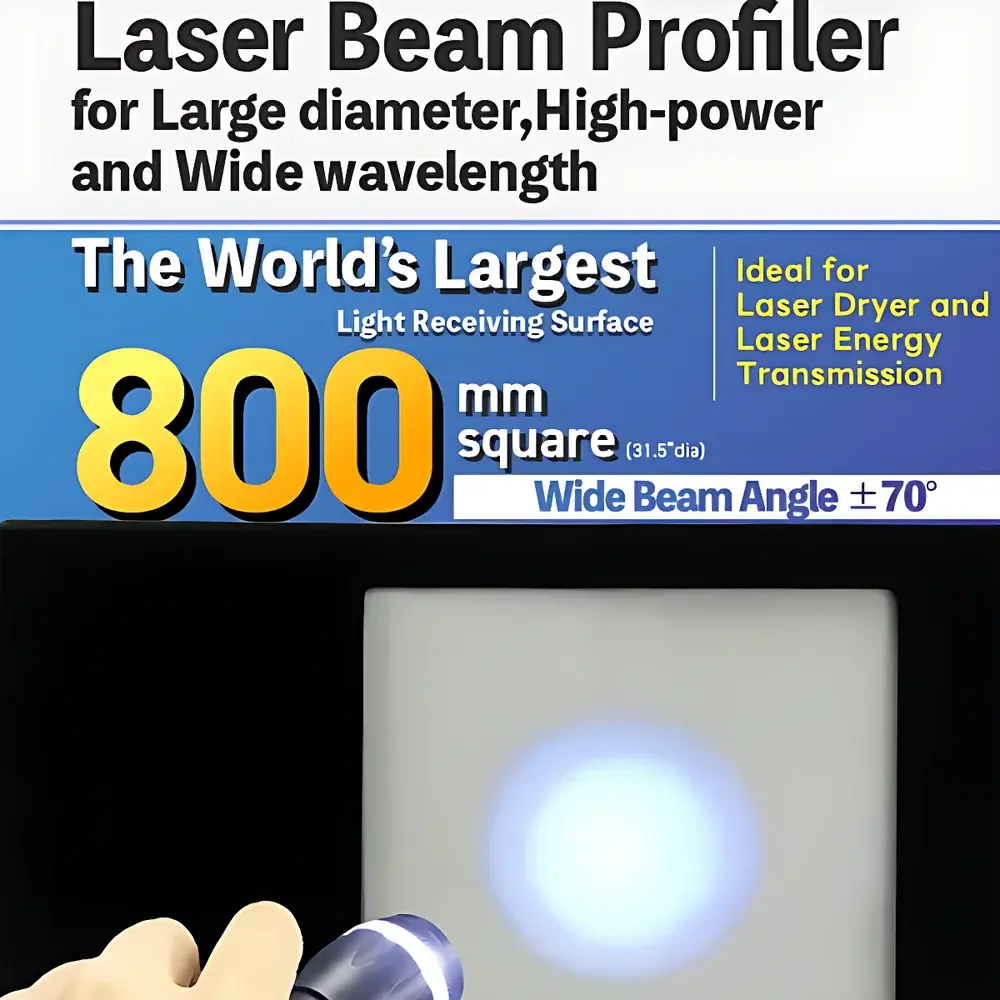
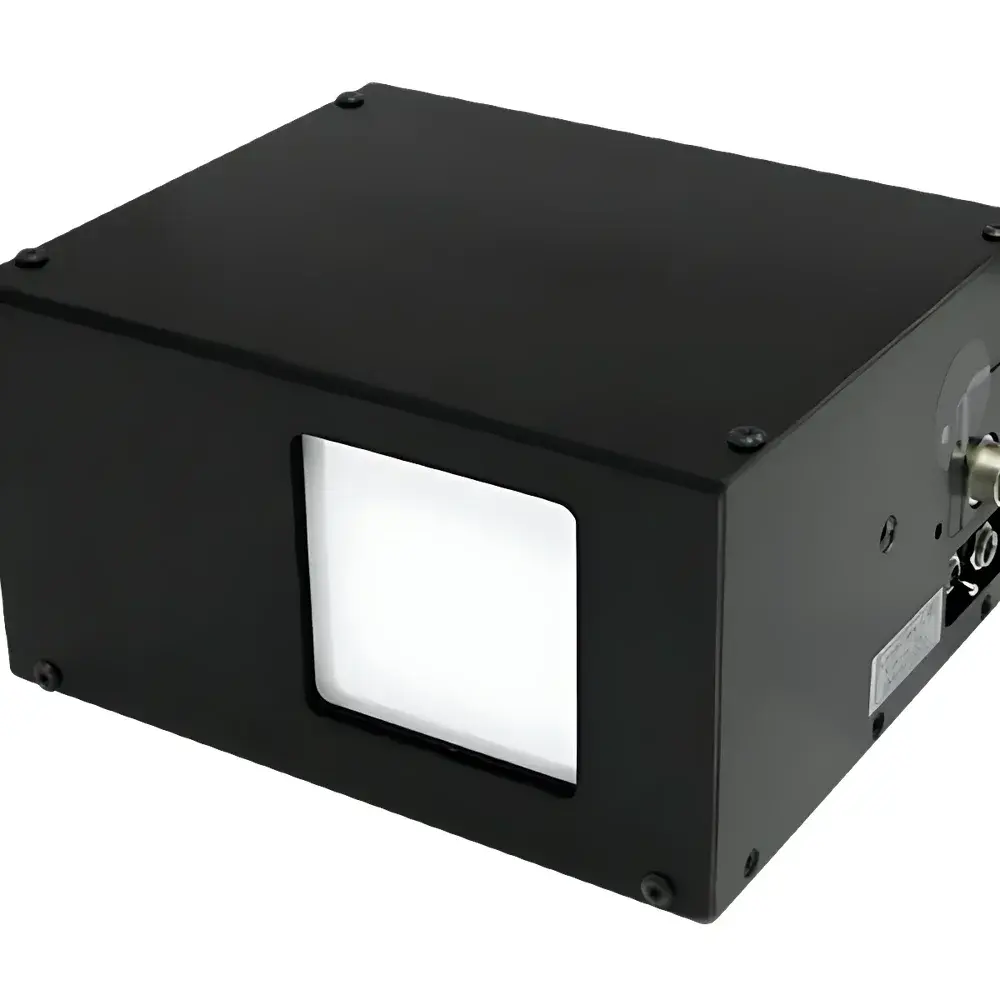
Kokyo Beam Profiler for Large-Aperture Laser Beams
| Brand | Kokyo |
|---|---|
| Origin | Imported (Asia) |
| Model | Beam Profiler |
| Beam Diameter Range | 2 µm to 800 mm |
| Wavelength Range | 190 nm to 16 µm |
| Power Density Range | 0.001 W/m² to 100 kW/m² |
| Compliance | Designed for ISO 11146-1/-2, ISO 13694, and ANSI Z136.1 alignment |
Overview
The Kokyo Beam Profiler for Large-Aperture Laser Beams is an engineered optical measurement instrument designed to characterize the spatial intensity distribution, beam diameter, divergence, and propagation dynamics of high-energy and large-diameter laser beams. Utilizing high-resolution CCD/CMOS sensor arrays—optionally coupled with scanning-slit or knife-edge detection modules—the system implements standardized beam analysis principles defined in ISO 11146-1 (determination of beam widths and diameters) and ISO 11146-2 (determination of beam propagation parameters). Unlike conventional small-beam profilers limited to sub-millimeter apertures, this platform supports direct imaging and quantitative profiling of collimated or divergent beams up to 800 mm in physical extent—enabling accurate diagnostics for industrial cutting lasers, fusion-grade Nd:YAG systems, free-space optical communication transceivers, and LiDAR transmitter arrays. Its design addresses a critical metrology gap: the inability of standard camera-based profilers to maintain dynamic range, linearity, and M² reproducibility when confronted with non-Gaussian, multi-mode, or highly asymmetric intensity distributions across extended optical fields.
Key Features
- Large-aperture imaging capability: Supports full-field beam capture from 2 µm to 800 mm via interchangeable sensor modules—including vacuum-cooled InGaAs for mid-IR (up to 16 µm) and UV-enhanced Si sensors (down to 190 nm)
- High dynamic range operation: Simultaneous attenuation and gain control enables stable measurements across power densities spanning six orders of magnitude (0.001–100 kW/m²)
- Multi-modal analysis architecture: Integrates ISO-compliant D4σ, knife-edge, and second-moment algorithms for beam width (ISO 11146), along with real-time M² calculation per ISO 11146-2
- Modular synchronization interface: IEEE 1588 PTP time-stamping and TTL-triggered acquisition support multi-camera array deployment for 3D beam propagation mapping
- Ruggedized mechanical housing: Aluminum alloy chassis with thermal stabilization (±0.1°C) ensures dimensional stability during long-duration beam drift or pointing stability tests
Sample Compatibility & Compliance
The profiler accommodates continuous-wave (CW), pulsed (ns–ms), and quasi-CW laser sources across UV, visible, NIR, SWIR, and MWIR spectral bands. It meets optical safety requirements per ANSI Z136.1 and IEC 60825-1 for Class 3B and Class 4 laser measurement environments. Calibration traceability follows NIST-traceable reference standards for pixel pitch, quantum efficiency, and responsivity. All firmware and software modules comply with GLP/GMP documentation requirements—including audit trails, user access controls, and electronic signature support per FDA 21 CFR Part 11 when configured with optional validation packages.
Software & Data Management
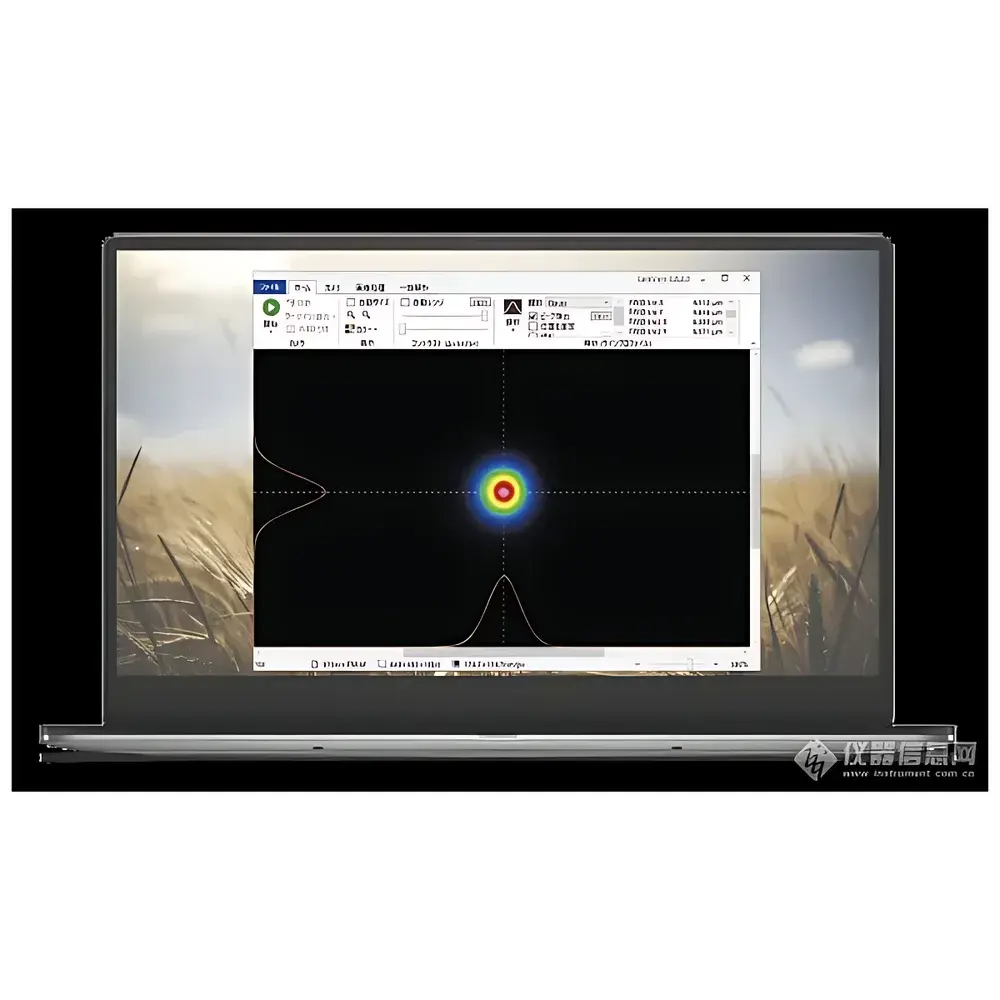
The proprietary BeamStudio™ v5.x software provides real-time visualization, batch processing, and automated report generation compliant with ISO/IEC 17025 laboratory accreditation templates. It supports raw frame export in HDF5 and TIFF formats, time-series data logging at up to 1 kHz sampling, and scripting via Python API for integration into automated test benches. Multi-camera synchronization allows spatiotemporal reconstruction of beam evolution over propagation distances—critical for LiDAR emitter qualification and fiber-coupled laser alignment verification. All measurement metadata—including ambient temperature, humidity, exposure time, and lens configuration—is embedded in EXIF-compatible headers for full traceability.
Applications
- Characterization of high-power industrial CO₂, fiber, and disk lasers used in welding, cladding, and additive manufacturing
- M² and BPP (beam parameter product) validation for OEM laser module certification against IEC 60825-2 and EN 60825-1
- LiDAR transmitter beam uniformity, divergence, and near/far-field profiling for autonomous vehicle sensor development
- Optical system alignment verification in synchrotron beamlines and EUV lithography illumination systems
- LED and VCSEL array far-field pattern analysis for AR/VR microdisplay illumination homogeneity assessment
- Beam stability and pointing jitter quantification under thermal cycling or mechanical vibration per MIL-STD-810H
FAQ
What beam profiling methods does this system support?
It supports ISO 11146-compliant second-moment (D4σ), knife-edge, and scanning-slit techniques—each selectable based on beam type, coherence, and signal-to-noise ratio.
Can it measure ultrafast pulsed lasers?
Yes—when equipped with gated intensified sensors or synchronized photodiode triggering, it captures single-shot pulse profiles at repetition rates up to 1 MHz.
Is calibration traceable to national standards?
All factory calibrations are performed using NIST-traceable reference sources and documented per ISO/IEC 17025 Annex A.2.
Does the software support automated pass/fail testing against user-defined tolerances?
Yes—BeamStudio™ includes configurable QC workflows with statistical process control (SPC) charts and automatic flagging of out-of-spec results.
How is thermal drift compensated during long-duration measurements?
Active thermal regulation of the sensor mount and real-time dark-frame subtraction ensure <0.3% intensity drift over 8-hour continuous operation.




