Microphase MPCVD-50 Microwave Plasma Chemical Vapor Deposition System for Carbon Nanotube Synthesis
| Brand | Microphase |
|---|---|
| Origin | Japan |
| Model | MPCVD-50 |
| Heating Method | Hot-Wall |
| Base Vacuum | 10 Pa |
| Operating Pressure Range | Adjustable from atmospheric to low vacuum (10–10⁵ Pa) |
| Maximum Temperature | 1200 °C |
| Quartz Tube Dimensions | Ø50 mm / Ø70–110 mm × 1000 mm |
| Substrate Size Range | 60 mm × 60 mm to 120 mm × 120 mm |
| Precursor Gases | H₂, N₂, CH₄, C₂H₅OH (ethanol) |
| Deposited Materials | Vertically aligned CNT arrays, CNT powders, freestanding CNT films, and patterned CNT structures |
| Gas Control | Triple-channel mass flow controllers (MFCs) for inert, hydrocarbon, and reducing gases |
| Ethanol Delivery | Precision syringe pump with gravimetric calibration |
| Compliance | Designed for ISO/IEC 17025-compliant lab environments |
Overview
The Microphase MPCVD-50 is a bench-scale microwave plasma-enhanced chemical vapor deposition (MPCVD) system engineered for the controlled synthesis of carbon nanomaterials—including vertically aligned carbon nanotube (CNT) forests, high-aspect-ratio CNT powders, continuous freestanding CNT films, and catalyst-patterned CNT architectures. Unlike conventional thermal CVD systems, this platform integrates 2.45 GHz microwave excitation within a hot-wall quartz tube furnace, enabling non-equilibrium plasma generation at reduced substrate temperatures while maintaining high dissociation efficiency of carbon precursors (e.g., ethanol, methane). This facilitates selective growth of single-walled CNTs (SWCNTs) and multi-walled CNTs (MWCNTs) with tunable morphology, crystallinity, and alignment—critical for applications in interconnects, field emission cathodes, flexible electronics, and electrochemical sensors. The system operates across a broad pressure regime (10 Pa to atmospheric), allowing process optimization for kinetic-limited or diffusion-controlled growth regimes.
Key Features
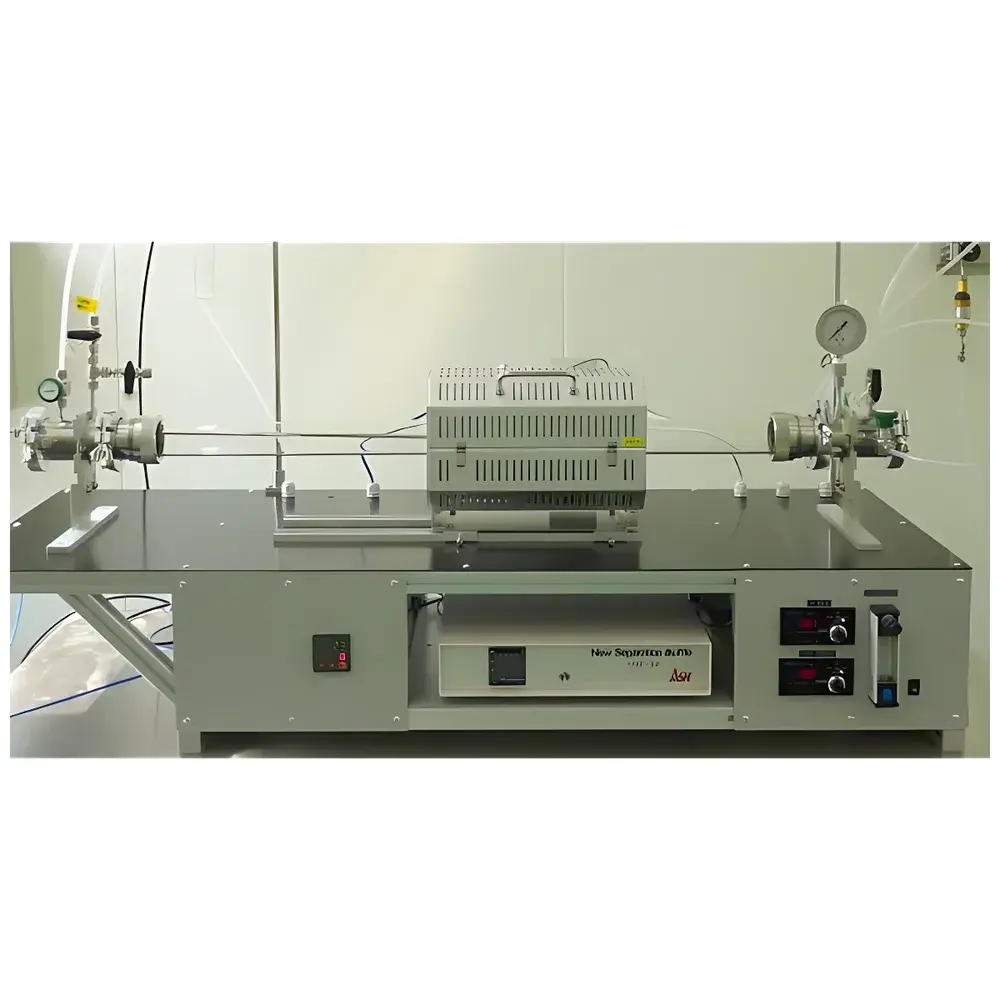
- Hot-wall quartz tube furnace with precise axial temperature uniformity (±5 °C over 300 mm zone) and maximum operating temperature of 1200 °C
- Integrated 2.45 GHz microwave generator (0–1.5 kW, adjustable power output) with waveguide coupling and impedance-matching network for stable plasma ignition and maintenance
- Triple-channel mass flow controller (MFC) system supporting independent regulation of H₂, N₂/Ar (inert carrier), and CH₄/C₂H₅OH (carbon source) with ±1% full-scale accuracy
- Dedicated ethanol liquid injection module featuring a calibrated syringe pump with real-time flow feedback and vaporization pre-chamber for reproducible carbon feedstock delivery
- Modular vacuum exhaust system comprising dual-stage rotary vane pump and optional turbo-molecular pump upgrade (base pressure <10⁻² Pa), compatible with pressure-controlled CVD, annealing, nitridation, and oxidation protocols
- Robust mechanical design with vibration-damped optical-grade stainless steel frame, integrated gas leak detection ports, and CE-compliant electrical safety architecture
Sample Compatibility & Compliance
The MPCVD-50 accommodates substrates ranging from 60 mm × 60 mm to 120 mm × 120 mm, including Si/SiO₂ wafers, quartz plates, metallic foils (Ni, Fe, Co), and flexible polyimide carriers. Catalyst thin films (e.g., Fe/Al₂O₃, Co/MgO bilayers) may be pre-deposited via sputtering or spin-coating prior to loading. The system complies with ISO 14644-1 Class 8 cleanroom handling requirements for semiconductor-grade material processing. All gas lines meet ASTM E2913-13 standards for ultra-high-purity (UHP) compatibility, and MFC calibration certificates are traceable to NIST standards. Optional data logging modules support 21 CFR Part 11-compliant electronic records for regulated R&D environments.
Software & Data Management
System operation is managed via a Windows-based control interface with deterministic real-time scheduling (100 ms loop cycle). The software provides synchronized logging of temperature profiles (Type K thermocouples), microwave forward/reflected power, chamber pressure (capacitance manometer), gas flow rates, and ethanol injection volume. Raw datasets are exported in CSV and HDF5 formats for post-processing in MATLAB, Python (NumPy/Pandas), or JMP. Audit trail functionality records all parameter modifications with user ID, timestamp, and reason-for-change fields—enabling full traceability under GLP and internal QA procedures.
Applications
- Growth of vertically aligned CNT arrays (>500 µm height) for thermal interface materials and MEMS actuators
- Scalable synthesis of SWCNT-enriched powders for conductive composites and battery anodes
- In situ catalyst activation and CNT nucleation studies under varying H₂/CH₄ ratios and plasma power densities
- Thermal annealing and graphitization of amorphous carbon layers under controlled reducing atmospheres
- Hybrid process integration: sequential catalyst deposition → plasma pretreatment → CNT growth → post-growth etching
- Process development for wafer-level CNT integration into back-end-of-line (BEOL) interconnect stacks
FAQ
What plasma frequency does the MPCVD-50 use, and why is it standardized at 2.45 GHz?
The system employs a 2.45 GHz magnetron-based microwave source—the industrial, scientific, and medical (ISM) band allocated globally for plasma applications. This frequency ensures optimal electron energy distribution for efficient dissociation of C–H bonds in ethanol and methane without excessive ion bombardment damage to substrates.
Can the MPCVD-50 synthesize nitrogen-doped or boron-doped CNTs?
Yes—by introducing NH₃ or B₂H₆ as secondary dopant gases through the third MFC channel, with process parameters optimized for substitutional doping without compromising structural integrity.
Is remote monitoring supported for multi-user lab environments?
The system includes Ethernet TCP/IP communication capability and optional VNC-enabled remote desktop access, subject to institutional firewall policies and IT security review.
What maintenance intervals are recommended for the microwave waveguide and quartz tube?
Quartz tubes should be inspected after every 50 h of plasma operation for microcracks or carbon deposits; waveguide windows require cleaning every 200 h using IPA-soaked lint-free wipes and visual inspection for arcing marks.
Does the system support rapid thermal processing (RTP) profiles?
While not an RTP furnace, the hot-wall design enables heating rates up to 20 °C/min and programmable ramp/soak/cool sequences—sufficient for most CNT nucleation and coalescence studies.