
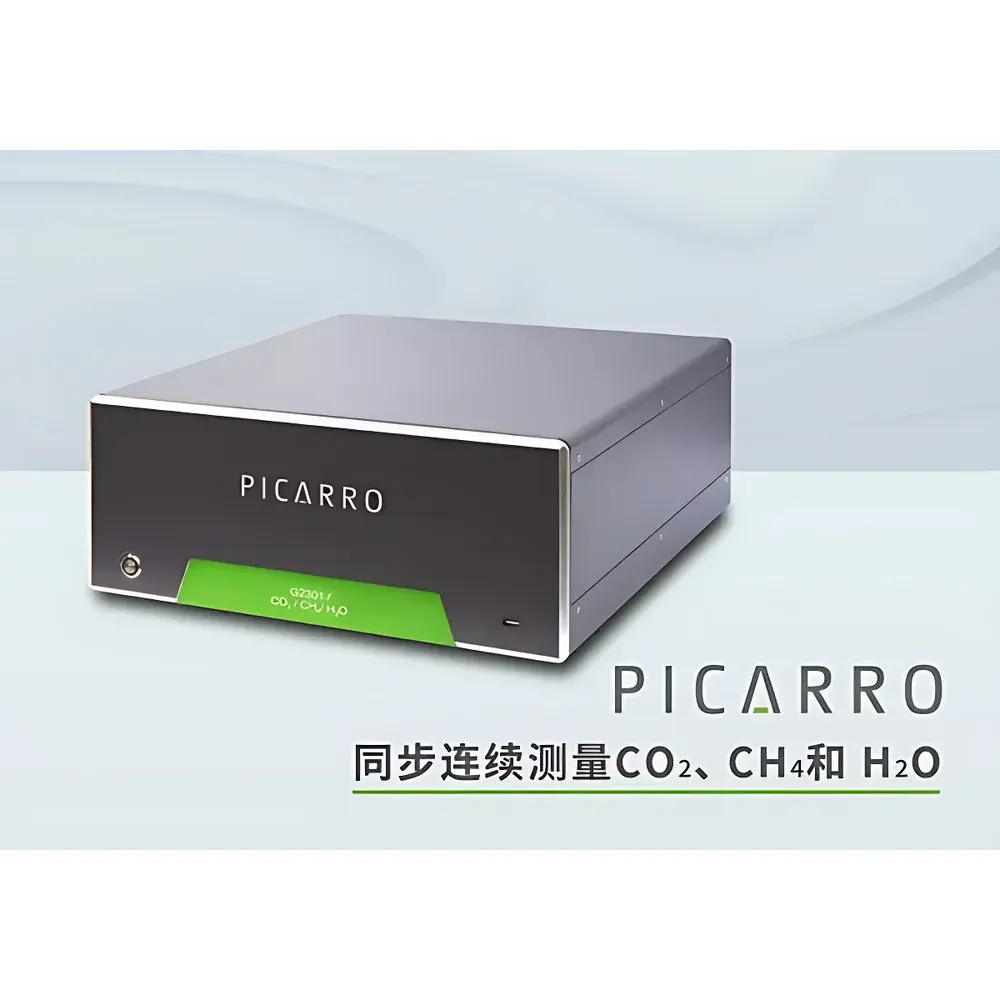
Picarro G2301 Cavity Ring-Down Spectroscopy (CRDS) Gas Concentration Analyzer
| Brand | Picarro |
|---|---|
| Origin | USA |
| Model | G2301 |
| Measurement Principle | Cavity Ring-Down Spectroscopy (CRDS) |
| Simultaneous Target Gases | CO₂, CH₄, H₂O |
| Detection Sensitivity | <0.5 ppb (CH₄), <70 ppb (CO₂), <80 ppm (H₂O) |
| Precision (1σ, 5 s) | CO₂ <70 ppb, CH₄ <0.5 ppb, H₂O <80 ppm |
| Precision (1σ, 5 min) | CO₂ <25 ppb, CH₄ <0.22 ppb, H₂O <30 ppm |
| Max Drift (24 h, STP) | CO₂ <120 ppb, CH₄ <1 ppb, H₂O <100 ppm |
| Water Vapor Correction | Automatic dry-mole-fraction reporting |
| Operating Pressure Range | 300–1000 Torr (40–133 kPa) |
| Sample Flow Rate | <0.4 SLM at 760 Torr |
| Temperature Control Stability | ±0.005 °C (cavity) |
| Pressure Control Stability | ±0.0002 atm (cavity) |
| Sample Temp. Range | −10 to +45 °C |
| Ambient Temp. Range (operational) | 10 to 35 °C |
| Data Interfaces | RS-232, Ethernet, USB, analog (0–10 V optional) |
| Dimensions (Analyzer) | 43.2 × 17.8 × 44.5 cm (W×H×D) |
| Weight | 26.9 kg (incl. external pump) |
| Power | 100–240 VAC, 47–63 Hz, <375 W peak |
Overview
The Picarro G2301 Cavity Ring-Down Spectroscopy (CRDS) Gas Concentration Analyzer is an ultra-high-precision, field-deployable instrument engineered for continuous, simultaneous quantification of carbon dioxide (CO₂), methane (CH₄), and water vapor (H₂O) in ambient air or controlled gas streams. Leveraging patented CRDS technology, the G2301 achieves exceptional sensitivity and long-term stability by measuring the decay rate of laser light trapped within a high-finesse optical cavity—where absorption-induced changes in ring-down time are directly proportional to trace gas concentration. This physics-based, calibration-free measurement principle eliminates reliance on reference standards during routine operation and ensures intrinsic accuracy traceable to fundamental optical constants. Designed specifically for atmospheric monitoring networks, eddy covariance flux studies, emissions verification, and air quality research, the G2301 meets the stringent performance criteria established by the World Meteorological Organization (WMO) and the Integrated Carbon Observation System (ICOS) for greenhouse gas observatories.
Key Features
- Simultaneous, real-time measurement of CO₂, CH₄, and H₂O with independent, high-resolution detection channels—no cross-interference or spectral overlap artifacts.
- Sub-part-per-trillion-level effective noise floor: <0.5 ppb (1σ, 5 s) for CH₄ and <70 ppb (1σ, 5 s) for CO₂—validated across production batches per Picarro’s statistical process control protocol.
- Active thermal and pressure stabilization of the optical cavity: ±0.005 °C temperature control and ±0.0002 atm pressure regulation ensure minimal instrumental drift (<120 ppb CO₂ and <1 ppb CH₄ over 24 h at STP).
- Integrated water vapor correction algorithm automatically computes and reports dry-air mole fractions for CO₂ and CH₄—eliminating manual dew-point corrections and reducing data processing overhead in long-term monitoring campaigns.
- No consumables, no moving parts in the optical path, and no required sample drying or filtration—enabling robust, maintenance-light operation in remote or unattended installations.
- Compact benchtop form factor (43.2 × 17.8 × 44.5 cm) with optional 19-inch rack-mount kit; includes external vacuum pump, Swagelok® inlet fittings, and embedded 240 GB SSD for local data logging.
Sample Compatibility & Compliance
The G2301 accepts untreated, non-condensing gas samples across a wide operational envelope: sample temperature from −10 °C to +45 °C, pressure from 300 to 1000 Torr (40–133 kPa), and relative humidity up to 99% at 40 °C. Its optical design tolerates particulate-laden air without degradation—provided no liquid condensation occurs in the sample line. The analyzer complies with ISO/IEC 17025 requirements for testing laboratories when operated within specified environmental conditions (10–35 °C ambient, <85% RH non-condensing). While not inherently 21 CFR Part 11 compliant out-of-the-box, its data output architecture supports integration with validated LIMS or ELN systems that enforce audit trails, electronic signatures, and change control—making it suitable for GLP and GMP-aligned environmental monitoring workflows where raw spectral data and metadata integrity are critical.
Software & Data Management
Picarro’s proprietary Analyze software provides real-time visualization, configurable alarm thresholds, and automated report generation (CSV, PDF). All raw ring-down time series, cavity pressure/temperature logs, and diagnostic flags are timestamped and stored locally on the internal SSD. Data export supports industry-standard protocols including Modbus TCP and NMEA 0183 over Ethernet or RS-232. For regulatory environments, users may configure the system to stream time-synchronized, checksum-verified datasets to secure network-attached storage via FTPS or SFTP. The firmware implements deterministic data acquisition at ≤2.8 s typical interval (≤5 s maximum), with rise/fall response times <3 s (10–90%/90–10%), ensuring fidelity in dynamic concentration events such as plume encounters or chamber flush cycles.
Applications
- Atmospheric baseline monitoring at WMO/GAW and ICOS stations requiring inter-laboratory comparability and multi-year stability.
- Urban and regional air quality assessment—quantifying fugitive CH₄ emissions from landfills, wastewater treatment plants, and natural gas infrastructure.
- Eddy covariance and relaxed eddy accumulation systems for ecosystem-scale CO₂ and CH₄ flux partitioning.
- Calibration transfer and validation of lower-cost sensor networks using high-accuracy reference-grade measurements.
- Controlled-environment studies (e.g., climate chambers, soil incubation systems) where concurrent H₂O interference correction is essential for accurate greenhouse gas accounting.
- Mobile platform deployments (e.g., aircraft, vans, buoys) leveraging low power draw (~120 W analyzer + ~150 W pump) and shock-resistant mechanical design.
FAQ
Does the G2301 require daily calibration with certified gas standards?
No. CRDS is an absolute spectroscopic technique; calibration is performed once at factory using NIST-traceable pressure and temperature references. Field verification uses zero air and span checks only for diagnostic confirmation—not for accuracy maintenance.
Can the G2301 operate unattended for extended periods?
Yes. With its solid-state laser source, passive thermal management, and embedded data storage, the G2301 is routinely deployed in polar, tropical, and alpine sites for >12 months between service visits—provided ambient conditions remain within specification.
How does the water vapor correction algorithm handle variable humidity?
The instrument measures H₂O simultaneously at high SNR and applies first-principles spectroscopic modeling to compute dilution-corrected dry-mole fractions for CO₂ and CH₄—no empirical fitting or lookup tables are used.
Is analog output available for integration into SCADA systems?
Yes. Optional 0–10 V analog outputs are configurable per gas species and can be scaled to user-defined concentration ranges with 16-bit resolution.
What is the minimum detectable concentration change for CH₄ under typical field conditions?
At 5-second averaging, the 1σ noise-equivalent concentration is <0.5 ppb; at 5-minute averaging, it improves to <0.22 ppb—enabling detection of sub-ppb enhancements above background in well-mixed air masses.
Related Products






