
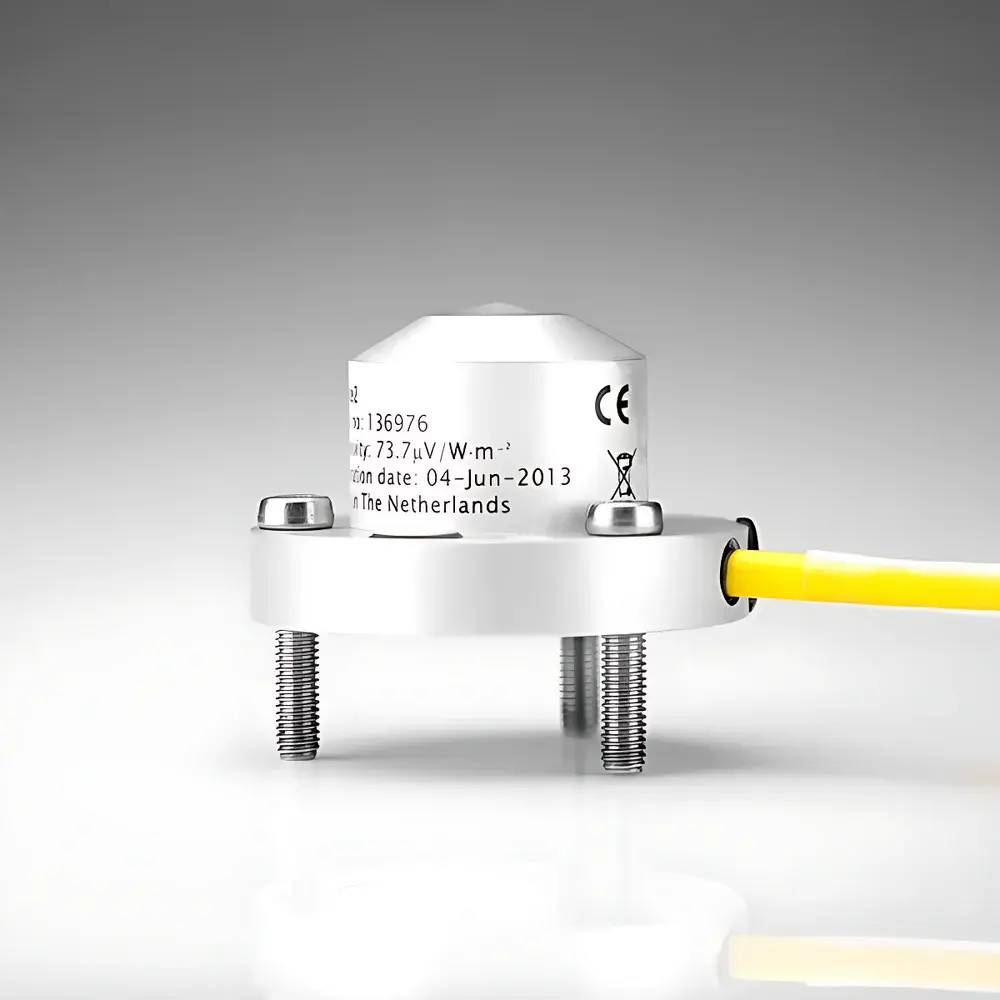
Kipp & Zonen SP Lite2 Pyranometer
| Brand | Kipp & Zonen |
|---|---|
| Origin | Netherlands |
| Model | SP Lite2 Pyranometer |
| Spectral Range | 400–1100 nm |
| Sensitivity | 60–100 µV/W/m² |
| Response Time (95%) | < 500 ns |
| Directional Error (up to 80°, 1000 W/m² beam) | < 10 W/m² |
| Temperature Response | < −0.15 %/°C |
| Operating Temperature Range | −40 °C to +80 °C |
| Maximum Irradiance | 2000 W/m² |
| Field of View | 180° |
| Output | Analog voltage (mV), calibrated for direct conversion to W/m² |
Overview
The Kipp & Zonen SP Lite2 Pyranometer is a compact, high-stability silicon photodiode-based instrument engineered for accurate measurement of global horizontal irradiance (GHI) — the total solar radiation received on a horizontal surface from the entire hemisphere (180° field of view). It operates on the principle of spectral responsivity matched to the solar spectrum, with its photodiode detector and precision cosine-corrected diffuser enabling reliable quantification of broadband shortwave irradiance across variable solar zenith angles. Unlike thermopile-based pyranometers, the SP Lite2 leverages semiconductor technology to deliver fast temporal response and low power requirements while maintaining traceable calibration against ISO 9060:2018 Class C specifications. Its design prioritizes robustness in outdoor deployment, making it suitable for long-term unattended operation in diverse climatic conditions — from arid deserts to humid agricultural zones and high-latitude research stations.
Key Features
- Cosine-corrected optical diffuser: Optimized scattering geometry ensures angular response adheres closely to Lambert’s cosine law, minimizing directional error (< 10 W/m² up to 80° zenith angle at 1000 W/m² irradiance).
- Fast electrical response: 95% rise time under 500 nanoseconds enables capture of rapid irradiance transients — critical for cloud-edge analysis and PV system performance validation.
- Stable silicon photodiode sensor: Operates within 400–1100 nm spectral range, covering >90% of terrestrial solar energy; sensitivity calibrated between 60–100 µV/W/m² with individual certificate traceable to NIST or PTB standards.
- Integrated mounting hardware: Built-in leveling bubble and adjustable leveling screws allow precise horizontal alignment; M6 threaded base compatible with standard mounting masts and tilt adapters.
- Weather-resistant construction: Anodized aluminum housing with tempered glass dome rated IP67; operational across −40 °C to +80 °C without condensation-induced drift.
- Modular configuration support: Two SP Lite2 units can be mounted back-to-back (with optional mounting bracket) to form a basic albedometer setup for simultaneous downwelling and upwelling irradiance measurement.
Sample Compatibility & Compliance
The SP Lite2 is designed for outdoor exposure under natural solar illumination and requires no external power source — output is passive analog voltage (mV), directly proportional to incident irradiance. It complies with the functional classification defined in ISO 9060:2018 as a “Class C” pyranometer, indicating suitability for routine monitoring where high-precision reference-grade measurements are not mandated. While not certified to ASTM G173 or IEC 61724-1 for PV performance monitoring, its spectral match and cosine response meet the minimum technical criteria for use in solar resource assessment per IEC 61724-1 Annex A. The instrument is compatible with all standard data loggers accepting millivolt inputs (e.g., Campbell Scientific CR series, HOBO UX120, Delta-T DL2e), and supports integration into SCADA and IoT telemetry platforms via analog-to-digital signal conditioning. Calibration certificates include uncertainty budgets aligned with ISO/IEC 17025 requirements.
Software & Data Management
No proprietary software is required for basic operation; raw voltage output is converted to W/m² using the unit-specific calibration factor (provided with each instrument). For automated systems, Kipp & Zonen recommends pairing the SP Lite2 with their CloudNet data acquisition suite or third-party platforms supporting Modbus RTU or SDI-12 protocols (via optional signal conditioner). All calibration data, including temperature dependence coefficients and directional correction tables, are supplied digitally in CSV format. When deployed in regulated environments (e.g., utility-scale solar farms under IEC 62446-1), users may implement audit-trail-enabled logging to satisfy GLP-aligned documentation practices. The device does not incorporate onboard memory or wireless transmission; data integrity relies on external logger firmware compliant with IEC 62446-3 for long-term traceability.
Applications
- Solar photovoltaic (PV) plant performance ratio (PR) monitoring and yield forecasting
- Agricultural meteorology: reference evapotranspiration (ET₀) estimation using FAO-56 Penman-Monteith method
- Urban climate studies: surface energy balance modeling and heat island effect quantification
- Environmental science: aerosol optical depth estimation via clear-sky irradiance deviation analysis
- Educational laboratories: hands-on radiometry training and atmospheric physics experiments
- Building-integrated photovoltaics (BIPV) and daylight harvesting control systems
FAQ
Is the SP Lite2 suitable for BSRN (Baseline Surface Radiation Network) stations?
No — BSRN mandates thermopile-based Class A pyranometers (e.g., CMP21 or SMP22) due to superior thermal offset stability and spectral flatness. The SP Lite2 is intended for applications where cost, size, and speed outweigh absolute metrological rigor.
Can it measure diffuse irradiance alone?
Not natively — diffuse-only measurement requires a shading ring or tracker-mounted shadow band. However, when paired with a second SP Lite2 on a solar tracker in shaded configuration, it can support derived diffuse irradiance calculations.
What is the recommended recalibration interval?
Kipp & Zonen recommends recalibration every two years for critical applications, or annually under high-UV/dusty conditions. Field verification using a reference pyranometer is advised before major data campaigns.
Does it require desiccant maintenance?
No — the sealed optical assembly contains no hygroscopic components; the tempered glass dome prevents internal fogging even at high humidity and sub-zero temperatures.
How is temperature dependence compensated?
The SP Lite2 exhibits a typical temperature coefficient of < −0.15 %/°C. For applications requiring <1% uncertainty over wide ambient ranges, users should apply the published temperature correction polynomial included in the calibration report.
Related Products







