
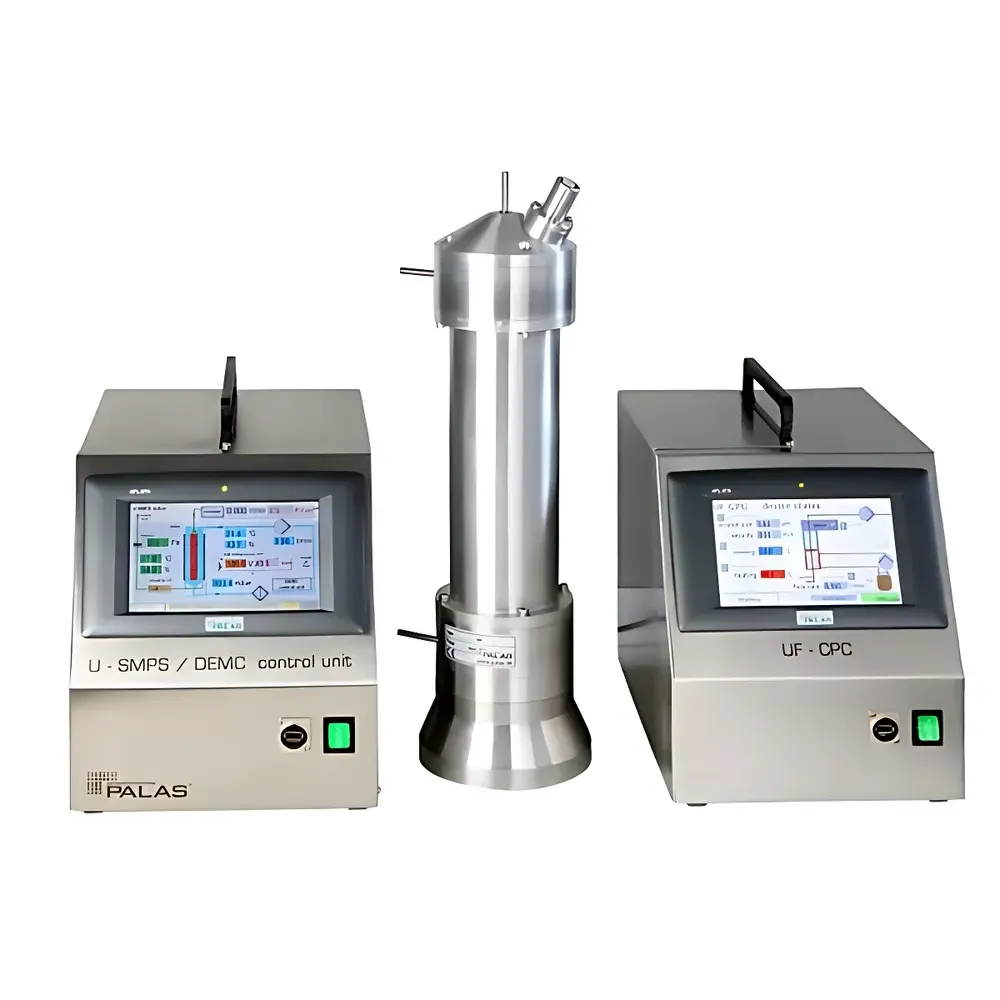
Palas U-SMPS 2050X / 2100X / 2200X Universal Scanning Mobility Particle Sizer
| Brand | Palas |
|---|---|
| Origin | Germany |
| Model | 2050X / 2100X / 2200X |
| Particle Size Range | 8–1200 nm |
| Classification Principle | Differential Electrical Mobility (DEMC, per ISO 15900) |
| Neutralizer Type | Integrated X-ray Neutralizer (XRC 049) |
| Scan Time | ≤30 s per distribution |
| Channels | Up to 64 per decade (logarithmic) |
| Display | 7-inch capacitive touchscreen GUI |
| Data Logging | Built-in recorder with linear/log scaling |
| Interfaces | USB, LAN, WLAN, RS-232/485 |
| Compatibility | Interoperable with third-party DMAs, CPCs, and aerosol electrometers |
| Software | Palas Evaluation Suite with statistical analysis, export (CSV, PDF), and audit-trail-ready data management |
Overview
The Palas U-SMPS 2050X / 2100X / 2200X Universal Scanning Mobility Particle Sizer is a high-precision, traceable aerosol sizing system engineered for metrological-grade particle size distribution (PSD) measurements in the 8 nm to 1200 nm range. It operates on the principle of differential electrical mobility classification—defined in ISO 15900 as Differential Electrical Mobility Classification (DEMC)—where charged aerosol particles are separated in a laminar, radially symmetric electric field within a cylindrical classifier column. The system integrates an X-ray-based bipolar neutralizer (XRC 049), eliminating regulatory constraints associated with radioactive sources (e.g., 85Kr) while maintaining charge equilibrium consistent with the Boltzmann steady-state distribution. This enables compliant transport, installation, and long-term operation in regulated laboratory, calibration, and field-deployed environments. Each U-SMPS configuration includes a long-column DEMC unit, a condensation particle counter (CPC)—typically Palas UF-CPC series—and embedded firmware that applies the Wiedensohler algorithm to reconstruct number-weighted PSDs from raw voltage-scan and count-rate data. The instrument is designed for primary calibration traceability, supporting reference-grade applications such as filter efficiency testing, nanoparticle emission characterization, and inter-laboratory comparison studies.
Key Features
- Integrated X-ray neutralizer (XRC 049) compliant with IAEA and national radiation safety regulations—no licensing or special transport documentation required
- Long-column DEMC architecture enabling full-range sizing from 8 nm to 1200 nm with resolution up to 64 channels per decade (logarithmic scale)
- Sub-30-second full-spectrum scan capability with real-time voltage ramping and synchronized CPC counting
- 7-inch industrial-grade capacitive touchscreen with intuitive graphical user interface (GUI), supporting multilingual operation and parameter lockout for GLP/GMP workflows
- Built-in data logger with configurable sampling intervals, linear/logarithmic display modes, and timestamped metadata embedding (temperature, pressure, flow rates)
- Multi-interface connectivity: USB 2.0, 10/100BASE-T Ethernet (LAN), IEEE 802.11 b/g/n WLAN, and RS-232/RS-485 serial for SCADA or PLC integration
- Open-system architecture compliant with ISO 15900 and ASTM D8196; interoperable with third-party DMAs, nano-CPCs (e.g., TSI 3776, Grimm 5.415), and aerosol electrometers
- Internal quality assurance protocol: all components undergo factory calibration verification against NIST-traceable standards; final assembly and functional testing performed at Palas headquarters in Karlsruhe, Germany
Sample Compatibility & Compliance
The U-SMPS accommodates a broad spectrum of aerosol types—including combustion-generated soot, metallic nanoparticles, salt aerosols, and bioaerosol surrogates—provided they are introduced in a stable, dilute, and dry state. Optional upstream conditioning modules include silica gel or Nafion dryers to reduce relative humidity below 35% RH, minimizing hygroscopic growth artifacts. A certified impactor (cut-point ≥1.2 µm) is recommended upstream of the DEMC inlet to exclude coarse particles that could compromise classification integrity or induce space charge effects. All configurations meet ISO 15900:2020 requirements for electrical mobility spectrometry, and measurement uncertainty budgets are documented per EURAMET cg-19 guidelines. For regulated environments, the system supports 21 CFR Part 11-compliant audit trails when operated with Palas Evaluation Suite v4.2+ and network-authenticated user roles. It is routinely deployed in laboratories accredited to ISO/IEC 17025 and operating under GLP or GMP frameworks for inhalation toxicology, cleanroom monitoring, and environmental reference method validation.
Software & Data Management
The Palas Evaluation Suite provides comprehensive post-processing and visualization tools for raw U-SMPS datasets. Functions include automatic background subtraction, mobility-to-diameter conversion using calibrated transfer functions, multi-scan averaging (geometric mean, median, standard deviation), time-series trending, and overlay comparison across instruments or campaigns. Data exports comply with FAIR principles: CSV files contain full metadata headers (instrument ID, calibration date, sheath flow rate, CPC model, neutralizer type), while PDF reports embed traceable uncertainty statements and compliance flags. The software supports automated batch processing for long-term monitoring applications and integrates with LIMS via RESTful API (available upon license). Internal memory retains ≥30 days of continuous logging at 1-Hz resolution; external storage is supported via USB mass storage mode or network-mounted SMB shares. Firmware updates are delivered through signed binary packages verified via SHA-256 checksums.
Applications
- Filter testing and certification (EN 1822, ISO 29463) using polydisperse challenge aerosols
- Fundamental aerosol science: nucleation, coagulation, and growth kinetics in smog chambers and flow reactors
- Environmental monitoring: urban nanoparticle emissions profiling, atmospheric new particle formation (NPF) event analysis
- Occupational hygiene: workplace exposure assessment for engineered nanomaterials (ENMs) per ISO/TR 12885
- Inhalation toxicology: dose-controlled aerosol delivery systems requiring precise PSD input for in vitro and in vivo studies
- Instrument calibration: serving as a primary reference for OPCs, optical particle counters, and SMPS clones
- Climate research: cloud condensation nuclei (CCN) activation studies requiring sub-50 nm sizing fidelity
FAQ
What neutralizer technology does the U-SMPS use, and why is it advantageous?
The U-SMPS integrates the Palas XRC 049 X-ray neutralizer, which replaces traditional 85Kr sources. This eliminates Class 7 radioactive material handling requirements, simplifies international shipping, and avoids decommissioning liabilities—while delivering identical bipolar charge equilibrium performance per ISO 15900 Annex C.
Can the U-SMPS operate without a connected PC?
Yes. All core functions—including scan initiation, real-time visualization, data logging, and parameter configuration—are fully operational via the onboard touchscreen GUI. A PC is only required for advanced evaluation, report generation, or network integration.
Is the system compatible with non-Palas CPCs or DMAs?
Yes. The U-SMPS adheres to open communication protocols (Modbus TCP, ASCII serial commands) and accepts analog/digital inputs from third-party CPCs and DMAs. Configuration templates for common models (e.g., TSI 3081 DMA, Cambustion DMS500) are included in the Evaluation Suite.
How is measurement traceability ensured?
Each U-SMPS undergoes end-of-line calibration using NIST-traceable monodisperse aerosols (e.g., PSL, DEHS) and certified flow meters. Calibration certificates list expanded uncertainties (k=2) for mobility diameter, count efficiency, and scan linearity—fully aligned with ILAC-P10 requirements.
What maintenance is required for long-term reliability?
Routine maintenance is limited to quarterly sheath air filter replacement, annual XRC 049 source output verification, and biannual CPC saturation check. No internal optical alignment or high-voltage recalibration is needed during standard operation due to the passive, drift-stable electrode geometry and closed-loop flow control architecture.







