
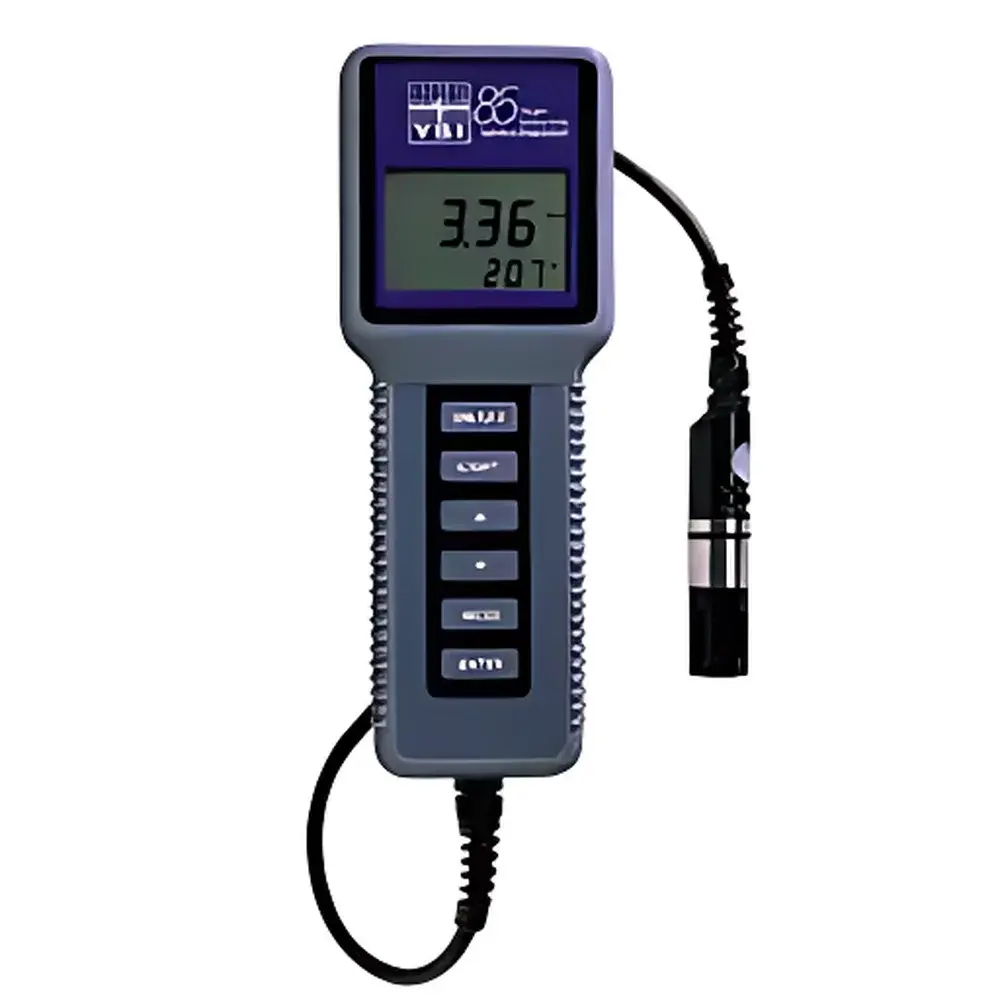
YSI YSI-85 Portable Dissolved Oxygen, Conductivity, Salinity, and Temperature Meter
| Brand | YSI |
|---|---|
| Origin | USA |
| Model | YSI-85 |
| Cable Length Options | 3 m, 7.5 m, 15 m, 30 m |
| Temperature Compensation | Automatic |
| Salinity Compensation Range | 0–80 ppt |
| Barometric Pressure Compensation Range | 0–3,000 m |
| Conductivity Reference Temperature | Adjustable between 15–25 °C |
| Conductivity Temperature Coefficient | Adjustable 0–4 %/°C |
| DO Range Selection | Automatic |
| Conductivity Range Selection | Automatic or Manual |
| Power Supply | Six AA alkaline batteries (~100 hours operation) |
| Ingress Protection | Exceeds IP65 |
| Dimensions | 24.1 cm (L) × 8.9 cm (W) × 5.6 cm (H) |
| Weight | 0.77 kg (with 3 m cable) |
| Probe Type | Integrated or interchangeable D-series probe (YSI-85D variant) |
| Connector | MIL-SPEC (MS) waterproof, field-serviceable |
Overview
The YSI YSI-85 is a rugged, handheld multiparameter meter engineered for field-deployable water quality assessment. It employs Clark-type polarographic electrochemical sensing for dissolved oxygen (DO) measurement, coupled with a four-pole nickel electrode cell for conductivity determination—both principles conforming to ASTM D888 and ISO 5814 standards for DO, and ASTM D1125 and ISO 7888 for conductivity. Designed explicitly for environmental monitoring professionals conducting in situ measurements in rivers, lakes, estuaries, wastewater outfalls, and groundwater wells, the instrument integrates real-time temperature, salinity, barometric pressure, and conductivity compensation algorithms to deliver traceable, field-calibrated DO values in mg/L or % saturation. Its microprocessor-controlled architecture ensures stable baseline response, minimal drift, and repeatable calibration across variable thermal and ionic environments.
Key Features
- Integrated sensor platform supporting simultaneous measurement of dissolved oxygen, conductivity, salinity, temperature, and calculated parameters including total dissolved solids (TDS) and resistivity
- Automatic temperature, salinity, and barometric pressure compensation—configurable within operational limits (0–80 ppt salinity; 0–3,000 m elevation)
- Interchangeable D-series probe option (YSI-85D) with MIL-SPEC (MS) waterproof connectors enabling rapid field replacement of cables up to 30 meters in length
- Ergonomic housing with high-contrast backlit LCD display optimized for low-light conditions and extended outdoor readability
- Stainless-steel probe body with polymer-coated electrode tips for mechanical protection and consistent immersion dynamics
- Onboard non-volatile memory storing up to 50 measurement sets with timestamp; data retention maintained during battery replacement
- Self-diagnostic boot sequence verifying sensor continuity, battery voltage, and firmware integrity prior to operation
- IP65-rated enclosure exceeding industrial ingress protection requirements for dust and water jet resistance
- Conductivity reference temperature and temperature coefficient fully adjustable (15–25 °C; 0–4 %/°C), supporting compliance with site-specific regulatory protocols
Sample Compatibility & Compliance
The YSI-85 is validated for use in natural waters, treated effluents, brackish systems, and saline groundwater—covering conductivity ranges typical of freshwater (0–20 mS/cm) through hypersaline conditions (up to ~80 ppt). Its DO sensor utilizes a replaceable 5906 membrane cap with integrated electrolyte gel, ensuring reproducible response per US EPA Method 360.5 and APHA Standard Methods 4500-O G. The instrument supports GLP-compliant data logging when paired with optional YSI DataTrak software and external download hardware. While not FDA 21 CFR Part 11-certified out-of-box, audit trails and electronic records generated via validated data transfer workflows meet basic GMP documentation expectations for environmental surveillance programs.
Software & Data Management
Data retrieval is accomplished via RS-232 serial interface using YSI-provided terminal emulation tools or third-party ASCII-compatible applications. The built-in memory retains parameter identifiers, numeric values, date/time stamps, and unit annotations without requiring continuous PC connection. Optional YSI DataTrak v3.x enables batch export to CSV or Excel formats, trend visualization, and report generation aligned with ISO/IEC 17025 documentation frameworks. Firmware updates are distributed as signed binary packages through YSI’s authorized support portal, maintaining version traceability for laboratory quality systems.
Applications
- Regulatory surface water monitoring under Clean Water Act Section 304/305(b) reporting requirements
- Wastewater treatment plant influent/effluent characterization and process control verification
- Aquatic ecosystem health assessments including hypolimnetic oxygen profiling and eutrophication studies
- Coastal zone management involving salinity intrusion mapping and estuarine mixing analysis
- Groundwater quality screening during Phase I/II environmental site assessments (ESAs)
- Educational field laboratories requiring portable, maintenance-minimal instrumentation for student-led sampling campaigns
FAQ
Does the YSI-85 require factory recalibration between deployments?
No—field calibration using air-saturated water (for DO) and standard KCl solutions (for conductivity) is sufficient between uses. Full factory recalibration is recommended annually or after physical damage to the probe assembly.
Can the YSI-85 operate continuously submerged?
No—the meter itself is not submersible; only the probe and cable are rated for underwater use. The handheld unit must remain above water level during operation.
Is the internal memory password-protected or encrypted?
No—the stored dataset is unencrypted and accessible via direct serial readout; users requiring data security must implement external encryption at the host system level.
What probe options are compatible with the YSI-85D configuration?
Only YSI-manufactured D-series probes (e.g., 5906 DO cap, 5860 conductivity cell) with MS-series connectors are supported; third-party probes are not electrically or mechanically interoperable.
How does the instrument handle temperature gradients during vertical profiling?
It applies real-time temperature compensation to each individual reading but does not perform dynamic thermal lag correction—rapid descent rates (>1 m/sec) may introduce transient offset in DO values due to sensor thermal inertia.







