
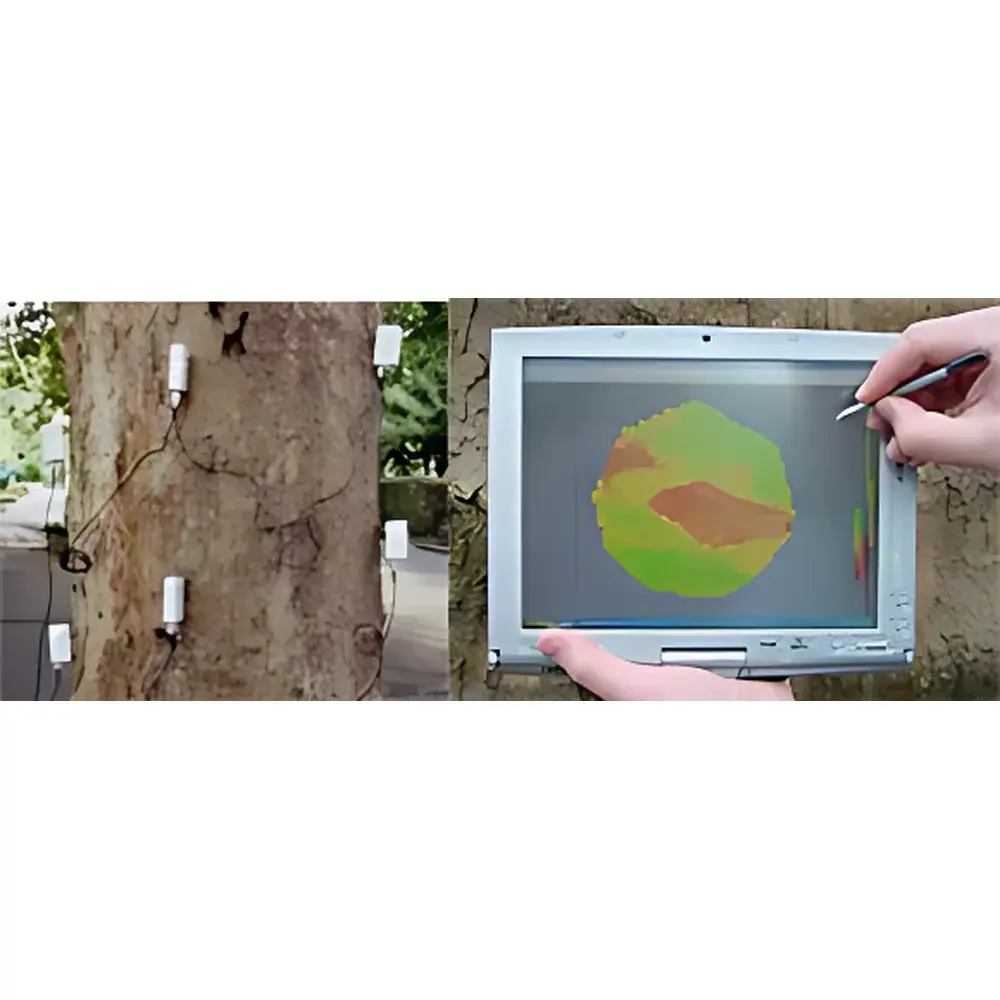
ARBOTOM Pulse-Induced Tree Tomography System by Rinntech
| Brand | Rinntech |
|---|---|
| Origin | Germany |
| Product Type | Imported Industrial Forestry Instrument |
| Distribution Model | Authorized Distributor |
| Pricing | Available Upon Request |
Overview
The ARBOTOM Pulse-Induced Tree Tomography System is a non-invasive, field-deployable diagnostic instrument engineered for structural assessment of living trees and felled timber. It operates on the principle of stress wave propagation tomography: low-energy mechanical pulses are generated at multiple sensor positions around the trunk or log circumference; transit times of these waves through the wood matrix are measured with microsecond precision. Variations in wave velocity—caused by internal anomalies such as decay, cavities, cracks, or density gradients—are reconstructed into 2D cross-sectional or 3D volumetric tomograms using inverse Radon transform algorithms. Unlike X-ray or ultrasound-based systems, ARBOTOM requires no ionizing radiation or coupling media, making it compliant with occupational safety regulations and suitable for repeated measurements in public green spaces, urban forestry, and protected natural areas.
Key Features
- Pulse-based acoustic tomography with adjustable sensor arrays (2–24+ transducers), enabling flexible deployment across trunk diameters from 10 cm to over 200 cm without geometric constraint.
- Real-time color-coded tomographic visualization: decay zones appear in red-orange (reduced wave velocity), sound wood in blue-green (normal velocity), and voids/cavities in deep red (near-zero transmission).
- Integrated Arboradix module for root zone assessment—uses ground-coupled pulse transmission to detect compromised root architecture up to 1.5 m lateral distance and 0.8 m depth.
- Field-portable operation via ruggedized tablet PC or laptop interface; all control logic, data acquisition, and reconstruction occur onboard without cloud dependency.
- Full measurement traceability: each scan logs timestamp, GPS coordinates (optional external module), sensor configuration, ambient temperature/humidity, and operator ID.
- Compliant with DIN EN 1995-1-1 (Eurocode 5) and TRVL guidelines for static safety evaluation of standing trees in municipal and arboricultural practice.
Sample Compatibility & Compliance
ARBOTOM accommodates broad botanical diversity—including deciduous species (e.g., Quercus robur, Acer pseudoplatanus) and conifers (e.g., Picea abies, Pinus sylvestris)—across varying moisture contents (30–120% MC, green to air-dry). Measurements are unaffected by bark thickness up to 50 mm or surface irregularities (e.g., lichens, minor fissures). The system meets CE marking requirements under Directive 2014/30/EU (EMC) and 2014/35/EU (LVD). Data export formats include CSV (raw transit times), PNG/JPEG (tomograms), and XML (structured assessment reports), supporting integration into municipal tree inventories aligned with ISO 17892-12 (geotechnical investigation) and DIN 18930 (urban tree management documentation).
Software & Data Management
The proprietary ARBOTOM Control Suite (v6.3+) runs natively on Windows 10/11 x64 platforms and supports offline operation. It includes: (i) adaptive mesh generation for irregular trunk contours, (ii) multi-scan fusion for longitudinal profiling, (iii) automated anomaly classification per IUFRO Tree Risk Assessment Protocol (TRAP v2.1), and (iv) audit-trail logging compliant with GLP principles—every parameter change, image annotation, or report export is time-stamped and user-authenticated. Exported reports include quantitative metrics: percentage decay volume, cavity diameter estimation, and structural integrity index (SII), calculated per EN 12572-3 Annex B. All data files are cryptographically signed to ensure evidentiary admissibility in municipal liability assessments.
Applications
- Urban forestry risk management: prioritization of hazardous tree removal in parks, streetscapes, and school grounds.
- Forestry inventory optimization: pre-harvest quality grading of standing timber for veneer, construction-grade logs, or biomass sourcing.
- Conservation biology: longitudinal monitoring of ancient or heritage trees (e.g., >300-year-old oaks) to inform preservation strategies.
- Arboricultural consultancy: objective documentation for insurance claims, legal disputes, or municipal compliance audits.
- Research applications: correlation studies between tomographic decay patterns and fungal DNA sequencing (e.g., Ganoderma applanatum colonization mapping).
FAQ
Does ARBOTOM require calibration against reference standards?
No—system calibration is performed automatically before each measurement sequence using built-in time-of-flight reference paths. Field validation is supported via ASTM D143-22 (wood mechanical properties) correlation datasets.
Can measurements be conducted during rain or high humidity?
Yes—sensor housings meet IP67 ingress protection; however, prolonged rainfall may attenuate surface-coupled pulses, prompting optional use of hydrophobic coupling gel (Rinntech Part No. R-GEL-02).
Is operator training required for regulatory compliance?
Yes—Rinntech-certified Level 1 Operator Training (8-hour course) is mandatory for issuing legally defensible safety assessments in EU member states under DIN 4072-2.
How is data security ensured during field deployment?
All local storage uses AES-256 encryption; USB export triggers automatic hash verification; no telemetry or remote access functionality is embedded in firmware.
What maintenance intervals are recommended?
Biannual verification of pulse generator output energy (±5% tolerance) and sensor impedance matching using Rinntech Calibration Kit CK-ARB-2024; no user-serviceable parts inside transducer housings.







