
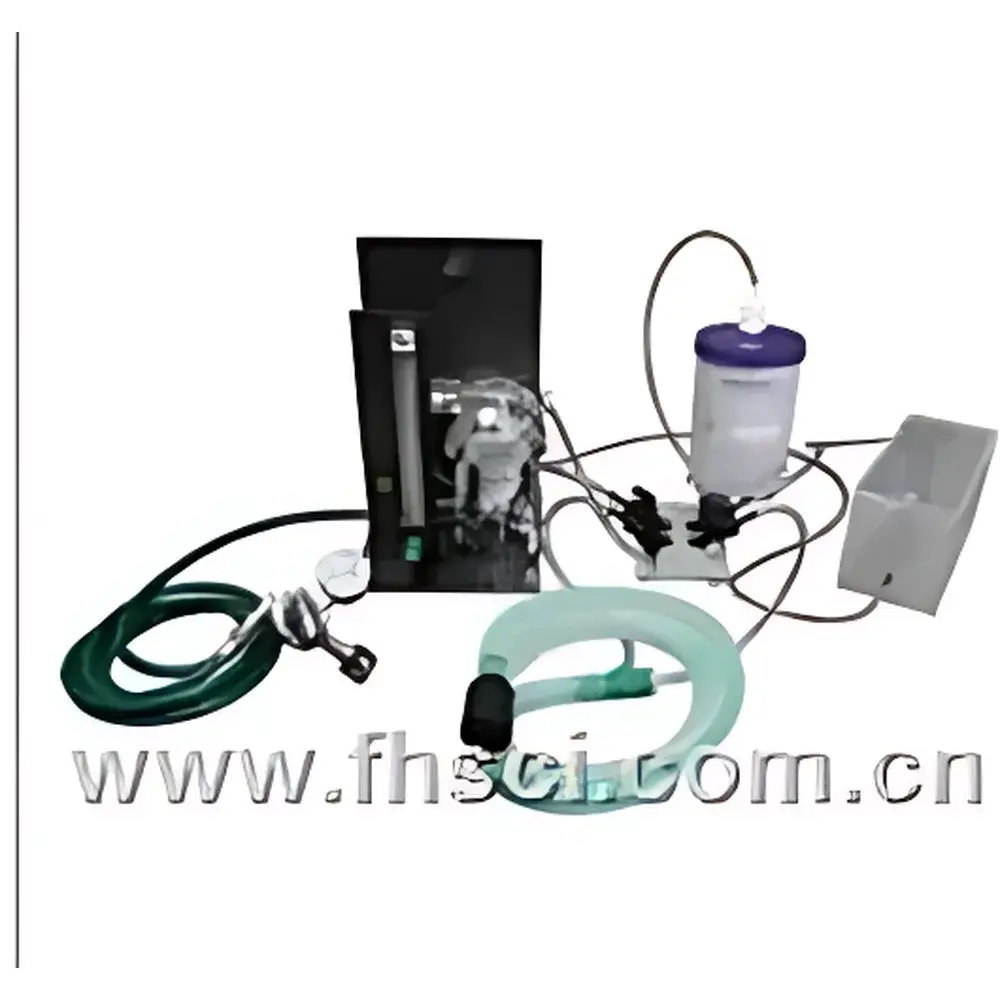
Harvard Apparatus Tabletop Animal Anesthesia Machine
| Brand | Harvard Apparatus |
|---|---|
| Origin | USA |
| Model | Tabletop |
| Flowmeter Options | 0.2–4 L/min O₂, 0–1000 mL/min O₂, Dual O₂ (0.2–4 L/min + 0–1000 mL/min), or O₂ + N₂O with Fail-Safe Valve |
| Dimensions (W×D×H) | 30" × 20" × 32.5" (762 × 508 × 825.5 mm) |
| Weight | 25 lb (11.34 kg) |
| Animal Capacity | Single subject up to 4.5 kg |
| Circuit Type | Non-rebreathing |
| Compatible Vaporizers | Tech3, Tech4, Ohio, and 100-series |
| CO₂ Absorber | Optional standalone unit (Part #723010) |
Overview
The Harvard Apparatus Tabletop Animal Anesthesia Machine is a compact, non-rebreathing anesthesia delivery system engineered for precision, safety, and flexibility in preclinical research environments. Designed specifically for small-animal studies—particularly rodents and rabbits weighing up to 4.5 kg—the system operates on the principle of fresh-gas flow (FGF) delivery, eliminating CO₂ rebreathing through a unidirectional, open-circuit architecture. Unlike high-flow vaporizer-based systems requiring scavenging and complex CO₂ absorption, this tabletop platform delivers consistent anesthetic agent concentration via calibrated oxygen (and optionally nitrous oxide) flow control, paired with compatible calibrated vaporizers (Tech3, Tech4, Ohio, or 100-series). Its modular design supports rapid setup and reconfiguration, making it ideal for shared core facilities, teaching laboratories, and mobile surgical stations where space, weight, and regulatory traceability are critical constraints.
Key Features
- Compact footprint (30″ W × 20″ D × 32.5″ H) enables placement on standard lab benches, carts, or procedure tables without dedicated cabinetry
- Lightweight construction (25 lb / 11.34 kg total system weight including vaporizer) facilitates portability between imaging suites, surgery rooms, and behavioral labs
- Dual- or single-flowmeter configurations support protocol-specific gas delivery: precise low-flow (0–1000 mL/min) for neonatal or geriatric models, and higher-range (0.2–4 L/min) for adult rodents under prolonged anesthesia
- Fail-safe oxygen/nitrous oxide interlock (Model 723014) prevents hypoxic gas mixtures by mechanically restricting N₂O flow unless minimum O₂ flow is verified
- Robust dome-style flow control valves resist mechanical wear and maintain calibration stability over extended use cycles
- Powder-coated steel chassis provides corrosion resistance, ESD-safe grounding, and easy decontamination—compatible with common lab disinfectants (e.g., 70% ethanol, quaternary ammonium solutions)
- MRI-compatible variant available for integration into 3T and 7T small-animal imaging workflows, meeting ASTM F2503-22 requirements for magnetic field safety
Sample Compatibility & Compliance
This anesthesia system is validated for use with mice, rats, guinea pigs, and rabbits up to 4.5 kg. It complies with ISO 8536-4:2022 (infusion equipment) for gas pathway integrity and meets essential performance criteria outlined in AAALAC International’s Guide for the Care and Use of Laboratory Animals (9th Edition) for anesthetic gas delivery. All flowmeters are factory-calibrated per ISO/IEC 17025:2017 standards and supplied with traceable calibration certificates. The fail-safe valve assembly (723014) satisfies ANSI Z79.11-2021 requirements for oxygen deficiency protection in mixed-gas anesthesia systems. Optional standalone CO₂ absorber (Part #723010) integrates seamlessly and conforms to ISO 8536-6:2016 for absorbent canister design and sorbent capacity verification.
Software & Data Management
The Tabletop Anesthesia Machine is a hardware-only platform with no embedded microprocessor or digital interface—ensuring electromagnetic compatibility (EMC) in sensitive electrophysiology and MRI environments. All operational parameters (flow rates, vaporizer dial settings, gas source pressure) are manually set and visually verified via analog flow tubes and calibrated dials. This analog-first architecture eliminates software validation burdens under FDA 21 CFR Part 11 and EU Annex 11, making it suitable for GLP-compliant toxicology studies where audit trails must originate from operator logs—not automated data capture. Integration with third-party physiological monitoring systems (e.g., ADInstruments PowerLab, Kent Scientific PhysioSuite) is achieved via standardized analog output ports (0–5 V DC) for real-time flow rate telemetry.
Applications
- Short-duration surgical procedures (e.g., craniotomy, laparotomy, tail vein cannulation) in rodent models
- Functional MRI (fMRI) and PET/MRI acquisition where RF interference and magnetic susceptibility must be minimized
- Teaching laboratories requiring intuitive, low-maintenance anesthesia delivery for undergraduate and graduate instruction
- Longitudinal studies involving repeated anesthesia sessions, where consistent depth-of-anesthesia and rapid recovery kinetics are essential
- Regulatory toxicology studies conducted under OECD Test Guidelines 407, 422, and 452, where equipment qualification follows IQ/OQ protocols per GxP standards
FAQ
Is the Tabletop Anesthesia Machine suitable for use with isoflurane and sevoflurane?
Yes—when paired with compatible calibrated vaporizers (Tech3, Tech4, Ohio, or 100-series), the system supports both isoflurane and sevoflurane across their full clinical concentration ranges (0.5–5% v/v).
Can I use this system for animals larger than 4.5 kg?
No—the non-rebreathing circuit design and flowmeter range are optimized for subjects ≤4.5 kg. Larger species require rebreathing circuits with CO₂ scrubbing and higher-flow gas delivery.
Does the system include a CO₂ absorber?
The base configuration does not include a CO₂ absorber; however, a standalone, ISO-compliant absorber unit (Part #723010) is available as an optional accessory.
What maintenance is required?
Annual recalibration of flowmeters is recommended. Vaporizer servicing should follow manufacturer guidelines (typically every 12–18 months). Dome valves require no scheduled lubrication but should be inspected for particulate ingress during routine cleaning.
Is technical documentation provided in English with regulatory references?
Yes—each unit ships with an English-language User Manual, Calibration Certificate, Declaration of Conformity (CE), and a detailed Installation Qualification (IQ) checklist aligned with ISO 13485 and 21 CFR Part 820 requirements.




