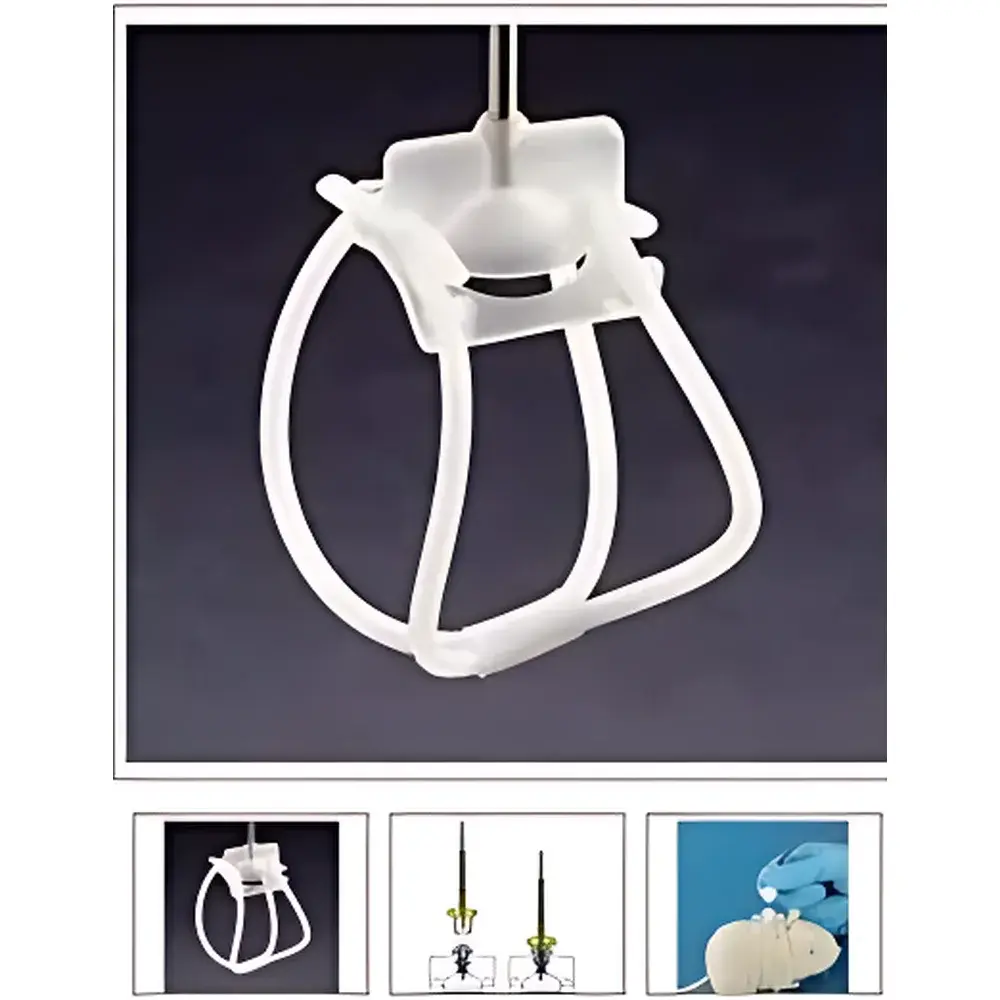
Vascular Access Harness for Rodent Chronic Studies
| Origin | USA |
|---|---|
| Manufacturer Type | Authorized Distributor |
| Import Status | Imported |
| Model | Vascular Access Harness |
| Pricing | Available Upon Request |
Overview
The Vascular Access Harness is a precision-engineered, non-restrictive restraint system designed specifically for chronic vascular access and continuous biofluid sampling in conscious, freely moving rodent models (e.g., rats and mice). Unlike conventional tethering or jacket-based systems, this harness employs a saddle-shaped, low-profile anatomical design that minimizes cutaneous pressure, thermal retention, and mechanical irritation—critical factors influencing animal welfare, physiological stability, and data fidelity in longitudinal pharmacokinetic (PK), toxicokinetic (TK), and bile duct cannulation studies. The device functions as a stable interface between indwelling catheters (e.g., jugular vein, carotid artery, or common bile duct catheters) and external collection or infusion lines, enabling uninterrupted sampling without requiring manual handling, sedation, or repeated restraint. Its operation relies on passive fluid dynamics and gravity-assisted flow management—particularly in bile collection configurations—where physiological pressure gradients drive bile into a calibrated collection reservoir upon reaching a defined volumetric threshold.
Key Features
- Biomechanically optimized saddle architecture with contoured dorsal and ventral support zones, reducing contact area by >60% compared to conventional vest-style harnesses
- Medical-grade thermoplastic elastomer (TPE) construction: hypoallergenic, latex-free, autoclavable (up to 121°C, 15 psi), and compliant with ISO 10993-5 cytotoxicity standards
- Integrated rotating swivel coupling (360° continuous rotation) to prevent catheter torsion, kinking, or dislodgement during ambulatory activity
- Modular port configuration: dual-access lumens (inlet/outlet) compatible with standard Luer-lock or microbore polyethylene tubing (ID 0.38 mm–0.76 mm)
- Adjustable Velcro®-based sizing system accommodating weight ranges from 200 g to 500 g (rat) and 25 g to 45 g (mouse), validated per OECD TG 407 and 422 guidelines
- No metal components—MRI-compatible and free of magnetic interference for multimodal imaging-integrated protocols
Sample Compatibility & Compliance
The harness supports chronic implantation of silicone, polyurethane, or PE catheters used in cardiovascular monitoring, intravenous infusion, arterial blood sampling, and biliary drainage. It is routinely deployed in GLP-compliant PK/PD studies conducted under FDA 21 CFR Part 58 and EMA Guideline on Non-Clinical Safety Studies. For bile collection applications, the system interfaces with Class I medical-grade collection reservoirs meeting ISO 8536-4 sterility requirements. All materials comply with USP Biological Reactivity Tests, and the full assembly undergoes bioburden testing per ISO 11737-1 prior to distribution. Documentation includes full traceability to raw material lot numbers and third-party biocompatibility certification reports.
Software & Data Management
While the harness itself is hardware-only, it integrates seamlessly with industry-standard telemetry platforms (e.g., Data Sciences International DSI, EMKA Technologies) and automated sample fraction collectors (e.g., Gilson FC204, Tecan Fluent). When paired with time-stamped infusion pumps or programmable peristaltic collectors, the system enables audit-trail–capable data capture aligned with FDA 21 CFR Part 11 requirements—including electronic signatures, user access logs, and immutable event timestamps. Optional RFID-tagged harness units support inventory tracking and study-specific assignment within LIMS environments.
Applications
- Chronic intravenous dosing and serial blood sampling in toxicology and safety pharmacology studies
- Uninterrupted bile duct cannulation for enterohepatic recirculation assessment and cholestatic drug metabolism profiling
- Long-term arterial pressure waveform acquisition in hypertension or heart failure models
- Subcutaneous or intraperitoneal microdialysis probe stabilization during neuropharmacological investigations
- GLP-compliant repeat-dose toxicity studies requiring ≥14-day continuous vascular access (per ICH S7A and S7B)
- Behavioral neuroscience paradigms where locomotor freedom must be preserved during simultaneous IV administration
FAQ
Is the harness suitable for both rats and mice?
Yes—adjustable sizing accommodates Sprague-Dawley/Wistar rats (200–500 g) and C57BL/6 or BALB/c mice (25–45 g); separate size kits are available.
Can it be sterilized between uses?
Yes—autoclavable at 121°C for 15 minutes; chemical sterilization with 70% ethanol or hydrogen peroxide vapor is also validated.
Does it interfere with telemetry transmitter signals?
No—non-metallic construction ensures full compatibility with radiotelemetry systems operating in the 433 MHz and 915 MHz bands.
What catheter types are recommended for use with this harness?
Silicone (Silastic®) or polyurethane catheters with outer diameters of 0.5–0.9 mm; PE-50 or PE-10 tubing for bile duct cannulation is supported via custom adapter fittings.
How frequently should the harness be inspected during chronic studies?
Daily visual inspection for skin integrity, harness fit, and catheter patency is required per AAALAC International standards; full replacement every 72 hours is recommended for bile collection protocols.