
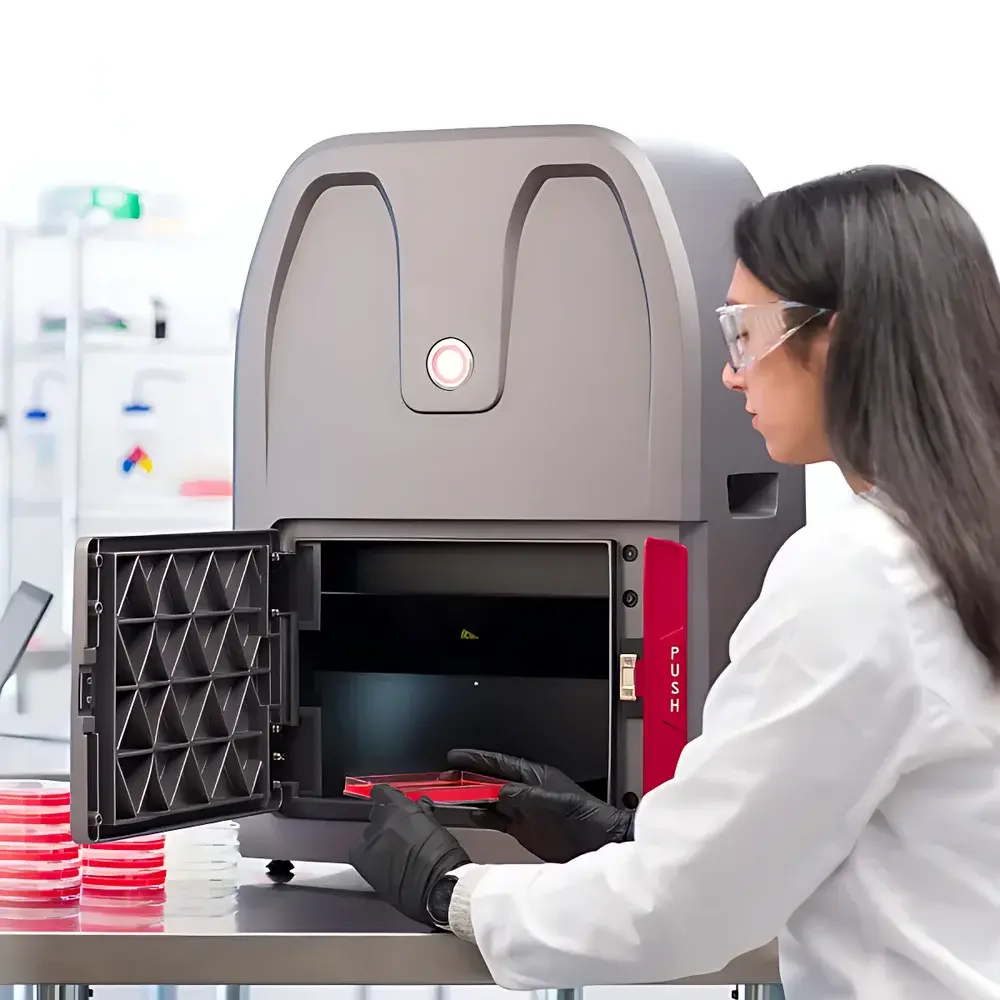
Resonon Bio-LIF Hyperspectral Fluorescence Imaging System
| Brand | Resonon |
|---|---|
| Origin | USA |
| Manufacturer Type | Authorized Distributor |
| Product Category | Imported Instrument |
| Model | Resonon Bio-LIF Hyperspectral Fluorescence Imaging System |
| Price Range | USD 1,500–1,500,000 (FOB) |
| Spectral Resolution (FWHM) | 1.9 nm |
| Excitation Wavelength | 532 nm |
| Emission Range | 550–1000 nm |
| Spatial Resolution | 60 µm/pixel |
| Image Dimensions | 1600 × 2065 pixels |
| Spectral Bands per Pixel | 335 |
| Scan Time | 25 s |
| SNR (max) | 255 |
| Weight | 28 kg |
| Dimensions | 50 × 70 × 28 cm |
| Power Supply | 120/240 VAC |
| Operating Temperature | +10 to +35 °C |
| Sample Compatibility | 90 mm Ø Petri dishes or standard 96-well microplates (127 × 86 mm) |
Overview
The Resonon Bio-LIF Hyperspectral Fluorescence Imaging System is a purpose-built scientific instrument engineered for non-invasive, spatially resolved molecular fluorescence analysis of biological specimens. It integrates laser-induced fluorescence (LIF) excitation at 532 nm with push-broom hyperspectral imaging across the 550–1000 nm emission range, enabling simultaneous acquisition of high-fidelity spectral signatures and two-dimensional spatial distribution data from each pixel. Unlike conventional fluorometers or single-point spectrometers, Bio-LIF captures full hyperspectral cubes (x, y, λ) with 335 contiguous spectral bands per pixel and a narrow full-width-at-half-maximum (FWHM) of 1.9 nm—sufficient to resolve subtle Stokes shifts, vibronic fine structure, and overlapping emission peaks from chlorophylls, flavonoids, NAD(P)H, phenolic compounds, and microbial autofluorescence markers. This capability supports quantitative physiological phenotyping, early stress detection in plant tissues, postharvest quality monitoring, and microbiological screening without sample extraction or labeling.
Key Features
- Laser excitation at 532 nm with stable TEM00 beam profile and integrated power stabilization for reproducible fluorescence induction.
- Push-broom scanning architecture delivering 1600 × 2065-pixel spatial resolution at 60 µm/pixel sampling—optimized for standard 96-well plates (127 × 86 mm) and 90 mm Petri dishes.
- High-throughput acquisition: complete hyperspectral cube captured in ≤25 seconds, minimizing photobleaching and enabling kinetic studies under controlled illumination conditions.
- Onboard spectral calibration using integrated reference sources ensures wavelength accuracy traceable to NIST-traceable standards; automatic exposure control dynamically adjusts integration time per line to maintain optimal signal saturation across heterogeneous samples.
- Rugged optomechanical design housed in a compact 50 × 70 × 28 cm enclosure (28 kg), compatible with standard laboratory benchtop environments and biosafety cabinets.
- Compliance-ready architecture: firmware supports timestamped metadata logging, user authentication, and audit-trail generation—facilitating alignment with GLP, ISO/IEC 17025, and FDA 21 CFR Part 11 requirements when deployed in regulated QC/QA workflows.
Sample Compatibility & Compliance
Bio-LIF accommodates intact, hydrated biological specimens including whole leaves (e.g., cottonwood, Arabidopsis), seedlings, fungal colonies, bacterial lawns (e.g., E. coli cultures), harvested fruits/vegetables, and cell monolayers on transparent substrates. Its non-contact, non-destructive measurement modality eliminates the need for homogenization, solvent extraction, or fluorescent tagging—preserving native biochemical states and enabling longitudinal monitoring. The system meets IEC 61000-6-3 (EMC emissions) and IEC 61000-6-2 (immunity) standards. Optical safety complies with ANSI Z136.1 Class 3R laser product classification. All software-generated reports include embedded EXIF-like metadata (acquisition time, instrument ID, calibration status, operator ID), supporting traceability in ISO 17025-accredited laboratories.
Software & Data Management
The Bio-LIF software suite provides a modular, scriptable environment built on a Qt/C++ core with Python API access. Core modules include real-time preview, automated spectral cube stitching, dark-current and flat-field correction, and batch processing pipelines compliant with FAIR (Findable, Accessible, Interoperable, Reusable) data principles. Advanced analysis tools support spectral unmixing (via constrained non-negative matrix factorization), fluorescence lifetime proxy mapping (using ratio-based indices such as F685/F740), and multivariate statistical modeling (PCA, PLS-DA). User-defined plugins can be compiled and loaded at runtime—enabling integration with third-party libraries (e.g., scikit-learn, OpenCV) or proprietary algorithms. Raw data is stored in HDF5 format with embedded ontologies (OBOE, ENVO) for semantic interoperability with LIMS and ELN systems.
Applications
- Plant physiology: Quantification of photosynthetic efficiency, drought/stress response kinetics, and senescence progression via chlorophyll-a/b, carotenoid, and anthocyanin spectral fingerprints.
- Postharvest science: Detection of enzymatic browning, microbial spoilage onset, and internal bruising in apples, tomatoes, and leafy greens prior to visible symptom development.
- Microbial diagnostics: Discrimination of E. coli, S. aureus, and L. monocytogenes based on endogenous fluorophore profiles (NADH, riboflavin, porphyrins) without culturing or reagents.
- Seed viability assessment: Rapid, label-free evaluation of embryo metabolic activity through red/far-red fluorescence ratio mapping.
- Phytochemical screening: Spatial profiling of secondary metabolites (e.g., quercetin, rutin) in medicinal plant tissues for breeding and quality control.
FAQ
What laser safety class applies to the Bio-LIF system?
The 532 nm excitation source is certified as ANSI Z136.1 Class 3R—requiring no interlocks but mandating use of protective eyewear (OD ≥4 at 532 nm) during open-beam operation.
Can Bio-LIF be integrated into an existing laboratory automation workflow?
Yes—via TCP/IP and RESTful API endpoints, the system supports remote triggering, parameter upload, and raw cube retrieval; compatible with Beckhoff TwinCAT, LabVIEW, and Python-based orchestration frameworks.
Is spectral calibration required before each measurement session?
No—built-in tungsten-halogen and neon-lamp references enable automated, per-scan wavelength validation; manual recalibration is recommended quarterly or after mechanical shock.
Does the software support compliance with 21 CFR Part 11 for electronic records?
Yes—when configured with network-authenticated user accounts and enabled audit logging, Bio-LIF software meets predicate rule requirements for electronic signatures and record retention.
What is the minimum detectable fluorescence quantum yield under standard operating conditions?
Based on NIST-traceable reference standards (e.g., quinine sulfate in 0.1 M H2SO4), the system achieves reliable detection down to ΦF ≈ 0.008 with SNR > 10 at 25 s integration, assuming typical leaf tissue reflectance and detector quantum efficiency.






