
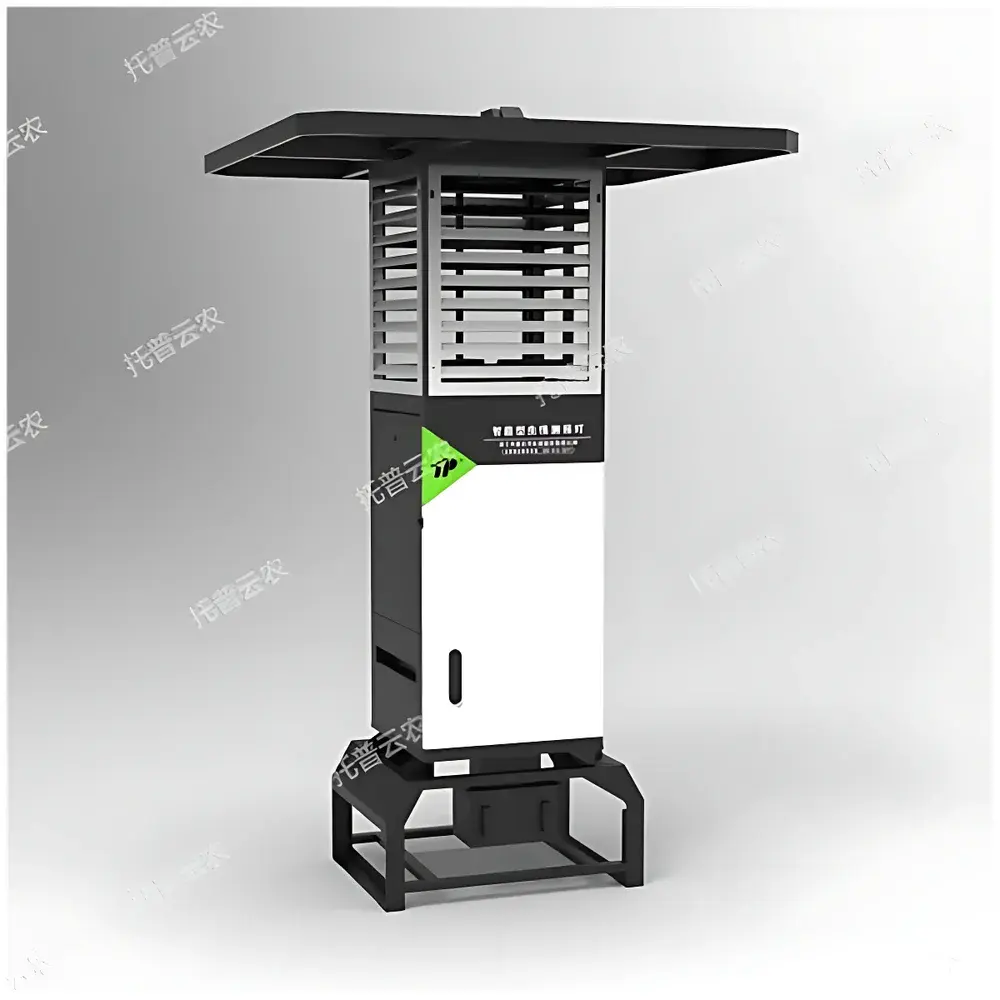
Top Cloud-agri TPCB-II-C7.0plus & TPCB-III-C7.0plus Intelligent Pest Monitoring and Forecasting System
| Brand | Top Cloud-agri |
|---|---|
| Origin | Zhejiang, China |
| Manufacturer Type | OEM Manufacturer |
| Country of Origin | China |
| Model | TPCB-II-C7.0plus / TPCB-III-C7.0plus |
| Instrument Category | Pest Surveillance Instrument |
| Power Supply | AC 220 V / DC 12 V |
| Display | 7-inch capacitive touchscreen |
Overview
The Top Cloud-agri TPCB-II-C7.0plus and TPCB-III-C7.0plus Intelligent Pest Monitoring and Forecasting Systems are fully automated, solar- and grid-compatible field instruments engineered for continuous, unattended surveillance of agricultural and forestry insect populations. Based on integrated phototactic trapping, infrared-based insect mortality treatment, precision conveyor-based imaging, and AI-powered computer vision, these systems capture, kill, dry, separate, image, identify, count, and transmit pest data in near real time. Designed for deployment across rice paddies, orchards, forest margins, and grain storage perimeters, they serve as core components of national and regional pest early-warning networks—replacing labor-intensive manual trap inspections with standardized, auditable, timestamped digital records compliant with FAO IPM guidelines and China’s National Agricultural Standard NY/T 1997–2011 for pest monitoring equipment.
Key Features
- Robust 304 stainless-steel enclosure with rain-shedding louvers and oversized canopy—enabling uninterrupted operation during precipitation via integrated rain-insect separation chamber and automatic rain-triggered dormancy mode.
- Dual-layer far-infrared insect processing chamber (upper/lower zones), programmable between 60–85 °C ±5 °C; achieves ≥98% mortality rate and ≥95% specimen integrity for morphological preservation.
- 20-megapixel industrial-grade CMOS camera with adjustable focus and LED ring illumination, mounted above a vibration-assisted conveyor belt that ensures uniform monolayer distribution of specimens prior to imaging.
- Capacitive 7-inch Android-based touchscreen interface (full Chinese UI) supporting local configuration, manual/interval-triggered imaging (adjustable from 10 minutes to 3 hours per frame), and real-time preview.
- Onboard GPS module enabling georeferenced deployment mapping, remote device tracking, and theft recovery via cloud platform integration.
- Multi-modal power architecture: AC 220 V mains or DC 12 V input compatible with 100 Ah battery + 320 W solar panel array—optimized for off-grid rural deployment.
- Automated optical filtering system at entry aperture to exclude non-target macro-arthropods, minimizing interference in micro-pest recognition pipelines.
- Light-sensing and time-scheduled control logic: automatic activation at dusk, deactivation at dawn; immune to transient ambient light spikes.
Sample Compatibility & Compliance
The system is validated for automated detection and enumeration of key lepidopteran and hemipteran pests endemic to East Asian agroecosystems—including Nilaparvata lugens (brown planthopper), Sogatella furcifera (white-backed planthopper), Cnaphalocrocis medinalis (rice leafroller), Chilo suppressalis (striped stem borer), and Scirpophaga incertulas (yellow stem borer). Recognition accuracy meets defined performance thresholds per internal validation protocol: ≥85% for S. furcifera, ≥90% for the remaining species. Image resolution and depth-of-field preserve diagnostic morphological features (e.g., wing venation, antennal segmentation, abdominal banding) required for taxonomic verification. All firmware and data transmission modules comply with IEC 62443-3-3 cybersecurity standards for industrial IoT devices. Data export formats (JPEG, CSV, JSON) support interoperability with national pest databases and FAO’s EMPRES-i platform.
Software & Data Management
Data acquisition, preprocessing, and reporting occur through a secure cloud-native SaaS platform accessible via web browser or native Android/iOS applications. Each image frame is embedded with EXIF metadata (GPS coordinates, UTC timestamp, sensor ID, exposure settings) and stored with SHA-256 checksum integrity verification. The platform implements role-based access control (RBAC), audit trails for all configuration changes, and optional 21 CFR Part 11–compliant electronic signatures for regulatory reporting workflows. Image analysis employs convolutional neural networks trained on >500,000 manually annotated field-captured specimens; model updates are delivered over-the-air (OTA) without hardware intervention. Raw images and processed counts are retained for ≥18 months; automated daily backups to geo-redundant object storage ensure continuity under GLP/GMP-aligned operational protocols.
Applications
- Real-time dynamic mapping of pest population density gradients across heterogeneous landscapes (e.g., paddy-to-upland transitions).
- Validation and calibration of regional phenology models for target species under climate variability scenarios.
- Supporting decision thresholds for precision pesticide application—reducing unnecessary sprays by correlating trap counts with economic injury levels (EILs).
- Long-term trend analysis of pest range expansion, resistance emergence, and invasive species establishment.
- Integration with weather station networks and satellite-derived NDVI indices to build multivariate forecasting algorithms.
- Training dataset generation for entomological machine learning research and extension officer capacity building.
FAQ
What power options does the system support?
It operates on either AC 220 V mains supply or DC 12 V input—compatible with solar-charged battery banks (100 Ah recommended) and 320 W photovoltaic panels.
How is rain handled during operation?
Integrated rain-sensing circuitry triggers automatic shutter closure and conveyor dormancy; the rain-insect separation chamber diverts runoff while maintaining trap functionality.
Can identification results be manually corrected?
Yes—annotated images are accessible via the cloud platform, allowing entomologists to flag misclassifications and retrain the model using active learning feedback loops.
Is the system suitable for export to EU or North American markets?
CE marking and FCC certification are pending; current hardware design complies with EN 60529 (IP65 ingress protection) and RoHS Directive 2011/65/EU material restrictions.
What connectivity methods are supported for data upload?
Ethernet (fiber or copper), wireless bridge, and LTE Cat-4 4G modems—all configured via the onboard web interface or mobile app.



