
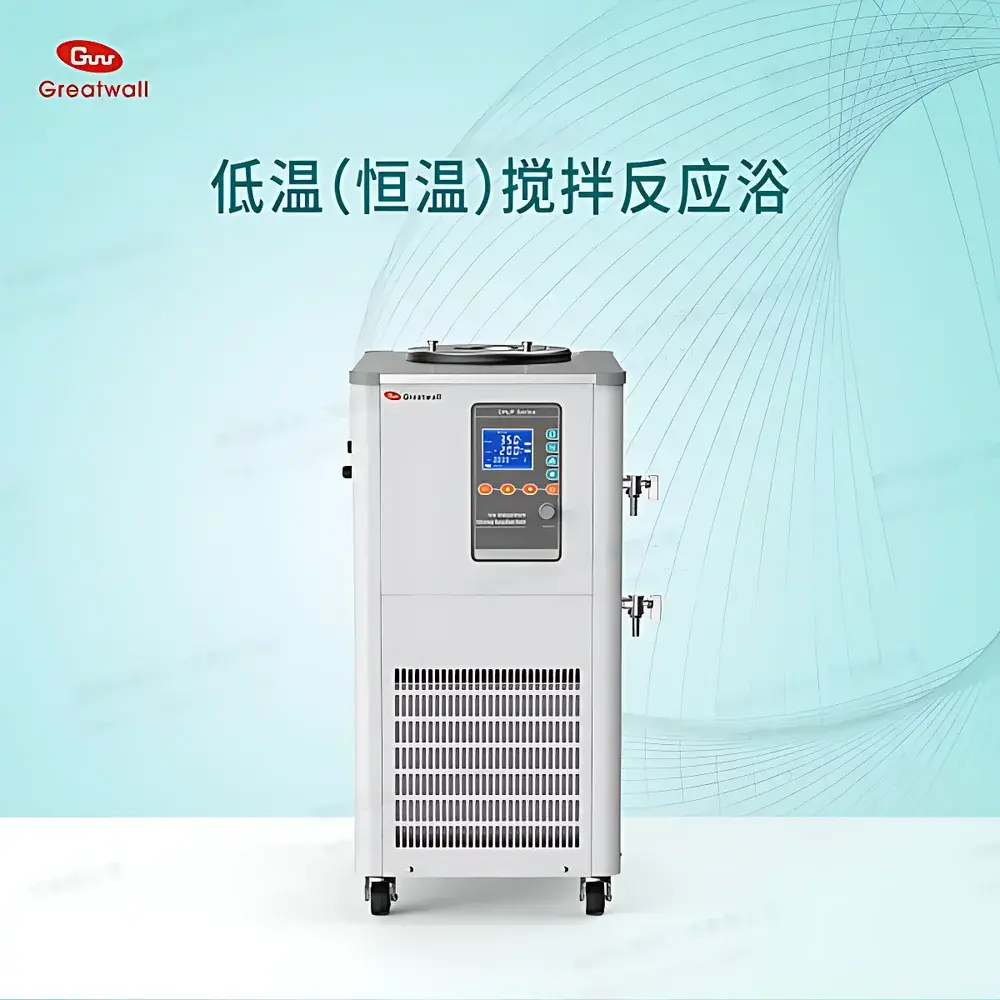
The Great Wall DHJF-2005 Low-Temperature Constant-Temperature Circulating Bath
| Brand | The Great Wall |
|---|---|
| Model | DHJF-2005 |
| Temperature Range | −20 to 99 °C |
| Temperature Stability | ±0.2 °C |
| Bath Volume | 5 L |
| Circulation Type | Internal & External |
| Temperature Control Mode | Refrigeration + Heating |
| Heating Power | 50 W |
| Power Supply | 220–240 V~, 50 Hz |
| Construction | 304 Stainless Steel Bath & Piping |
| Refrigeration System | Hermetic Piston Compressor (Secop) with Finned Air-Cooled Condenser, Capillary Tube Expansion, and Immersed 304 Stainless Steel Coil Evaporator |
| Heating System | External 304 Stainless Steel Tubular Heater (Compliant with JB/T 4088) with Mechanical Over-Temperature Cut-Off |
| Control System | PID Algorithm with 5-Stage Programmable Ramp/Soak Profiles |
| Display | LCD Interface |
Overview
The Great Wall DHJF-2005 Low-Temperature Constant-Temperature Circulating Bath is an engineered thermal management system designed for precise, stable, and bidirectional temperature control of external equipment or internal samples. It operates across a wide functional range of −20 °C to 99 °C, enabling both cryogenic cooling and high-temperature stabilization in a single compact unit. Its core architecture integrates a dual-mode thermodynamic loop—combining vapor-compression refrigeration and resistive heating—within a corrosion-resistant 304 stainless steel reservoir and circulation manifold. Unlike passive water baths, the DHJF-2005 delivers active temperature regulation via closed-loop feedback using a digital PID controller, ensuring high reproducibility in applications requiring thermal consistency over extended durations. This makes it suitable for use with externally connected instruments such as spectrophotometers, viscometers, calorimeters, and reaction jackets where accurate heat exchange or sample conditioning is critical.
Key Features
- Wide operational temperature span: −20 °C to 99 °C, supporting both sub-zero and near-boiling conditions in one platform
- High-stability thermal control: ±0.2 °C temperature uniformity across the bath volume under steady-state conditions
- Dual-circulation capability: Configurable internal recirculation (for bath homogeneity) and external circulation (for interfacing with peripheral devices)
- Robust refrigeration subsystem: Secop hermetic piston compressor paired with an air-cooled finned condenser and copper-alloy capillary expansion device; evaporator coil fully immersed in the bath and constructed from seamless 304 stainless steel to prevent mechanical failure during low-temperature operation
- Independent heating circuit: Externally mounted tubular heater compliant with JB/T 4088 industrial standards, featuring redundant mechanical over-temperature protection independent of electronic control logic
- Programmable thermal profiles: Five-segment ramp-and-soak sequences programmable via intuitive LCD interface, supporting automated temperature transitions without manual intervention
- Chemically inert wetted path: Entire fluid-contacting structure—including reservoir, pump housing, and circulation tubing—fabricated from 304 stainless steel to resist degradation from aqueous, ethylene glycol, or silicone oil-based heat transfer fluids
Sample Compatibility & Compliance
The DHJF-2005 accommodates standard laboratory heat transfer media including deionized water, 30–50% aqueous ethylene glycol solutions, and low-viscosity silicone oils—enabling compatibility with diverse thermal load requirements. Its sealed, low-noise pump assembly supports continuous operation at both cryogenic and elevated temperatures without cavitation or seal degradation. From a regulatory standpoint, the unit meets general electrical safety requirements per IEC 61010-1 for laboratory equipment. While not certified to specific ISO/IEC 17025 or GLP validation protocols out-of-the-box, its programmable control architecture, stable thermal output, and mechanical safety interlocks support integration into validated workflows where documented temperature traceability and audit-ready operation are required. Users implementing the DHJF-2005 in regulated environments (e.g., pharmaceutical QC labs) may perform IQ/OQ qualification using calibrated reference thermometers and third-party data loggers aligned with ASTM E74 or USP .
Software & Data Management
The DHJF-2005 operates via an embedded microcontroller with local LCD-based HMI—no proprietary PC software or driver installation is required. All setpoints, program stages, and real-time temperature readings are accessible directly on the front panel. Though the unit does not feature USB/Ethernet connectivity or native data export, its analog output (0–5 V or 4–20 mA, optional upon request) enables integration with external SCADA systems, PLCs, or data acquisition hardware for time-synchronized logging. For laboratories operating under FDA 21 CFR Part 11 requirements, external validation of temperature profiles—using independent NIST-traceable thermistors and timestamped digital recorders—is recommended to establish electronic record integrity and operator accountability.
Applications
- Temperature calibration of probes, sensors, and transducers across multi-point thermal ranges
- Stabilization of optical components in spectroscopic and interferometric setups sensitive to thermal drift
- Cooling/heating of jacketed reactors, rotary evaporators, and condensers in synthetic chemistry workflows
- Thermal preconditioning of polymer samples prior to DSC or DMA analysis
- Environmental stress testing of electronic assemblies under controlled thermal cycling
- Viscosity measurements requiring constant shear temperature (e.g., ASTM D445 compliance when paired with rotational viscometers)
FAQ
What types of heat transfer fluids are compatible with the DHJF-2005?**
Deionized water, 30–50% ethylene glycol/water mixtures, and low-volatility silicone oils (e.g., Dow Corning 200 Fluid series) are routinely used. Avoid halogenated solvents or highly acidic/basic media due to potential corrosion of stainless steel components.
Can the DHJF-2005 maintain −20 °C with ambient temperatures above 30 °C?**
Yes—its Secop compressor and finned condenser are rated for continuous operation up to 35 °C ambient, provided adequate ventilation (≥15 cm clearance on all sides) is maintained.
Is external circulation flow rate adjustable?**
The unit features a fixed-speed shielded magnetic drive pump delivering nominal flow rates of ~12–15 L/min at low backpressure; flow modulation requires an external needle valve or bypass loop.
Does the DHJF-2005 support RS232 or Ethernet communication?**
No—the standard configuration includes only local LCD control. Optional analog output modules (0–5 V or 4–20 mA) can be factory-installed for process monitoring integration.
How often should maintenance be performed?**
Inspect condenser fins quarterly for dust accumulation; verify refrigerant charge and compressor performance annually using calibrated pressure gauges and thermocouples per manufacturer service guidelines.



