
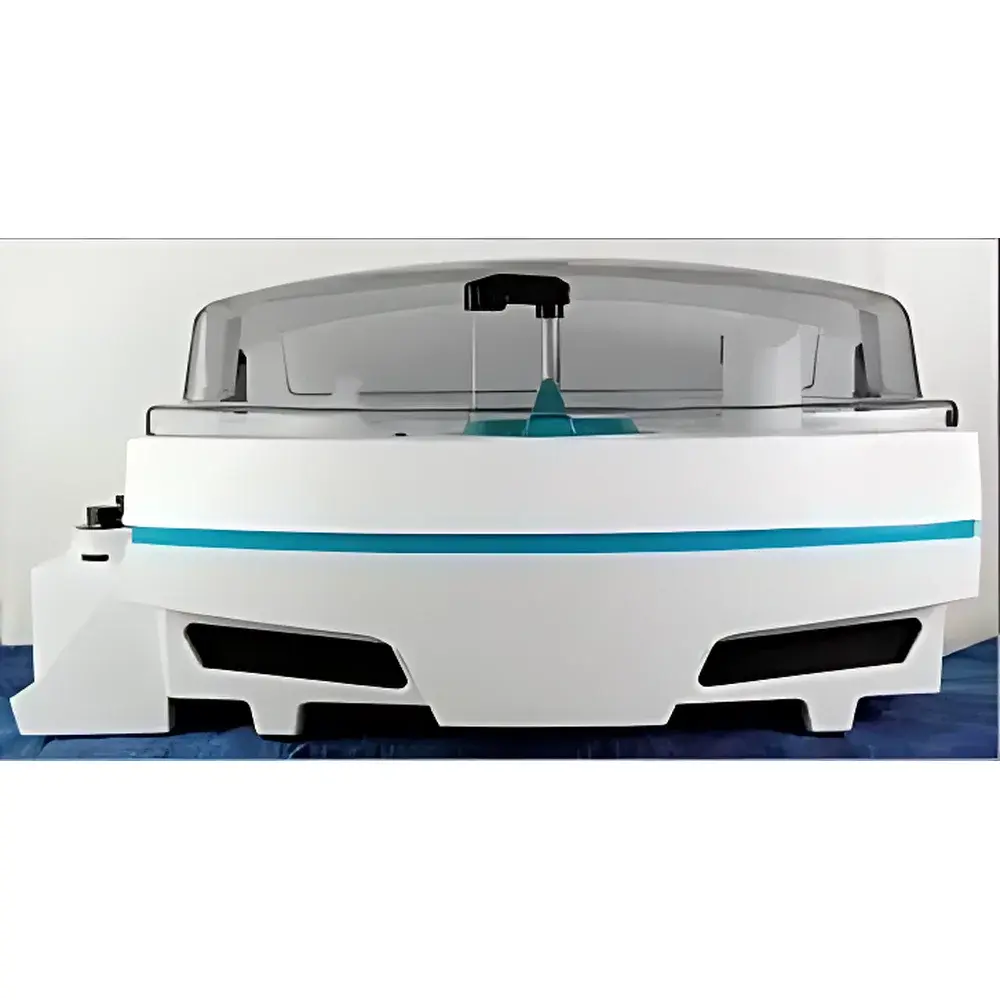
Smartchem 300 Automated Discrete Analyzer by AMS (Italy)
| [Origin | Italy |
|---|---|
| Manufacturer Type | Authorized Distributor |
| Origin Category | Imported Instrument |
| Model | Smartchem 300 |
| Pricing | Available Upon Request |
| Analysis Types | End-point, Kinetic, Differential, Dual-wavelength, Fixed-time |
| Reagent Positions | Up to 72 positions with refrigeration (4 movable racks × 16 slots + 8 fixed slots |
| Sample Positions | 4 universal sample carousels (15 positions each for cups or tubes Ø10–16 mm × 40–100 mm H) |
| Throughput | Up to 450 samples/h (with ISE module), 300 samples/h (photometric only) |
| Photometer | Dual-channel, direct-read, 9-position auto-select narrow-band interference filters (340–880 nm), 6 V/10 W halogen lamp, 6 mm pathlength, linear range 0.001–4.200 Abs, resolution 0.0001 Abs |
| Minimum Reaction Volume | 200 µL |
| Sample/Reagent Dispensing | Capacitive microdispenser, 3.0 µL–330 µL (1 µL increment), 37 °C reagent preheating, integrated probe washing, on-board dilution capability |
| Reaction Cuvettes | 80 reusable quartz/glass cuvettes across 4 independent rotating carousels (20 per carousel), automated cleaning with selectable acidic/alkaline/neutral wash solutions, temperature control at 37 °C ± 0.3 °C |
| Nitrate/Nitrite Module | Fully compliant with US EPA Method 353.2 |
| Optional ISE Module | Direct potentiometric measurement of Na⁺, K⁺, Cl⁻, Li⁺ (140 samples/h) |
| Barcode Scanning | Optional reagent and sample tube barcode readers |
| Compliance | ISO, AOAC, BATF, US EPA, AFNOR, COFRAC] |
Overview
The Smartchem 300 Automated Discrete Analyzer is a high-precision, modular platform engineered for routine and regulatory-compliant wet-chemistry analysis in environmental, food & beverage, agricultural, and clinical laboratories. Unlike continuous-flow or segmented-flow analyzers, the Smartchem 300 employs discrete (batch-mode) analysis—each sample and reagent combination is processed individually in a dedicated reaction cuvette under precisely controlled thermal and timing conditions. This architecture ensures maximum method flexibility, eliminates cross-contamination risks inherent in flow systems, and supports complex multi-step chemistries—including those requiring delayed additions, incubation, or kinetic monitoring. Designed and manufactured by AMS S.p.A. in Italy, the system integrates photometric, ion-selective electrode (ISE), and specialized modules (e.g., nitrate/nitrite per US EPA Method 353.2) within a single, compact footprint. Its fully computer-controlled operation enables unattended overnight runs, reproducible method execution, and full traceability—making it suitable for GLP, GMP, and ISO/IEC 17025-accredited environments.
Key Features
- Modular Three-Zone Architecture: Physically segregated sample, reagent, and reaction zones—each implemented as independent rotating carousels—minimize robotic arm travel distance and significantly reduce cycle time per analysis.
- High-Fidelity Dual-Channel Photometer: Equipped with nine auto-selected narrow-band interference filters (340–880 nm), a stabilized 6 V/10 W halogen source, and a 6 mm optical path, delivering exceptional linearity (0.001–4.200 Abs) and resolution (0.0001 Abs) without manual filter changes or recalibration.
- Intelligent Reagent Management: Up to 72 refrigerated (8–12 °C) reagent positions across four movable racks (16 slots each) and eight fixed slots; optional barcode tracking ensures full reagent lot traceability and expiration-based alerting.
- Flexible Sample Handling: Four universal sample carousels accommodate both disposable cups and standard test tubes (Ø10–16 mm × 40–100 mm); eight dedicated emergency slots permit priority insertion at any point during a run without interrupting ongoing assays.
- Robust Reaction System: 80 durable, optically matched cuvettes distributed across four independently indexed carousels; automated quality monitoring verifies cuvette integrity prior to use; low water consumption (1.5 L/h) and three configurable wash chemistries (acidic, alkaline, neutral) extend cuvette service life beyond 10,000 cycles.
- Integrated ISE Module (Optional): Plug-and-play potentiometric detection for Na⁺, K⁺, Cl⁻, and Li⁺ with drift-compensated electrodes, no routine maintenance required, and throughput up to 140 samples/h—fully synchronized with photometric workflows.
Sample Compatibility & Compliance
The Smartchem 300 accepts liquid samples across a broad viscosity and particulate range—compatible with clarified water, digested soil extracts, wine filtrates, serum supernatants, and fertilizer digestates. Sample containers include standard polypropylene cups (12–16 mm diameter), borosilicate glass tubes, and barcoded vials (with optional reader). All photometric methods are validated against internationally recognized reference standards and protocols, including ISO 7027 (turbidity), ISO 6775 (ammonia), ISO 15681-2 (phosphate), US EPA Methods 353.2 (nitrate/nitrite), 365.4 (phosphorus), and 4500-Cl⁻ G (chloride). The system supports audit-ready data integrity through electronic signatures, user access levels, and immutable audit trails—fully aligned with FDA 21 CFR Part 11 requirements when deployed with compliant LIMS or AMS’ SmartLink software suite.
Software & Data Management
Controlled via AMS SmartLink™ software, the Smartchem 300 provides a Windows-based interface with intuitive method editor, real-time instrument status dashboard, and comprehensive QC tracking. Users can store up to 999 fully customizable methods—including multi-step protocols with conditional logic, variable incubation times, and dynamic dilution routines. All parameters—including wavelengths, reaction kinetics, calibration curves (linear, quadratic, spline), and pass/fail criteria—are programmable without developer support. Raw absorbance data, cuvette IDs, reagent lot numbers, and environmental logs (temperature, pressure, humidity) are timestamped and exported in ASTM E1384-compliant ASCII or XML formats. Integration with third-party LIMS (via HL7 or ODBC) and ERP systems is supported through documented APIs and certified drivers.
Applications
The Smartchem 300 delivers standardized, accredited results across diverse sectors:
• Environmental Testing: COD, ammonia-N, nitrate-N, nitrite-N, phosphate, sulfate, fluoride, cyanide, hardness, chromium(VI), and total phenols in drinking water, wastewater, seawater, and leachates.
• Food & Beverage: Glucose, fructose, sucrose, titratable acidity, free/total SO₂, PANOPA index, OD₄₂₀/OD₅₂₀/OD₆₂₀ (wine color metrics), ascorbic acid, sorbic acid, and alcohol (TVA) in wines, juices, and dairy products.
• Agriculture & Soils: Ammonium, nitrate, boron, calcium, magnesium, total nitrogen (Kjeldahl), total phosphorus, chloride, and urea in plant tissue digests, soil extracts, and irrigation water.
• Feed & Fertilizer: Crude protein (via N×6.25), calcium, phosphorus, chloride, and urea in compound feeds, mineral premixes, and granular fertilizers.
• Tobacco & Plant Extracts: Nicotine, cyanide, formaldehyde, chloride, and nitrate in leaf homogenates and smoke condensates.
FAQ
Does the Smartchem 300 require daily calibration or frequent lamp replacement?
No—its dual-beam photometer self-references during every measurement, eliminating baseline drift; the halogen lamp has a rated lifetime of ≥2,000 hours and is field-replaceable in under five minutes.
Can existing Smartchem methods be migrated to the Smartchem 300?
Yes—AMS provides backward-compatible method conversion tools and validation support to ensure seamless transition from Smartchem 200 or 450 platforms.
Is remote monitoring and troubleshooting supported?
Yes—the system includes embedded Ethernet connectivity, SNMP-enabled health monitoring, and optional secure VPN access for AMS-certified engineers to perform diagnostics and firmware updates.
What documentation is provided for regulatory submissions?
AMS supplies IQ/OQ/PQ protocol templates, 21 CFR Part 11 configuration reports, and method validation packages compliant with ISO/IEC 17025 clause 7.2.2.
How is carryover managed between high-concentration and low-concentration samples?
The capacitive dispenser performs triple-wash cycles between aspirates; probe washing uses pressurized air and solvent rinse; cuvette cleaning includes ultrasonic agitation and multi-stage chemical regeneration—all logged per sample.




