
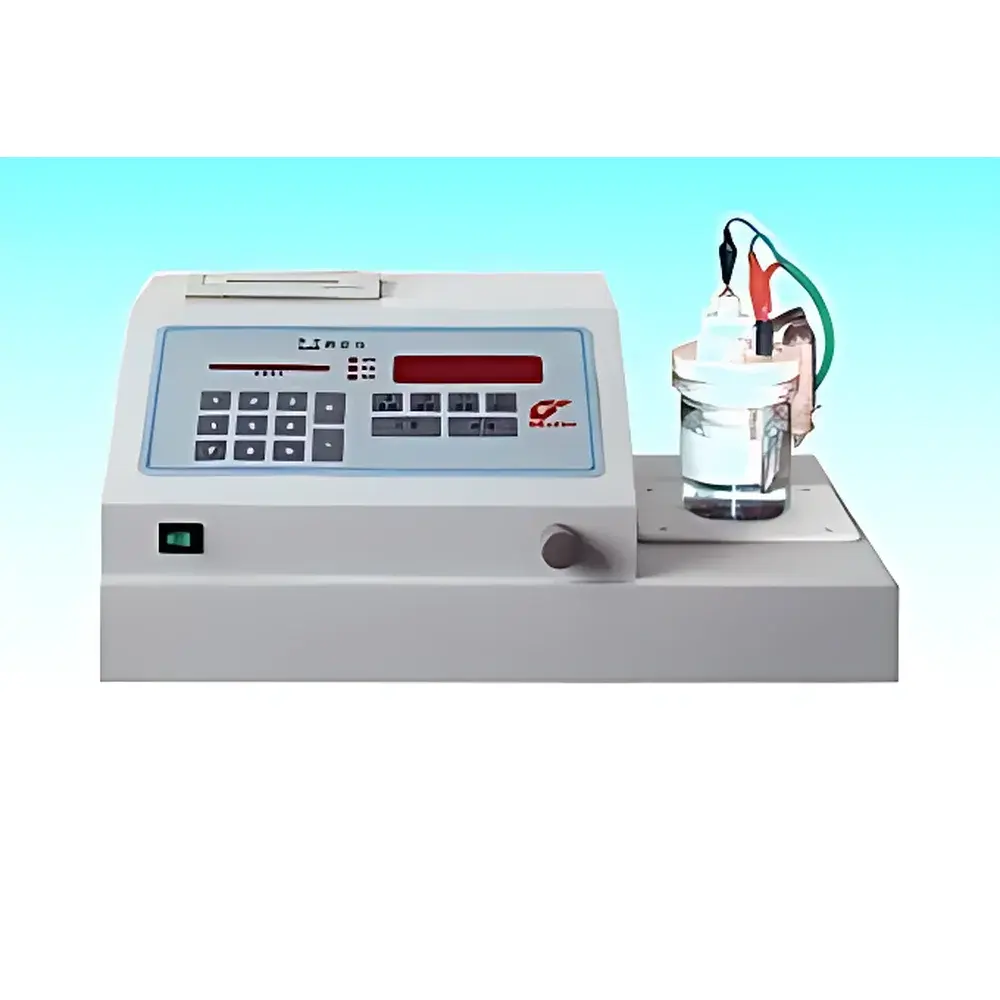
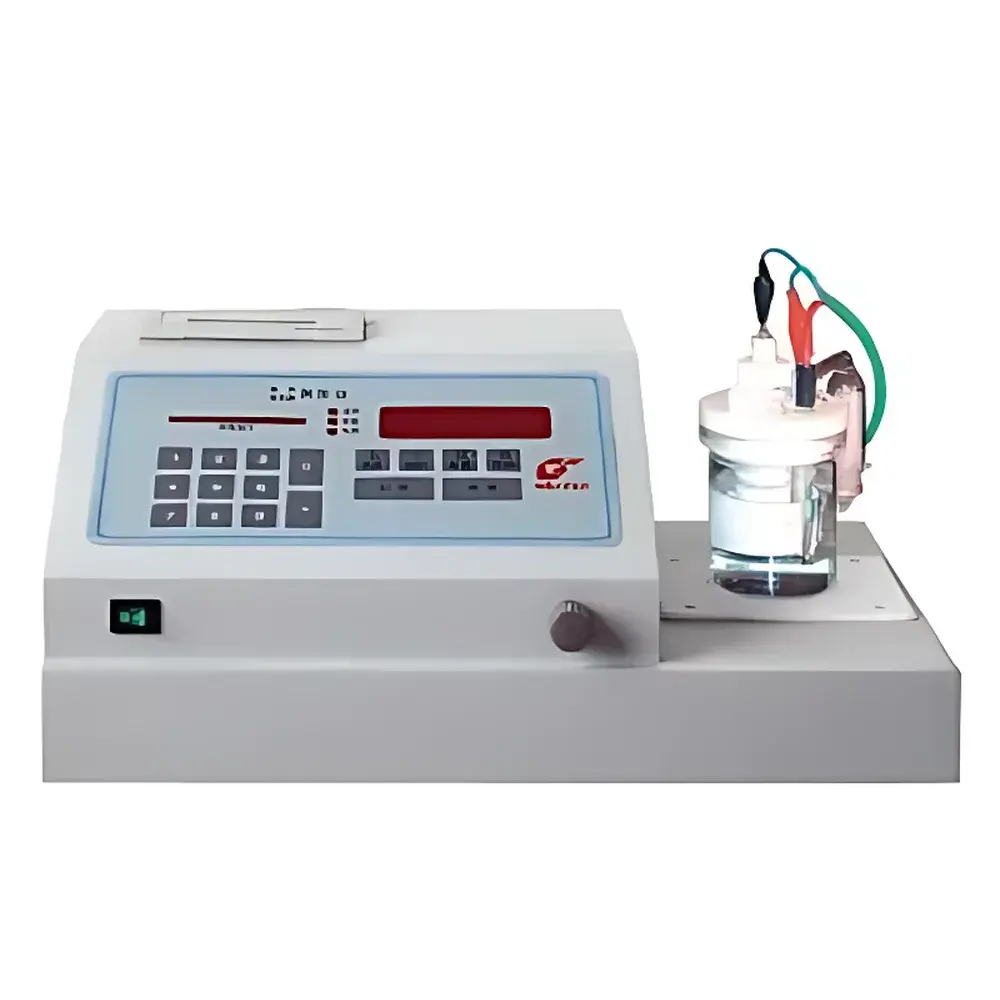
Kyoyuan KY-4Br Bromine Number & Bromine Index Analyzer (LCD Display)
| Brand | Kyoyuan |
|---|---|
| Origin | Jiangsu, China |
| Manufacturer Type | Direct Manufacturer |
| Region of Origin | Domestic (China) |
| Model | KY-4Br |
| Pricing | Upon Request |
| Measurement Principle | Microcoulometric Titration |
| Sample Type | Liquid |
| Method Standards | SH/T 0630–1996, SH/T 1551–2018, GB/T 11136–1989 (2004), SH/T 1767–2008 (2015), GB/T 1815–1997, ASTM D1492 |
| Bromine Number Range | 0–300 g Br/100 g oil |
| Bromine Index Range | 1–1000 mg Br/100 g oil |
| Accuracy | ±3% ±0.2 g Br (bromine number) |
| Resolution | 0.01 mg Br |
| Endpoint Detection | Dual-platinum electrode with potentiometric endpoint detection |
| Electrolysis Mode | Pulse current with bidirectional electrolysis capability |
| Control System | MCS-51 single-chip microcomputer |
| Display | 6-digit LED numeric display (units: g Br, mg Br, or µC) |
| Print Output | 16-character thermal printer for continuous result and parameter logging |
| Safety | Benzene-free electrolyte formulation |
| Reagent Consumption | <1 mL per sample |
| Endpoint Indication | Audible electronic tone |
Overview
The Kyoyuan KY-4Br Bromine Number & Bromine Index Analyzer (LCD Display) is a dedicated microcoulometric titration instrument engineered for precise, trace-level quantification of unsaturation in petroleum-based liquid samples. Based on the fundamental electrochemical principle of controlled-potential coulometry, the analyzer measures total bromine-reactive olefinic and diolefinic content by generating bromine *in situ* via electrolytic oxidation of bromide ions in a non-aqueous electrolyte solution. The amount of charge consumed during titration—directly proportional to bromine equivalents reacted—is integrated in real time to calculate bromine number (g Br/100 g sample) or bromine index (mg Br/100 g sample). Designed specifically for refinery process monitoring, quality assurance laboratories, and petrochemical R&D facilities, the KY-4Br delivers high reproducibility and method-compliant performance aligned with internationally recognized standard test methods including ASTM D1492, SH/T 0630–1996, and SH/T 1551–2018.
Key Features
- Microcoulometric measurement architecture with dual-platinum potentiometric endpoint detection ensures stable signal response and minimized drift over extended analysis sequences.
- Benzene-free electrolyte system eliminates exposure hazards associated with traditional halogenation reagents—supporting safer laboratory operation and reduced regulatory burden for chemical handling and waste disposal.
- Ultra-low reagent consumption (<1 mL per analysis) reduces operational cost and minimizes solvent waste generation—consistent with green analytical chemistry principles.
- Pulse-current electrolysis with reversible polarity control enables optimized bromine generation kinetics and improved recovery for low- and high-reactivity matrices alike.
- Integrated MCS-51 microcontroller provides deterministic timing, real-time charge integration, and automatic endpoint recognition without user intervention.
- Acoustic endpoint alert combined with 6-digit LED display (configurable for g Br, mg Br, or µC units) facilitates rapid visual and auditory confirmation of titration completion.
- Onboard 16-character thermal printer supports GLP-compliant documentation with timestamped output of results, calibration parameters, and system status flags.
Sample Compatibility & Compliance
The KY-4Br is validated for use with a broad spectrum of hydrocarbon liquids, including gasoline, kerosene, diesel fuel, lubricating base oils, light and heavy aromatic streams (e.g., BTX fractions), and naphthenic solvents. Its measurement range—0–300 g Br/100 g oil (bromine number) and 1–1000 mg Br/100 g oil (bromine index)—covers both highly saturated refinery cuts and reactive cracked feedstocks. All operational protocols conform to SH/T 0630–1996 (petroleum products), SH/T 1551–2018 (industrial aromatics), and ASTM D1492 (coulometric determination of bromine index in aromatic hydrocarbons). The instrument’s design incorporates fail-safe diagnostics—including open-circuit detection, electrode contamination alerts, and electrolyte depletion warnings—to support routine compliance with ISO/IEC 17025 internal quality requirements and preparatory readiness for GMP/GLP audits.
Software & Data Management
While the KY-4Br operates as a standalone embedded system without external PC dependency, its firmware implements full audit-trail functionality: every analysis cycle logs date/time stamp, sample ID (manually entered), measured charge (µC), calculated result, endpoint voltage threshold, and system error codes. Printed reports retain this metadata for traceability. Though not equipped with USB or Ethernet connectivity, the device supports manual data archival via printed hardcopy—sufficient for laboratories operating under tier-1 QA frameworks where electronic records are not mandated. Firmware logic enforces mandatory calibration verification prior to sample analysis, and all calibration coefficients are stored in non-volatile memory with write-protection against accidental overwrite.
Applications
- Real-time monitoring of hydrotreater effluent to quantify residual olefins and assess catalyst activity decay.
- Quality release testing of reformulated gasoline blends for compliance with maximum bromine index specifications (e.g., ≤10 mg Br/100 g).
- Stability assessment of jet fuel and diesel distillates during accelerated oxidation studies.
- Batch-to-batch consistency verification of aromatic extraction units producing benzene, toluene, and xylene (BTX) intermediates.
- Research-scale evaluation of alkylation, isomerization, and catalytic cracking product distributions based on unsaturation profiles.
FAQ
What electrolyte formulation is recommended for the KY-4Br?
Kyoyuan specifies a proprietary benzene-free, methanol-based electrolyte containing lithium bromide and sulfur dioxide—compatible with ASTM D1492 and SH/T 0630–1996 requirements.
Can the instrument be calibrated using certified reference materials?
Yes. Calibration is performed using traceable olefin standards such as cyclohexene or 1-octene solutions in iso-octane, with gravimetric preparation verified against NIST-traceable volumetric standards.
Is the KY-4Br suitable for analyzing viscous or high-boiling samples?
It is optimized for low-viscosity, volatile-to-medium boiling liquids (IBP–350 °C). Samples with kinematic viscosity >5 cSt at 40 °C require pre-dilution with iso-octane or toluene to ensure homogeneous dispersion and reliable electrode response.
How often does the dual-platinum electrode require maintenance?
Electrodes should be cleaned ultrasonically in acetone for 5 minutes after every 20–30 analyses; polishing with 0.3 µm alumina slurry is recommended monthly or when endpoint slope degradation exceeds 15% from baseline.
Does the instrument meet FDA 21 CFR Part 11 requirements?
No. As a stand-alone microcontroller-based analyzer without electronic signature capability, network connectivity, or role-based access control, it does not fulfill Part 11 criteria—but remains fully compliant with paper-based GLP workflows.





