
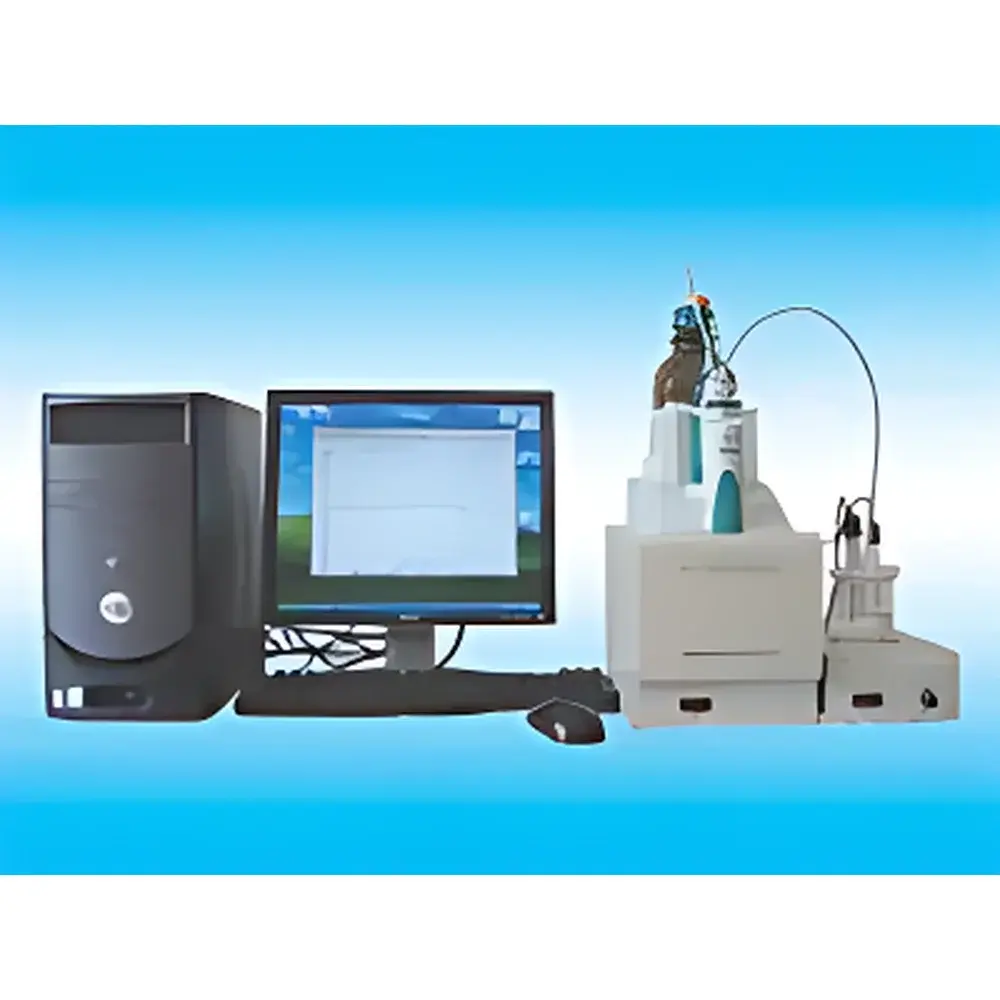
Kyoyuan KY-4 Automatic Potentiometric Titrator for Basic Nitrogen Determination
| Brand | Kyoyuan |
|---|---|
| Origin | Jiangsu, China |
| Manufacturer Type | Direct Manufacturer |
| Instrument Category | Domestic |
| Model | KY-4 |
| Instrument Type | Basic Nitrogen & Mercaptan Sulfur Analyzer |
| Application Scope | Dedicated Analyzer |
| Sample Form | Liquid |
| Measurement Range | ≥3 µg/g |
| Titration Method | Potentiometric Titration |
| Minimum Titration Volume | 0.01 mL |
| Potential Measurement Range | 0 to ±1999.5 mV |
| Burette Accuracy | ±0.1% F·S |
| Electronic Unit Basic Error | ±0.1% of full scale + 0.5 mV |
| Accuracy | Relative error ≤5% |
| Compliance Standard | SH/T 0162 |
Overview
The Kyoyuan KY-4 Automatic Potentiometric Titrator for Basic Nitrogen Determination is a dedicated electrochemical analyzer engineered for precise quantification of basic nitrogen compounds in petroleum products—including naphthas, kerosenes, diesel fuels, lubricating oils, and residual fuels—regardless of color depth. It operates on the fundamental principle of potentiometric titration, where the endpoint is identified by an inflection point in the potential (mV) versus titrant volume curve. The system employs a high-impedance dual-input potentiometric cell with a glass reference electrode and a platinum or antimony indicator electrode, enabling stable and reproducible potential monitoring under varying sample conductivity and matrix complexity. Unlike manual or semi-automated methods, the KY-4 integrates real-time derivative analysis of the titration curve, applying digital smoothing algorithms to suppress noise and refine endpoint detection—critical for low-concentration alkaline nitrogen species (≥3 µg/g) embedded in hydrocarbon matrices with interfering acidic or redox-active components.
Key Features
- Imported precision burette assembly with volumetric accuracy of ±0.1% F·S and minimum dispensing resolution of 0.01 mL, ensuring repeatable reagent delivery across extended analytical sequences.
- Dual high-impedance input circuitry (input impedance >1013 Ω) minimizes current draw from the electrochemical cell, preserving electrode potential stability during slow-titration protocols typical for weakly basic nitrogen compounds.
- Automated liquid handling functions: auto-refill, fixed-volume dosing, and closed-loop titrant replenishment—all synchronized with real-time potential feedback to maintain stoichiometric control.
- Endpoint determination via second-derivative (d²E/dV²) algorithm with adaptive thresholding, eliminating operator subjectivity and reducing inter-laboratory variability.
- Rugged industrial-grade chassis with electromagnetic interference (EMI) shielding, designed for continuous operation in refinery QC laboratories and ASTM/ISO-compliant testing environments.
Sample Compatibility & Compliance
The KY-4 is validated for liquid hydrocarbon samples per SH/T 0162—China’s national standard for basic nitrogen determination in petroleum products. It accommodates both light distillates (e.g., gasoline fractions) and heavy, viscous streams (e.g., vacuum gas oils), provided samples are dissolved in suitable solvent mixtures (e.g., chlorobenzene–acetic anhydride or toluene–perchloric acid systems) to ensure complete protonation of basic nitrogen sites. The instrument supports GLP-compliant workflows through audit-trail-enabled method storage, user-access logging, and timestamped result export. While not pre-certified to FDA 21 CFR Part 11, its data structure and electronic signature readiness align with GMP-aligned validation protocols when deployed with qualified LIMS integration.
Software & Data Management
The KY-4 operates under Kyoyuan’s proprietary Windows-based titration software, supporting method creation, sequence programming, and real-time curve visualization. All raw potential vs. volume data, smoothed derivatives, and calculated endpoints are stored in binary+CSV dual-format archives, enabling traceability and third-party statistical review (e.g., JMP, Minitab). Software modules include calibration verification logs, drift compensation routines for reference electrode stabilization, and batch reporting templates compliant with ISO/IEC 17025 documentation requirements. Exported reports contain full metadata: analyst ID, instrument serial number, calibration date, environmental temperature/humidity (if external sensor-integrated), and uncertainty estimates derived from repeatability studies per ISO 5725.
Applications
- Quantification of pyridinic, quinolinic, and carbazolic nitrogen species in crude assay and fractionation studies.
- Monitoring catalyst poisoning potential in hydrotreating feedstocks prior to reactor entry.
- Quality control of aviation turbine fuels (Jet A-1) per ASTM D3228 (though KY-4 implements SH/T 0162 methodology, results correlate strongly with ASTM-defined basic nitrogen thresholds).
- Supporting refinery process optimization by tracking nitrogen removal efficiency across catalytic cracking and hydrodesulfurization units.
- Research applications in fuel formulation, including evaluation of nitrogen-scavenging additives and compatibility testing with advanced exhaust aftertreatment systems.
FAQ
What electrochemical cell configuration does the KY-4 support?
The instrument is configured for two-electrode potentiometric measurement using a combination glass reference electrode and inert indicator electrode (Pt or Sb), optimized for non-aqueous, low-dielectric media common in petroleum analysis.
Can the KY-4 be used for mercaptan sulfur analysis as stated in its instrument type?
Yes—when reconfigured with iodometric titration parameters and appropriate redox electrodes, the platform supports SH/T 0259 for mercaptan sulfur; however, method switching requires separate validation per application.
Is the 0.01 mL minimum titration volume achievable across the full burette capacity?
Yes—the servo-controlled dosing mechanism maintains ±0.005 mL volumetric repeatability at all dispense volumes between 0.01 mL and 25 mL, verified per ISO 8655-3 gravimetric calibration protocols.
How is compliance with SH/T 0162 demonstrated during routine operation?
Each analysis run embeds mandatory procedural checkpoints: blank subtraction, standard recovery verification (using certified NIST-traceable basic nitrogen standards), and endpoint reproducibility assessment across triplicate injections—all logged automatically in the audit trail.
Does the system support remote diagnostics or networked data transfer?
The KY-4 includes Ethernet and RS-232 interfaces; secure FTP and OPC UA connectivity options are available via optional firmware upgrade, enabling integration into centralized refinery MES platforms.





