
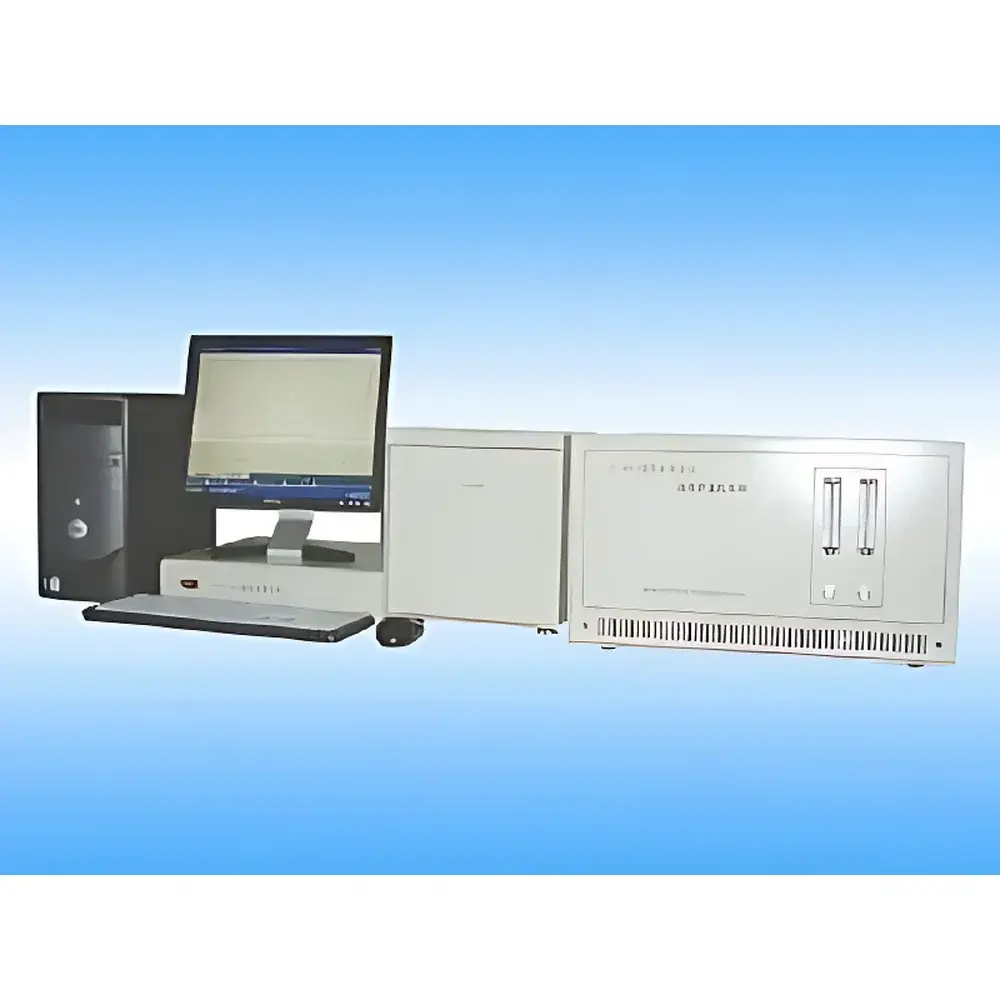
Kyuan KY-200 Microcoulometric Sulfur and Chlorine Analyzer
| Origin | Jiangsu, China |
|---|---|
| Manufacturer Type | Authorized Distributor |
| Origin Category | Domestic (PRC) |
| Model | KY-200 |
| Pricing | Available Upon Request |
| Measurement Principle | Microcoulometric Titration (ASTM D5808 / SH/T 0253 / GB/T 11061.4) |
| Analyte Forms | Total Sulfur (as SO₂), Total Chlorine (as HCl) |
| Sample Types | Liquid, Solid, Gas (with optional injectors) |
| Detection Range | 0.1–10,000 mg/L for both S and Cl |
| LOD | 0.1 mg/L (S and Cl) |
| Repeatability | CV ≤ 3% (x > 10 mg/L) |
| Temperature Control | Ambient to 1100 °C, ±1 °C accuracy |
| Carrier Gases | Industrial-grade N₂ and O₂ |
| Cooling | Intelligent Fan-based Air Cooling |
| Power Requirement | 1500 W |
| Compliance Standards | SH/T 0253, GB/T 11061.4, SH/T 0222, GB/T 3208, GB/T 18612, ASTM D5808 |
Overview
The Kyuan KY-200 Microcoulometric Sulfur and Chlorine Analyzer is a fully automated, benchtop elemental analyzer engineered for precise quantification of total sulfur and total chlorine in petroleum, chemical, environmental, and research-grade samples. It operates on the fundamental principle of microcoulometric titration—where analyte-derived species (SO₂ from sulfur or HCl from chlorine) are generated via high-temperature oxidative pyrolysis in a controlled N₂/O₂ atmosphere, swept into a dual-mode coulometric titration cell, and quantitatively determined by electrochemical generation of titrant (I₂ for sulfur; Ag⁺ for chlorine). The system applies Faraday’s law to convert the integrated electrolysis charge (in coulombs) directly into mass concentration (mg/L), eliminating reliance on calibration curves for primary quantification. Designed for routine compliance testing and method validation, the KY-200 meets the metrological requirements of multiple internationally referenced standards—including ASTM D5808, SH/T 0253, GB/T 11061.4, and GB/T 18612—making it suitable for laboratories operating under GLP, ISO/IEC 17025, or regulatory QA/QC frameworks.
Key Features
- Digital microcoulometric architecture with real-time charge integration and auto-zeroed baseline correction for enhanced signal stability
- Programmable high-temperature pyrolysis furnace (ambient to 1100 °C) with ±1 °C thermal regulation and intelligent air-cooling system featuring automatic fan activation/deactivation
- Modular sample introduction: standard liquid autosampler included; optional solid sampler and gas sampling valve available for heterogeneous matrices
- Integrated quartz combustion tube and dual-mode titration cell optimized for low carryover and rapid electrode regeneration
- Embedded microprocessor and dedicated PC software enabling full system control, real-time status monitoring, parameter logging, and audit-ready result reporting
- Compliance-ready configuration supporting electronic signature, user access levels, and data integrity features aligned with FDA 21 CFR Part 11 expectations for regulated environments
Sample Compatibility & Compliance
The KY-200 accommodates liquid hydrocarbons (e.g., gasoline, diesel, naphtha), solid samples (e.g., catalysts, polymers, lubricant additives), and gaseous streams (e.g., natural gas, refinery off-gas) when equipped with appropriate injection modules. Its measurement scope spans 0.1–10,000 mg/L for both sulfur and chlorine, with verified detection capability at the 0.1 mg/L level—meeting the lower limits required for ultra-low-sulfur diesel (ULSD) and organochloride screening per ISO 8217 and ASTM D975. The instrument adheres strictly to test methodologies defined in SH/T 0253 (light distillates), GB/T 11061.4 (natural gas), SH/T 0222 (LPG), GB/T 3208 (aromatics), and GB/T 18612 (crude oil organic chloride). All hardware and firmware components are traceably manufactured in accordance with ISO 9001-certified processes, and analytical performance is validated using NIST-traceable SRMs (e.g., NIST SRM 2724b for sulfur, custom AgCl-based standards for chlorine).
Software & Data Management
The KY-200 is operated via Kyuan’s proprietary Windows-based analysis suite, which provides intuitive workflow navigation, multi-channel real-time signal visualization (electrolysis current, furnace temperature, gas flow), and customizable report templates compliant with laboratory information management system (LIMS) export formats (CSV, XML, PDF/A-1b). Raw charge-integration data, calibration verification logs, and system diagnostic records are stored with immutable timestamps and user attribution. Audit trail functionality captures all critical events—including method edits, result overrides, and maintenance interventions—with configurable retention policies. For regulated laboratories, optional 21 CFR Part 11 modules support role-based electronic signatures, biometric login integration, and encrypted database backups synchronized to network-attached storage (NAS) infrastructure.
Applications
- Quality control of refined fuels for compliance with EN 590, ASTM D975, and China VI sulfur specifications
- Organochloride screening in crude oil and feedstocks to prevent catalyst poisoning in hydrotreating units
- Trace chlorine monitoring in pharmaceutical solvents and electronic-grade chemicals per ICH Q5C and SEMI F57
- Environmental analysis of soil leachates and wastewater effluents under EPA Method 9096A adaptations
- R&D support for developing low-sulfur reformulated lubricants and biofuel blends
- Teaching laboratories conducting instrumental analysis courses on electroanalytical techniques and redox stoichiometry
FAQ
What sample matrices can be analyzed without modification?
Liquid hydrocarbons (e.g., gasoline, kerosene, jet fuel) are supported out-of-the-box using the standard syringe-driven liquid autosampler.
Is the instrument compatible with existing LIMS infrastructure?
Yes—the software exports structured analytical data in CSV and XML formats with configurable field mapping, enabling seamless ingestion into major LIMS platforms including LabWare, STARLIMS, and Thermo Fisher SampleManager.
How is system performance verified between calibrations?
The analyzer includes built-in system suitability checks: blank response assessment, electrolyte stability monitoring, and periodic standard recovery verification using certified reference materials (CRMs) traceable to national metrology institutes.
Does the KY-200 meet requirements for ISO/IEC 17025 accreditation?
Yes—its documented uncertainty budget, traceable calibration hierarchy, and comprehensive SOP support package (including IQ/OQ/PQ protocols) fulfill Clause 6.4 and Annex A.1 requirements for competence in elemental analysis.
What maintenance intervals are recommended for routine operation?
Quartz combustion tube inspection every 200 analyses; electrolyte replacement every 72 operational hours; ceramic frit cleaning weekly; full system leak check and gas line purging prior to each analytical batch.




