
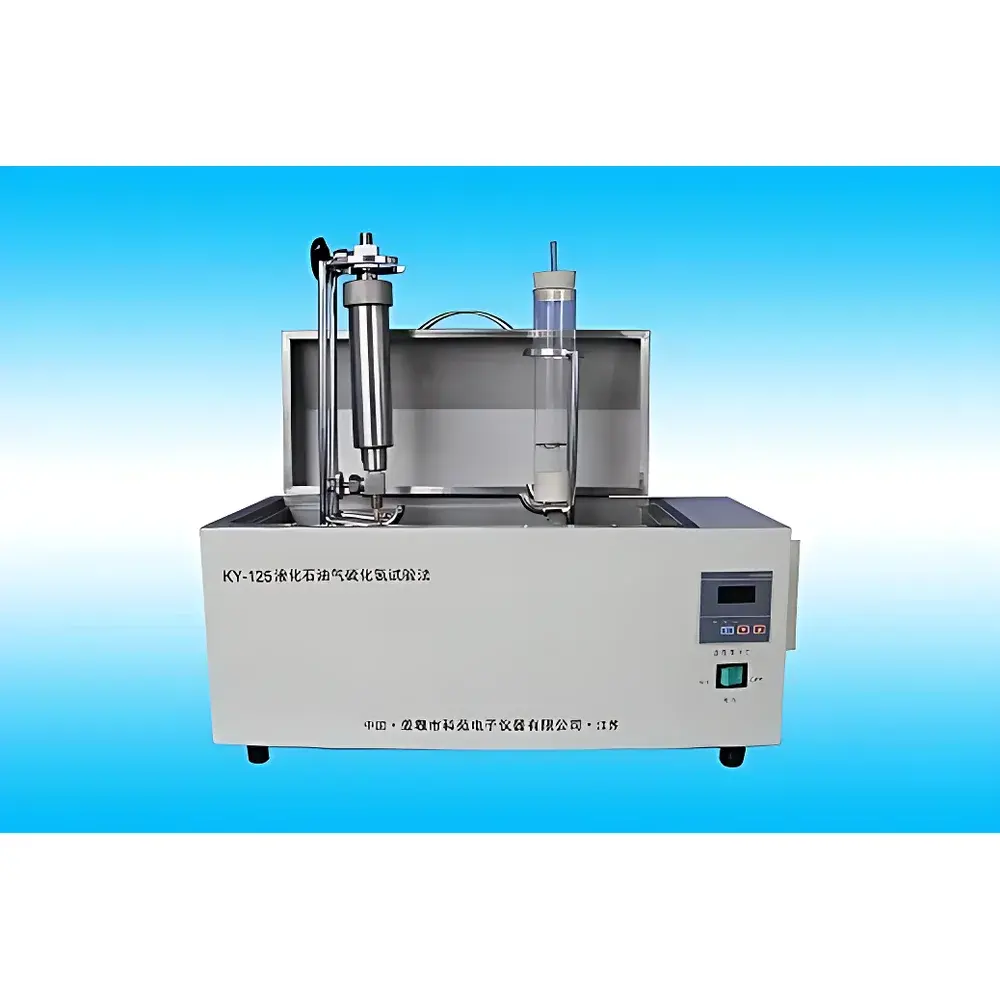
KY-0125 Hydrogen Sulfide Analyzer for Liquefied Petroleum Gas (Lead Acetate Method) – Jiangsu Keyuan
| Origin | Jiangsu, China |
|---|---|
| Manufacturer Type | Authorized Distributor |
| Origin Category | Domestic (PRC) |
| Model | KY-0125 |
| Price | Upon Request |
| Applicable Standard | ASTM D2420, SH/T 0125 |
| Heating Method | Electric Tubular Heater |
| Temperature Control | Digital PID Controller with PT100 Sensor |
| Flow Regulation | Adjustable Needle Valve + Visual Flowmeter |
| Total Power | 1000 W |
| Power Supply | AC 220 V, 50 Hz |
Overview
The KY-0125 Hydrogen Sulfide Analyzer for Liquefied Petroleum Gas (LPG) is a dedicated, standardized laboratory instrument engineered for qualitative and semi-quantitative detection of hydrogen sulfide (H₂S) in LPG streams using the lead acetate impregnated test strip method. It operates on the principle of selective chemical reaction: gaseous H₂S reacts with lead acetate on a treated paper strip to form black lead sulfide (PbS), producing a visible, persistent darkening—typically within 1–3 minutes—indicating presence above the detection threshold of 4 mg/m³. This method complies strictly with ASTM D2420 “Standard Test Method for Hydrogen Sulfide in Liquefied Petroleum Gases (LPG) (Lead Acetate Method)” and its Chinese national equivalent SH/T 0125. The analyzer’s thermal conditioning system ensures consistent vaporization of liquefied samples, enabling reproducible gas-phase exposure under controlled temperature and flow conditions—critical for minimizing false negatives due to incomplete volatilization or condensation.
Key Features
- Thermally regulated evaporation bath with electric tubular heating element (1000 W rated power), maintaining uniform thermal distribution across the sample path.
- Digital PID temperature controller integrated with PT100 platinum resistance sensor, delivering ±0.5 °C stability over the operational range (typically 40–60 °C, per ASTM D2420 requirements).
- Calibrated needle valve and direct-read flowmeter for precise, repeatable gas flow adjustment (recommended range: 100–300 mL/min), ensuring optimal contact time between sample gas and test strip.
- Standard-compliant borosilicate glass reaction cylinder with internal glass hook for secure, vertical suspension of lead acetate test strips—designed to ASTM D2420 dimensional and material specifications.
- Included 500 mL stainless steel LPG sampling cylinder with pressure-rated valve assembly, certified for safe handling of pressurized hydrocarbon gases up to 2.0 MPa.
- Robust benchtop architecture with grounded AC 220 V / 50 Hz input, EMI-filtered power supply, and thermal cut-off protection for operator safety and instrument longevity.
Sample Compatibility & Compliance
The KY-0125 is validated exclusively for LPG matrices (propane-, butane-, and isobutane-rich mixtures) as defined in ASTM D2420. It is not suitable for natural gas, refinery fuel gas, or sour crude vapors without method validation. Methyl mercaptan (CH₃SH) may produce transient yellow discoloration on the test strip—but fades within 5 minutes and does not compromise H₂S interpretation when observed per protocol. Other common sulfur compounds—including thiophenes, sulfides, and disulfides—do not yield stable color reactions under this methodology. The instrument supports GLP-aligned operation: all critical parameters (temperature setpoint, actual bath temperature, flow rate, exposure duration) are manually recorded in laboratory notebooks; optional external data loggers may be interfaced via analog output (0–5 V) for traceable audit trails.
Software & Data Management
The KY-0125 is a hardware-only, non-computerized analytical platform. No embedded firmware, touchscreen interface, or proprietary software is included. Temperature and flow settings are adjusted via front-panel controls; real-time values are displayed on dual digital indicators (temperature: °C; flow: mL/min). For laboratories requiring electronic recordkeeping, integration with LIMS or ELN systems can be achieved using third-party analog-to-digital converters (e.g., National Instruments USB-6009) to capture temperature and flow signals. While the device itself does not meet FDA 21 CFR Part 11 requirements for electronic signatures, it fully supports manual documentation practices compliant with ISO/IEC 17025 and ASTM E2500 for method verification and equipment qualification.
Applications
- Quality control testing of commercial LPG prior to distribution, verifying compliance with UOP 48, GPA 2140, and GB 11174 sulfur limits (≤10 ppmv H₂S).
- Refinery off-gas monitoring during amine treating unit performance checks.
- Field-deployable verification at terminal receiving points where rapid go/no-go decisions are required.
- Educational use in petrochemical engineering labs for teaching standardized gas impurity analysis techniques.
- Supporting root-cause investigations of odor complaints or corrosion incidents linked to H₂S breakthrough in LPG infrastructure.
FAQ
Is the KY-0125 compatible with natural gas or pipeline gas samples?
No. The instrument is calibrated and validated only for LPG per ASTM D2420. Natural gas requires alternative methods such as ultraviolet fluorescence (ASTM D5504) or gas chromatography (ISO 14532).
Can the lead acetate test strips be sourced separately?
Yes. Certified strips meeting ASTM D2420 specifications (e.g., Fisher Scientific Cat. No. S291-100 or equivalent) are commercially available; shelf life is 12 months unopened, stored at 2–8 °C.
What maintenance is required for long-term reliability?
Monthly cleaning of glass components with acetone followed by deionized water rinse; annual calibration of PT100 sensor and flowmeter against NIST-traceable references is recommended.
Does the unit include a certificate of conformance or factory calibration report?
Each unit ships with a manufacturer’s Declaration of Conformity to SH/T 0125 and a factory-assembled verification report confirming bath temperature stability and flow linearity at three setpoints (45 °C, 50 °C, 55 °C).





