
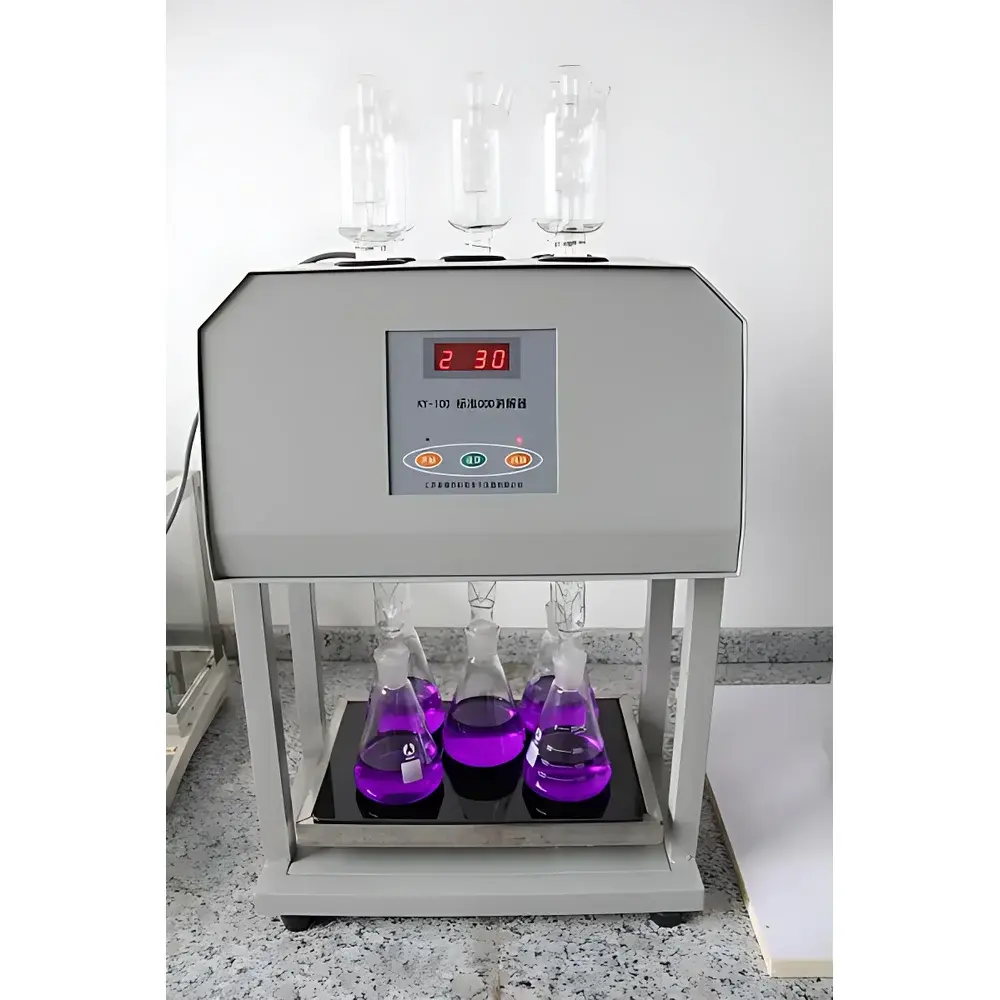
Kyoyuan KY-1005 Standard COD Digestion Block
| Brand | Kyoyuan |
|---|---|
| Origin | Jiangsu, China |
| Manufacturer Type | Direct Manufacturer |
| Country of Origin | China |
| Model | KY-1005 |
| Digestion Method | Reflux Digestion |
| Heating Module | Integrated Ceramic Heating Block |
| Batch Capacity | 5 × 250 mL Erlenmeyer Flasks |
| Temperature Setpoint | 165 °C (per GB 11914–1989 and ISO 6060) |
| Temperature Accuracy | ±1 °C at 165 °C |
| Timer Range | 0–999 min |
| COD Measurement Range | 0–1000 mg/L (direct), 0–10000 mg/L (after dilution) |
| Power Supply | AC 220 V ±10%, 50 Hz |
| Rated Power | 1300 W |
| Ambient Operating Temperature | 5–40 °C |
| Cooling Method | Forced-air convection (no tap water required) |
| Condenser Type | Glass “spike” reflux condenser (replaces spherical condenser) |
| Compliance | Fully aligned with GB 11914–1989, ISO 6060:1989, and EPA Method 410.4 principles |
Overview
The Kyoyuan KY-1005 Standard COD Digestion Block is a precision-engineered, benchtop thermal digestion system designed exclusively for the quantitative determination of Chemical Oxygen Demand (COD) in aqueous environmental samples—primarily wastewater, surface water, and industrial effluents. It implements the closed-reflux, dichromate oxidation method as defined by the Chinese national standard GB 11914–1989 and harmonized with ISO 6060:1989 and U.S. EPA Method 410.4. The instrument maintains strict control over three critical analytical parameters: temperature (165 °C ±1 °C), digestion duration (typically 120 minutes), and reagent stoichiometry—ensuring high inter-laboratory reproducibility and metrological traceability. Unlike open-heating or non-standardized hot plates, the KY-1005 integrates a calibrated ceramic heating block with uniform thermal distribution across all five positions, eliminating hot-spot-induced variability and supporting GLP-compliant routine analysis.
Key Features
- Five-position digestion block configured for standard 250 mL Erlenmeyer flasks with 24/40 ground-glass joints—enabling direct use of reflux assemblies without sample transfer.
- Microprocessor-controlled digital timer (0–999 min resolution: 1 min) with audible end-of-cycle alert and auto-shutdown function.
- Patented glass “spike” reflux condenser design—enhances condensation efficiency, minimizes volatile organic loss, and eliminates reliance on continuous tap-water cooling (reducing lab water consumption by >95% vs. traditional systems).
- Forced-air active cooling system integrated into the chassis—provides rapid post-digestion cooldown while maintaining operator safety and ambient lab humidity stability.
- Corrosion-resistant, thermally insulated housing with front-panel LED display and tactile membrane keys—designed for long-term operation in humid, chemically aggressive laboratory environments.
- Thermal stability validated per GB/T 2829–2002 sampling plans: ≤±1 °C deviation at setpoint under full-load conditions (5 flasks, 165 °C, 120 min).
Sample Compatibility & Compliance
The KY-1005 accommodates standard 250 mL borosilicate glass Erlenmeyer flasks (with 24/40 taper) and supports both low-range (0–1000 mg/L COD) and extended-range (0–10000 mg/L COD) analyses via proportional dilution—fully compliant with Section 7.2 of GB 11914–1989. Sample matrices include municipal sewage, pulp/paper effluent, food processing wastewater, and pretreated leachate. All digestion protocols adhere to ISO/IEC 17025:2017 clause 7.2.2 (method validation) and support audit-ready documentation when paired with Kyoyuan’s optional GLP-compliant logbook templates. The system satisfies core requirements of China’s HJ/T 399–2007 standard for wastewater monitoring laboratories and aligns with the QA/QC framework outlined in EPA SW-846 Method 410.4.
Software & Data Management
The KY-1005 operates as a standalone hardware platform with no embedded software or network interface—intentionally designed to meet ISO/IEC 17025:2017 Annex A.1 (instrument control simplicity) and avoid cybersecurity or firmware validation burdens common in connected devices. All operational parameters (set temperature, elapsed time, power status) are displayed locally via high-contrast LED. For laboratories requiring electronic recordkeeping, Kyoyuan provides a companion Excel-based QC workbook (free download) that automates calculation of COD concentration (mg/L), recovery rates for KHP standards (500 mg/L), and RSD validation per GB 11914–1989 Section 9.3. When used with optional Kyoyuan digital burettes (e.g., KBD-200 series), the system fully supports 21 CFR Part 11–compliant audit trails via third-party LIMS integration.
Applications
- Routine compliance testing for discharge permits under China’s “Water Pollution Prevention and Control Law” (2017 Amendment).
- Wastewater treatment plant (WWTP) influent/effluent monitoring per HJ 91.1–2019.
- Environmental impact assessment (EIA) baseline studies and follow-up verification.
- Research-grade COD method development and inter-laboratory comparison exercises.
- Validation of on-site rapid COD sensors (e.g., UV-Vis or electrochemical probes) against reference digestions.
FAQ
Does the KY-1005 comply with ISO 6060:1989?
Yes—the thermal profile, reflux geometry, reagent volumes, and digestion duration strictly mirror ISO 6060:1989 Annex A specifications.
Can I use round-bottom flasks instead of Erlenmeyer flasks?
No—the heating block geometry and condenser alignment are optimized exclusively for 250 mL Erlenmeyer flasks with 24/40 joints; substitution compromises reflux integrity and safety.
What is the maximum allowable chloride interference, and how is it mitigated?
As per GB 11914–1989, chloride concentrations >1000 mg/L require mercury sulfate masking; the KY-1005 supports this protocol without modification.
Is calibration certificate included with shipment?
A factory-issued temperature calibration report (traceable to NIM, China) is provided; on-site verification using a NIST-traceable RTD probe is recommended quarterly.
How is maintenance performed on the air-cooling system?
The axial fan and heat-sink assembly require biannual inspection for dust accumulation; no lubrication or replacement parts are needed within the first 5 years of operation.
Related Products







