
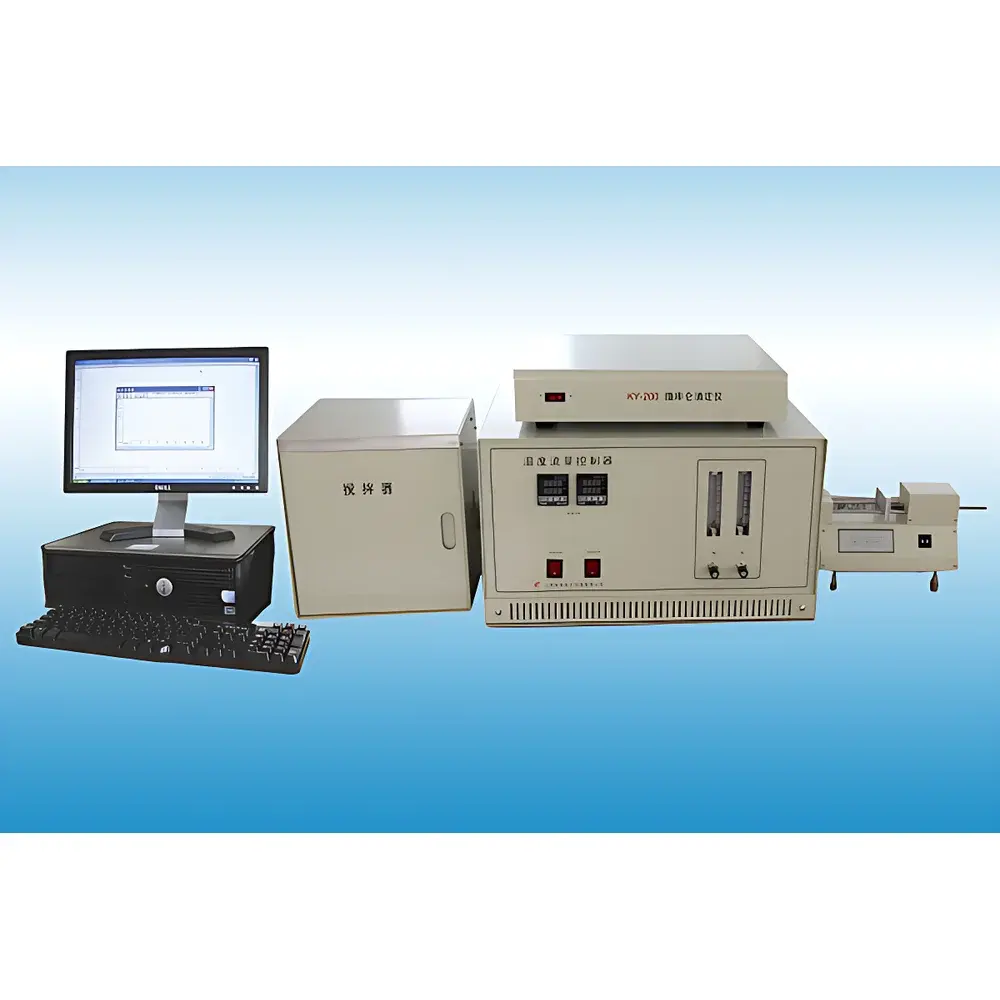
KY-200A Crude Oil Organic Chloride Analyzer by Keyuan Instruments
| Brand | Keyuan Instruments |
|---|---|
| Origin | Jiangsu, China |
| Manufacturer Type | OEM Producer |
| Country of Origin | China |
| Model | KY-200A |
| Pricing | Upon Request |
| Measurement Principle | Microcoulometric Titration (ASTM D5808 / GB/T 18612) |
| Sample Forms | Liquid, Solid, Gas (with optional injectors) |
| Chlorine Range | 0.1–10,000 mg/L |
| Detection Limit | 0.1 mg/L |
| Precision | RSD ≤20% (≤1.0 mg/L), ≤8% (1.0–100 mg/L), ≤3% (>100 mg/L) |
| Temperature Control | Ambient to 1100 °C ±1 °C |
| Carrier Gases | Industrial-grade O₂ and N₂ |
| Cooling Method | Intelligent Fan-cooled Cracking Furnace |
| Power Consumption | 1.5 kW |
Overview
The KY-200A Crude Oil Organic Chloride Analyzer is a microcoulometric total chlorine determination system engineered for high-precision quantification of organic chloride species in petroleum feedstocks and refined products. It operates on the fundamental principle of controlled pyrolytic conversion followed by electrochemical detection: samples are combusted in a dual-gas (O₂/N₂) environment at programmable temperatures up to 1100 °C, converting all organochlorine compounds quantitatively to hydrogen chloride (HCl). The evolved HCl is swept into a silver coulometric titration cell, where Cl⁻ ions react stoichiometrically with electrolytically generated Ag⁺. The charge consumed during this reaction—measured in real time—is directly proportional to chlorine mass via Faraday’s law of electrolysis. This method delivers trace-level sensitivity (0.1 mg/L detection limit) and compliance with internationally recognized test protocols including ASTM D5808-2009 and GB/T 18612-2011, making it suitable for regulatory monitoring, process control, and refinery feedstock qualification.
Key Features
- Digital microcoulometric architecture with embedded microprocessor control and real-time feedback loops for stable Ag⁺ generation and endpoint resolution
- Programmable high-temperature cracking furnace (ambient to 1100 °C, ±1 °C stability) with intelligent fan-based air cooling—fan activates automatically above 300 °C and deactivates post-cool-down to extend component life
- Modular sample introduction: compatible with liquid autosamplers (standard), solid sampling boats, and gas-tight syringes or gas loops (optional accessories)
- Integrated PC interface supporting full instrument control, parameter logging, real-time status visualization, and automated report generation (PDF/CSV)
- Self-diagnostic routines for cell conditioning, background current validation, and electrode response verification prior to analysis
- Robust hardware design optimized for continuous operation in QC laboratories—no consumable electrodes; silver anode is regenerated in situ
Sample Compatibility & Compliance
The KY-200A accepts liquid hydrocarbon matrices (crude oil, naphtha, diesel, jet fuel), solid catalysts or polymer residues (via quartz boat insertion), and low-pressure gaseous streams (e.g., refinery off-gas, LPG) when equipped with appropriate inlet modules. All analyses adhere to the metrological traceability framework defined in ISO/IEC 17025:2017. Data integrity meets ALCOA+ principles: attributable, legible, contemporaneous, original, accurate, complete, consistent, enduring, and available. Audit trails—including method parameters, calibration history, user actions, and raw coulometric integrals—are retained per GLP/GMP requirements. Instrument validation documentation supports IQ/OQ/PQ execution aligned with FDA 21 CFR Part 11 expectations for electronic records and signatures.
Software & Data Management
The proprietary Keyuan Analytical Workstation (v3.2+) provides a validated Windows-based platform for method development, sequence definition, calibration curve fitting (linear/regression weighting), and statistical evaluation (RSD, recovery %, LOD/LOQ). Raw charge-time integrals are stored with metadata (date/time, operator ID, sample ID, furnace profile, gas flow rates). Export formats include ASTM E1382-compliant .txt, CSV for LIMS integration, and printer-ready reports with embedded chromatogram-like coulograms. Software enforces role-based access control (administrator, analyst, reviewer) and supports electronic signature workflows compliant with 21 CFR Part 11 Annex 11 guidelines. Backups are configurable to network drives or NAS devices with automatic timestamping and version retention.
Applications
- Quantitative screening of crude oil batches for organic chloride contamination prior to distillation—critical for preventing corrosion in overhead systems and catalyst poisoning in hydrotreaters
- QC testing of middle distillates and reformulated gasoline to verify compliance with pipeline specification limits (e.g., ≤5 mg/kg Cl)
- Research-scale investigation of dechlorination efficiency in catalytic hydrodechlorination studies
- Environmental monitoring of chlorinated hydrocarbons in soil extracts or wastewater effluents from petrochemical sites
- Method transfer and cross-validation between ASTM D5808 and UOP 475 (microcoulometric vs. XRF-based Cl screening)
- Teaching laboratories demonstrating electrochemical stoichiometry, Faraday’s law, and combustion–titration coupling in analytical chemistry curricula
FAQ
What sample volume is required for liquid analysis?
Typical injection volume is 1–50 µL, adjustable based on expected chlorine concentration and selected calibration range.
Is routine maintenance of the titration cell required?
The Ag/AgCl reference electrode and working electrode are sealed and require no periodic replacement; monthly cell conditioning using standard HCl solution is recommended to maintain baseline stability.
Can the instrument be integrated into a centralized LIMS?
Yes—via TCP/IP or RS-232, with configurable data export templates supporting ASTM E1382 and ASTM E1461 message structures.
How is system suitability verified before sample analysis?
Automated system suitability tests include blank response check (<0.05 mg/L equivalent), standard recovery (85–115% for 10 mg/L Cl standard), and repeatability assessment (n=5 injections).
Does the analyzer support multi-point calibration with internal standard correction?
Yes—calibration curves may be constructed using external standards or bracketed internal standard addition (e.g., ¹³C-labeled chlorobenzene), with software applying response factor normalization.




