
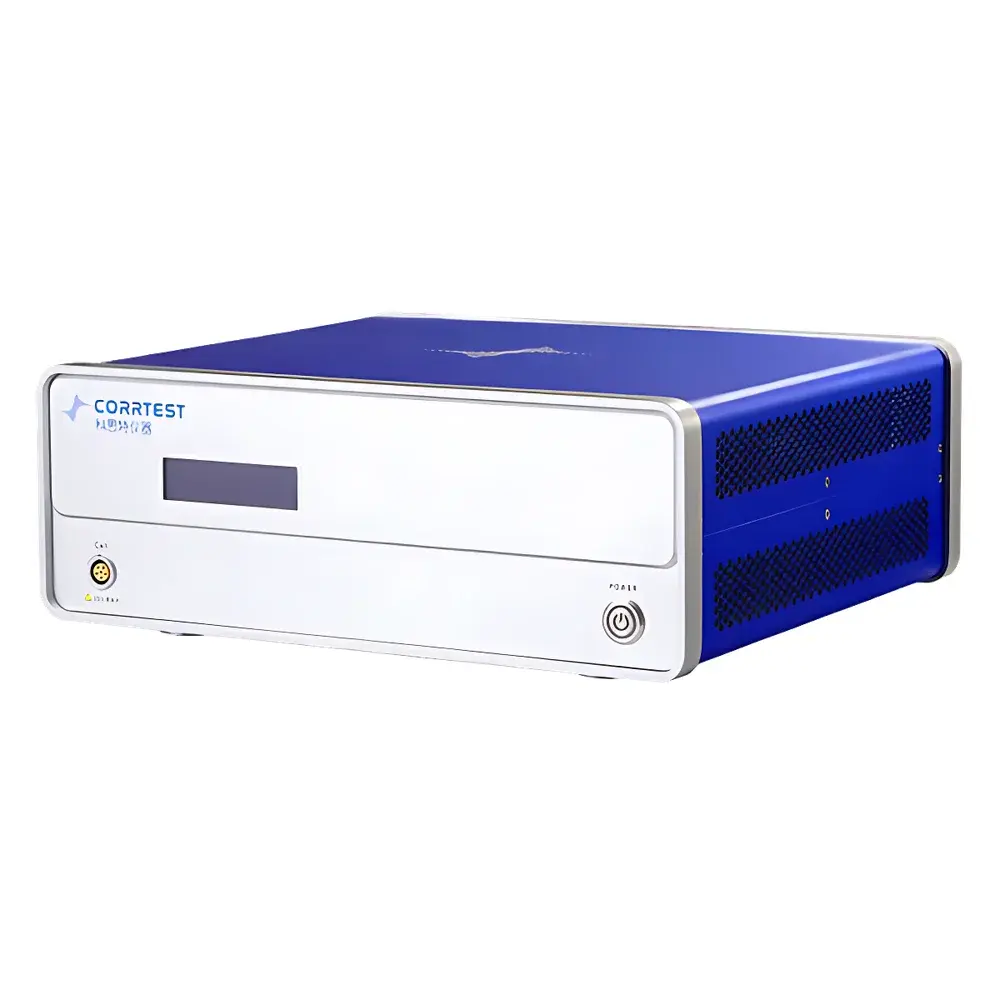
CorrTest CS300M Electrochemical Workstation
| Brand | CorrTest |
|---|---|
| Model | CS300M |
| Current Range | ±2 A |
| Current Accuracy | ±0.1% of full-scale reading |
| Potential Accuracy | ±0.1% of full-scale reading ±1 mV |
| Potentiostatic Range | ±10 V |
| Potentiodynamic Scan Rate (CV/LSV) | 0.001 mV/s to 10 V/s |
| Current Sensitivity | 1 pA |
| Potential Resolution | 3 mV (<10 Hz), 10 mV (>100 Hz) |
| EIS Frequency Range | Not specified |
| AD Acquisition | 16-bit @ 1 MHz, 20-bit @ 1 kHz |
| DA Resolution | 16-bit |
| Rise Time | <1 ms (<10 mA), <10 ms (<2 A) |
| Reference Electrode Input Impedance | 10¹² Ω |
| Voltage Compliance | ±21 V |
| Communication Interface | USB 2.0 |
| Low-Pass Filter | 8-stage programmable |
Overview
The CorrTest CS300M Electrochemical Workstation is a high-precision, benchtop potentiostat/galvanostat engineered for rigorous electrochemical research and industrial corrosion assessment. Built upon a dual-channel analog front-end architecture with real-time digital signal processing, the CS300M implements classical three-electrode potentiostatic control using feedback-stabilized operational amplifiers and high-speed current-to-voltage conversion. Its design adheres to fundamental electrochemical instrumentation principles—ensuring low-noise current measurement via transimpedance amplification, fast settling time for dynamic potential steps, and robust IR-drop compensation via positive feedback circuitry. The system supports both steady-state and transient electrochemical techniques critical to materials science, battery development, sensor validation, and corrosion engineering—particularly where quantitative kinetic and thermodynamic parameters must be extracted under controlled mass transport and interfacial conditions.
Key Features
- Wide current range from ±2 nA to ±2 A across 10 auto-ranging decades, enabling high-sensitivity picoampere-level detection and high-current electrodeposition or battery cycling
- Potentiostatic control accuracy of ±0.1% of full scale ±1 mV and galvanostatic accuracy of ±0.1% of full scale, traceable to internal voltage references calibrated against NIST-traceable standards
- Programmable low-pass filtering (8 stages) and adjustable sampling rates (up to 1 MHz at 16-bit resolution) to optimize signal-to-noise ratio for specific experimental time constants
- Integrated solution resistance (Rs) measurement and real-time IR compensation—essential for accurate polarization curve acquisition in high-resistivity media such as concrete pore solutions or organic electrolytes
- Dual independent analog output channels supporting simultaneous control of rotating disk electrode (RDE) speed and working electrode potential/current during hydrodynamic voltammetry experiments
- Comprehensive waveform generation engine supporting arbitrary potential/current step sequences, multi-step protocols, and synchronized trigger I/O for external equipment integration (e.g., spectrometers, temperature controllers)
Sample Compatibility & Compliance
The CS300M is compatible with standard three-electrode configurations (working, reference, counter) using common electrochemical cells—including aqueous, non-aqueous, molten salt, and solid-state electrolyte systems. It interfaces seamlessly with rotating disk electrodes (RDE), rotating ring-disk electrodes (RRDE), microelectrodes, and coated metal coupons for localized corrosion testing. All hardware and firmware comply with CE electromagnetic compatibility (EMC) Directive 2014/30/EU and Low Voltage Directive 2014/35/EU. While not certified for use in classified hazardous locations, its electrical isolation meets IEC 61010-1 safety requirements for laboratory instrumentation. Data integrity features—including timestamped raw data logging, user-defined metadata tagging, and audit trail support in CorrTest software—align with GLP and ISO/IEC 17025 documentation practices for accredited testing laboratories.
Software & Data Management
The CorrTest software suite provides a modular, scriptable environment for experiment design, real-time monitoring, and post-acquisition analysis. It supports ASTM G5, G59, G102, G106, and ISO 16773-compliant test templates for corrosion rate calculation, Tafel extrapolation, EIS equivalent circuit fitting (via ZView-compatible .z file export), and noise resistance analysis. All acquired datasets are stored in HDF5 format with embedded instrument configuration, calibration history, and environmental metadata—ensuring FAIR (Findable, Accessible, Interoperable, Reusable) data principles. Software-generated reports include customizable templates compliant with internal QA/QC workflows and can be exported to PDF, CSV, or MATLAB-compatible binary formats. Full audit trail functionality—including user login tracking, parameter change logs, and electronic signature fields—is available for laboratories operating under FDA 21 CFR Part 11–aligned quality systems.
Applications
- Electrodeposition kinetics and nucleation studies under controlled mass transport (e.g., RDE-based Levich and Koutecký–Levich analysis)
- Corrosion mechanism evaluation in aggressive environments—chloride-containing concrete, acidic soils, marine immersion, and high-temperature cooling water systems
- Performance benchmarking of corrosion inhibitors, protective coatings (e.g., epoxy, polyaniline), and cathodic protection systems via EPR, ZRA, and EN methods
- Electrocatalyst screening for oxygen reduction reaction (ORR), hydrogen evolution reaction (HER), and CO2 reduction using CV, LSV, and EIS
- Electrochemical impedance spectroscopy (EIS) of battery electrodes, solid-electrolyte interphases (SEI), and fuel cell membranes—though dedicated high-frequency EIS capability requires external frequency response analyzer (FRA) coupling
- Development and validation of amperometric and potentiometric biosensors, including enzyme-modified electrodes and DNA hybridization assays
FAQ
Does the CS300M support electrochemical impedance spectroscopy (EIS)?
The CS300M does not include an integrated frequency response analyzer (FRA); therefore, it cannot perform conventional single-sine EIS measurements across the full 10 mHz–1 MHz range. However, it supports pseudo-EIS via multi-sine perturbation or time-domain impedance estimation using transient responses—suitable for qualitative interface characterization when coupled with appropriate post-processing algorithms.
Is the CorrTest software compatible with Windows 11 and 64-bit systems?
Yes—CorrTest v5.5 and later versions are fully compatible with Windows 10 and Windows 11 (64-bit), requiring .NET Framework 4.8 and minimum 4 GB RAM for optimal performance during multi-channel acquisition and real-time FFT analysis.
Can the CS300M drive rotating disk electrodes (RDE) directly?
The CS300M includes a dedicated analog output channel for RDE speed control (0–10 V corresponding to 0–10,000 rpm), enabling synchronized potential scanning and rotation rate ramping without external controllers.
What level of IR compensation is supported?
The system implements analog positive-feedback IR compensation with user-adjustable gain (0–100%), allowing real-time correction of uncompensated resistance effects during potentiodynamic scans and transient measurements.
Are calibration certificates provided with the instrument?
Each unit ships with a factory calibration report documenting verification of potential accuracy, current accuracy, and timing fidelity against internal references. NIST-traceable calibration certificates are available upon request at additional cost and require return shipping to the manufacturer’s metrology lab.
Related Products




